

In this guide
- How do you plan a soccer practice?
- Free soccer practice plan template
- Soccer practice plan for 6 year olds
- Soccer practice plan for 8 year olds
- Soccer practice plan for 10 year olds
- First day of soccer practice plan
- How do you keep practice plans fresh all season?
- What should you write down before each practice?
- How do you adapt a plan when things go wrong?
- How do you review a practice afterwards?
- Frequently asked questions
- Related guides
- Try Play 2 Earn Sports
This soccer practice plan template is free to copy. It gives you one structure that works at every age, then four ready-made soccer practice plans: for 6 year olds, 8 year olds, 10 year olds and the first day of the season. For the bigger picture of what to teach and when, see How to coach youth soccer.
How do you plan a soccer practice?
Start with one theme, chosen from what you saw at the last game: dribbling, passing, shooting, defending or keeping the ball. Everything in the session should help that theme, from the warm-up to the scrimmage.
Then set the time blocks. For most youth teams, 60 minutes split into four parts works well. Younger players may need 45 minutes; older players can stretch to 75 or 90. Plan for water breaks every 15 to 20 minutes, and set out cones for the first two activities before players arrive so you don't lose the first ten minutes.
- Pick one theme.
- Choose a warm-up with a ball for every player.
- Choose two activities that build on the theme, the second with more pressure.
- Finish with a scrimmage.
- Write one coaching point per activity, no more.
- Plan a backup game in case something doesn't work.
Free soccer practice plan template
Copy this template onto a card, a phone note or a shared document. Fill in the blanks before every session.
Team and age: ________
Date and field: ________
Theme: ________ (one only)
Equipment: balls, cones, pinnies, goals, first aid kit, water
0-10 min, warm-up: ________ (ball each, everyone moving)
10-25 min, activity 1: ________ (coaching point: ________)
25-40 min, activity 2: ________ (coaching point: ________)
40-60 min, scrimmage: ________ (praise the theme when you see it)
Notes for next week: ________
Keep the template the same all season. Players learn the rhythm, sessions start faster, and if another coach has to step in, they can run your plan without a phone call.
Soccer practice plan for 6 year olds
At six, children play best in tiny groups with a ball each. Keep instructions under 30 seconds, use stories and characters, and plan 45 to 60 minutes. Theme: dribbling and stopping the ball.
| Time | Activity | Set-up | Coaching point |
|---|---|---|---|
| 0-10 min | Red light, green light | 20x20 yard square, ball each | Small touches, stop the ball with the sole |
| 10-25 min | Sharks and minnows | Same square, one or two sharks | Head up, keep the ball close |
| 25-40 min | Gate dribble | Ten cone gates scattered | Dribble through as many gates as you can |
| 40-60 min | 3v3 scrimmage | Two small fields, pop-up goals | Everyone touches the ball; no goalkeepers |
Soccer practice plan for 8 year olds
Eight year olds can start passing on purpose and enjoy 1v1 challenges. Theme: beating a player and passing to a teammate.
| Time | Activity | Set-up | Coaching point |
|---|---|---|---|
| 0-10 min | Dribble tag | 25x25 yard square, ball each, two taggers | Change direction and speed |
| 10-25 min | 1v1 to end lines | 10x15 yard channels | Attack the defender at speed, use a move |
| 25-40 min | Pass through the gates | Pairs, ten gates | Pass and move to the next gate |
| 40-60 min | 4v4 scrimmage | 30x20 yards, small goals | Look up: dribble or pass? |
Soccer practice plan for 10 year olds
At ten, players can handle a little more structure and short explanations. Theme: keeping the ball as a team.
| Time | Activity | Set-up | Coaching point |
|---|---|---|---|
| 0-10 min | Passing in pairs, then threes | Ball per pair, 20x20 square | Open the body, receive across the body |
| 10-25 min | Rondo 4v1, then 5v2 | 10x10 yard squares | Angles: give the passer two options |
| 25-40 min | 3v2 to goal | Half field, one keeper | Support the ball carrier, finish early |
| 40-60 min | 7v7 scrimmage | Half field | Spread out; one behind the ball |
First day of soccer practice plan
The first session sets the tone for the season. The goals are simple: learn every name, show that practice is fun, and let parents see an organised coach. Skills come later.
| Time | Activity | Set-up | Coaching point |
|---|---|---|---|
| 0-10 min | Name game with a ball | Circle, one ball | Say your name and pass; learn every name |
| 10-25 min | Dribble tag | Square, ball each | Everyone moving, lots of laughter |
| 25-40 min | Shooting game | Two lines, one goal, quick turns | Everyone scores at least once |
| 40-60 min | Small-sided scrimmage | Small teams by age | Watch who likes what; no corrections today |
Use the last five minutes to talk to parents: when and where you train, how you'll share schedule changes, your playing-time approach and how they can help. If you're unsure how to divide minutes on match day, read How do you give equal playing time in youth sports?.
How do you keep practice plans fresh all season?
Repeat the structure, change the details. Use the same four blocks every week but rotate themes over a four-week cycle, for example dribbling, passing, shooting, defending. Within an activity, change one variable when players master it: smaller space, fewer touches, a defender added or a time limit.
Children notice when practice feels new, even if the skill is the same. For game ideas that keep energy high, see how to make practice fun for kids. And if your club wants each age group to build on the last, link your plans to a player development pathway soccer so the themes for 8 year olds lead into the themes for 10 year olds.
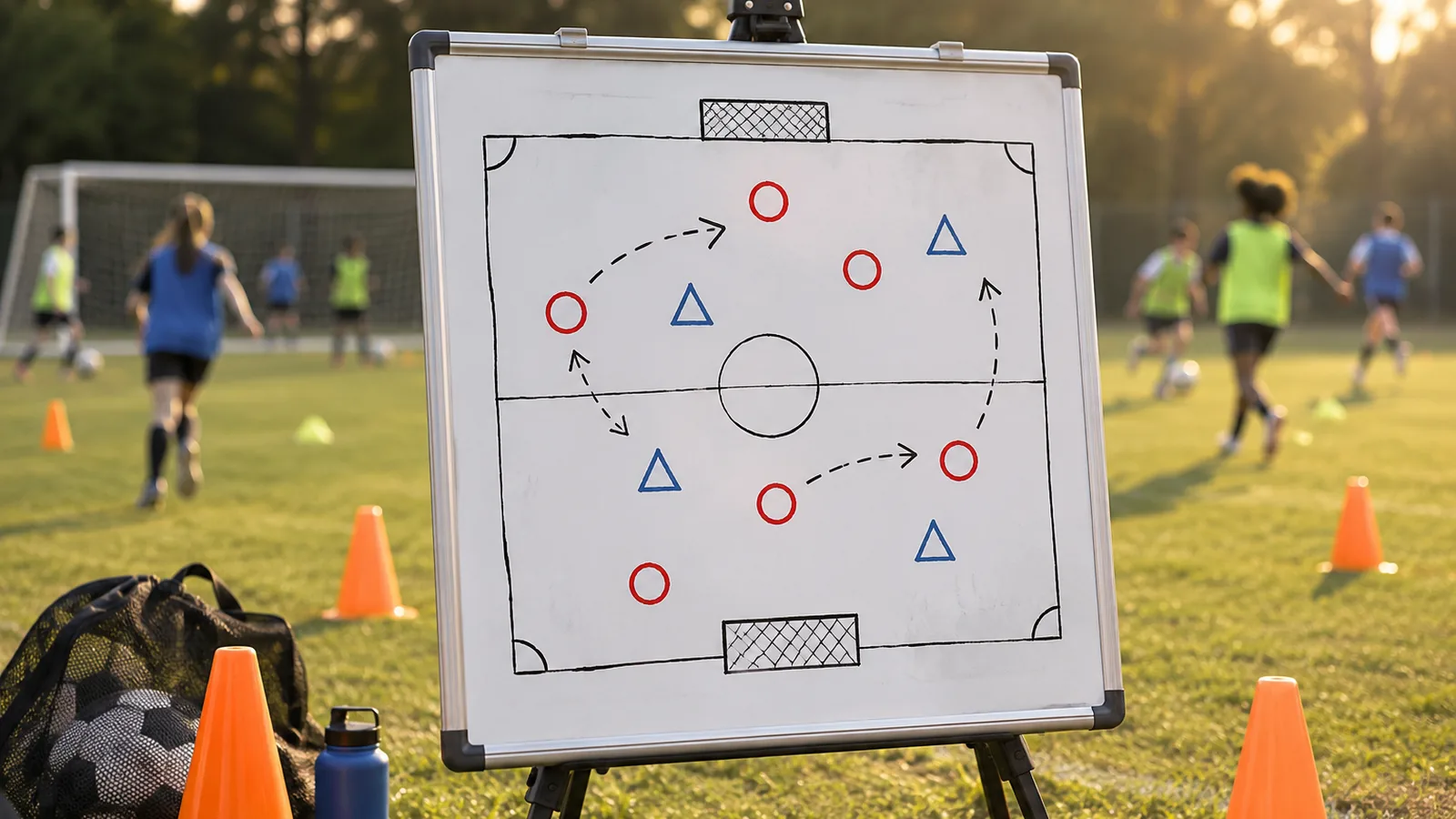
Before practice, you can draw a set piece or a formation once and send it to the team so they arrive ready: try soccer drills for kids free with the tactics board in Team Chat.
What should you write down before each practice?
A practice plan does not need to be long, but writing a few things down before you arrive saves time on the field and keeps the session on one theme. Fill these in the night before, on paper or on your phone.
- The theme: one skill or idea, such as passing to a teammate or shielding the ball.
- Expected players and any absences, so you can set up the right number of groups.
- Space and equipment: how many cones, bibs, balls and goals, and the size of each area.
- Timings for each block, including water breaks.
- One coaching point per activity, so you know what to watch for.
- A backup activity in case one does not work or numbers change.
How do you adapt a plan when things go wrong?
Plans change on the field all the time. If half the team is missing, shrink the area and run smaller games. If an activity is too hard, add a neutral player or make the area bigger; if it is too easy, make the area smaller or limit touches. If the weather turns, shorten the drills and move straight to the scrimmage, which keeps players warm and moving. The best plan is the one you are willing to change after five minutes.
How do you review a practice afterwards?
Spend two minutes after each session writing what worked, what did not and what to repeat. Over a season, these notes become your own library of plans that suit your team, and they make the next coach's job easier if you hand the team on.
- Did every player get lots of touches on the ball?
- Did the activities match the theme?
- Which activity did players enjoy most?
- What will you change next week?
Frequently asked questions
Around 45 minutes for 5 and 6 year olds, 60 minutes for most players from 7 to 11, and 75 to 90 minutes for teenagers. Match the length to attention span and your field booking, and end while players are still enjoying it.
Two or three activities plus a scrimmage is enough. More than that means more time explaining and setting up and less time playing. Spend 10 to 15 minutes on each activity and adjust it rather than switching to a new one.
Use the same structure every week and change the theme and activities. Players like a familiar rhythm, but repeating identical drills every session gets boring quickly.
Shrink the spaces and play smaller games, such as 2v2 instead of 4v4. Small numbers are a chance for more touches per player, so keep the same plan and scale it down.
Related guides
Try Play 2 Earn Sports
Play 2 Earn Sports is a free club and team management platform for soccer, hockey, basketball and more: scheduling, team chat, registration and club fees in one place. Clubs and leagues pay no plan fee; a US$3.99 platform fee applies per registration, and the club covers it or passes it on to families.
Play 2 Earn Sports is free for clubs and leagues, with any number of teams.
Plan your season in one place
Explore the Play 2 Earn Sports scheduling platform, compare current plans and pricing, or request a scheduling demo.
