
How many hockey players are on the ice at a time?
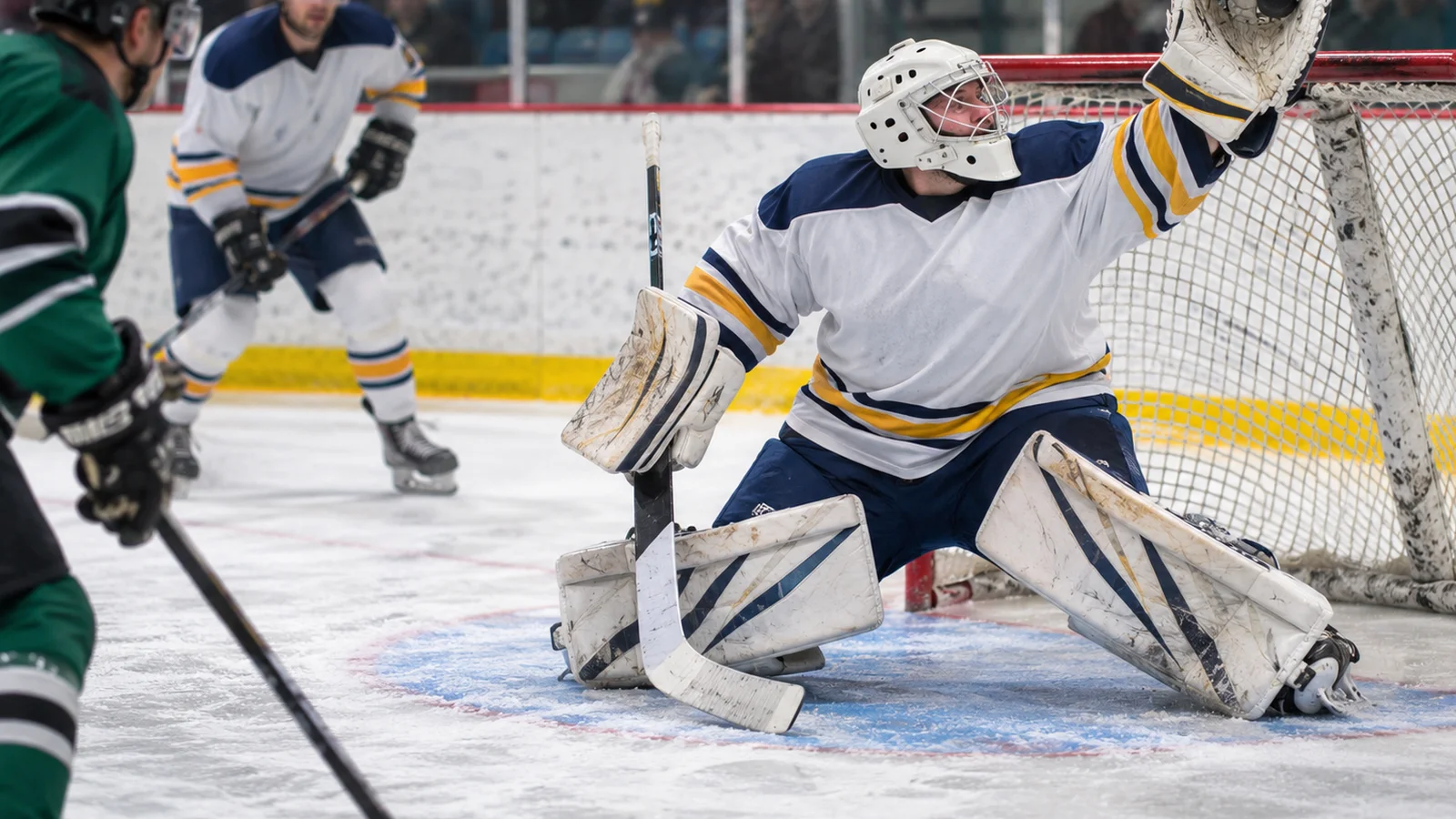
Each hockey team has six players on the ice at a time: a goalie, two defensemen and three forwards. That is why the sport is called five-on-five when both teams are at even strength, with a center, left wing and right wing forming the forward line.
Last updated
- Power plays add an extra skater after an opponent's penalty.
- Penalty kills usually use four skaters and a goalie.
- USA Hockey studies compare 5-on-5, 4-on-4 and 3-on-3 formats.
The six players in a full-strength lineup
At full strength, each team puts six players on the ice: one goaltender, two defencemen and three forwards. The forwards are usually a centre, a left wing and a right wing. The Canadian Encyclopedia lists six players, adopted in 1911, among the innovations that shaped the modern game.
With both teams at even strength, the game is described as five-on-five because each side has five skaters plus a goalie. That puts twelve players on the ice in total, six for each team.
How youth formats change the count
Hockey Canada's under-9 half-ice model does not use five-on-five. It uses 4-on-4 plus a goaltender in full goalie equipment, so each team has five players on the ice at a time. Each team is split into two units and dresses two goaltenders, one for each half.
USA Hockey has tested other formats. A study described by USA Hockey tested 84 players ages nine and 10 in cross-ice and full-ice scenarios of 5-on-5, 4-on-4 and 3-on-3. Its youth pathway uses cross-ice at 8U, half-ice at 10U and full-ice at 12U.
Shift length and player changes
The number on the ice stays constant while players change behind the play. Hockey Canada recommends 60-second shifts in U9 and caps them at two minutes. Games do not stop for changes: players change on the fly at a buzzer or whistle, and they must give up the puck immediately when the signal comes.
If a U9 team has fewer than four players on the bench, the player designated to stay out for the next shift must return to the bench before play continues. That rule keeps the 4-on-4 structure intact even when rosters are short.
How penalties affect the count in U9 hockey
Hockey Canada's U9 model is deliberately different from older levels. When a minor penalty is called, the official notes it and the offending player sits out the next shift, but the team does not play short-handed. Even a game misconduct does not create a short-handed situation in U9.
Coaches and officials still call penalties, and the game uses running time, continuous play on shift changes, no offside or icing, and no face-offs after goals. The point is to keep all players involved rather than to punish the team.
Why the ice surface and roster depth matter
Half-ice hockey is played on a smaller surface. Hockey Canada sets the maximum half-ice size at 100 feet by 85 feet, about 30 m by 26 m, on a rink that averages 200 feet by 85 feet (about 61 m by 26 m) in Canada.
Smaller areas increase involvement. Hockey Canada says players are closer to the play and get more puck touches, and that opportunities to be engaged in the play are doubled when the playing area is smaller. That is why the 4-on-4 model needs fewer players on the ice but more players rotating through.
Frequently asked questions
Is hockey 5-on-5 or 6-on-6?
Hockey is five-on-five at even strength. Each team has five skaters plus a goaltender, so six players per side and twelve on the ice in total. Rule books and broadcasters usually call the format five-on-five because the goaltenders are not counted as skaters.
Do under-9 teams play 5-on-5?
No. Hockey Canada's U9 half-ice game is 4-on-4 plus a goaltender in full equipment, so each team has five players on the ice. Each team is divided into two units and dresses two goaltenders, one for each half of the game.
How many goalies are on the ice at once?
One goaltender per team is on the ice at a time in a standard game, for two in total. In U9 half-ice hockey, each team dresses two goaltenders because the game is split into two halves, with one goalie used in each half.
How long is a shift in youth hockey?
Hockey Canada recommends 60-second shifts in U9 and allows a maximum of two minutes. Players change on the fly at a buzzer or whistle, and the game does not stop for the change. Coaches must ensure every player takes a turn double-shifting when rosters are small.
What happens when a U9 team has too few players?
The half-ice model still uses four skaters per team plus a goaltender. If fewer than four players are on the bench, the player chosen to stay out for the next shift must return to the bench before play continues. In some communities only one end of the ice is used when rosters are very small.
Sources
How do hockey players know when to come off the ice · Hockey questions · Find a hockey team
Running a club or league? See software to run a sports club, leaving SportsEngine, free round robin generator, or build a tournament online.
Open Next Play