
How does a basketball game start?
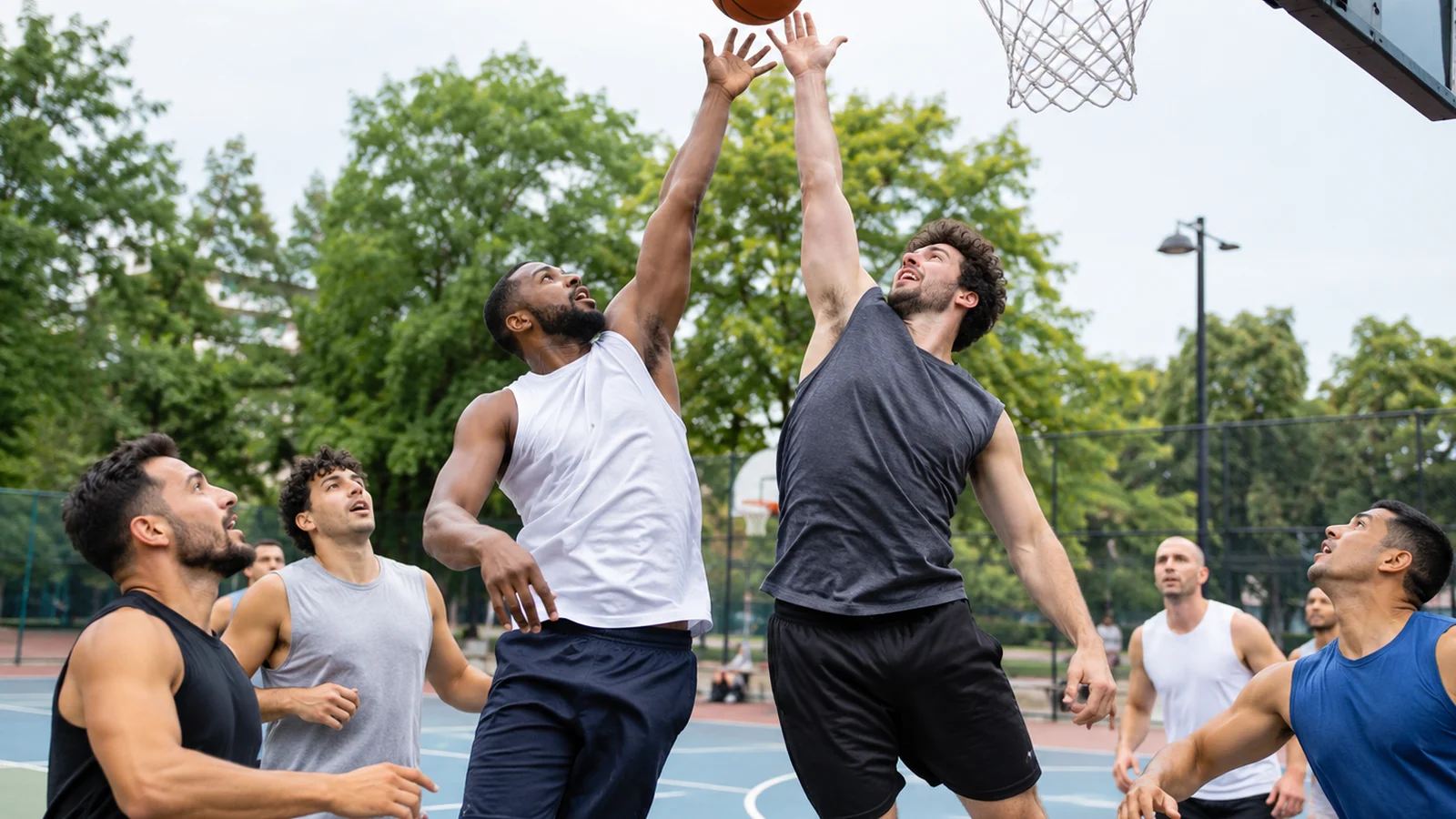
A basketball game starts with a jump ball in the center circle. An official tosses the ball between two opposing players, and each tries to tap it to a teammate. The game clock starts when the ball is legally tapped. After that, teams use throw-ins, free throws or alternating possession to restart play.
Last updated
- The game opens with a jump ball at center court
- Two opposing players jump and tap the toss
- The clock starts when the ball is legally tapped
- Throw-ins and free throws restart play later
The opening jump ball, step by step
The game and every overtime begin with a jump ball in the center circle. An official tosses the ball between any two opponents. Each jumper must keep at least one foot on or inside the half of the circle farthest from their own basket, and both feet inside the restraining circle. The other eight players stay outside the circle until the ball is tapped.
The toss must rise above both jumpers before either can touch it. A jumper may tap the ball only after it reaches its highest point, and may not catch it until it touches a non-jumper, the floor, the basket or the backboard. The clock does not start until that legal tap.
Jump-ball violations and the re-toss
A jumper who taps early, catches the toss, taps it more than twice, or steps out of their half before the tap commits a violation. Non-jumpers who enter the circle early also break the rule. If the ball falls to the floor without being tapped, an official whistles it dead and signals another toss.
The eight non-jumpers cannot take adjacent spots if an opponent wants one, and no player may stand directly behind an opponent on the circle. Those positions are set before the official releases the ball.
Who gets the ball after the opening tip
In the NBA, the team that gains first possession puts the ball in play at the opponent's endline to start the fourth period. The other team does the same at the start of the second and third periods. After any dead ball, play resumes with a jump ball, a throw-in or a free throw.
After a made basket or free throw, the thrower may run along the endline or pass to a teammate who is also out of bounds at the endline. On a throw-in, the clock starts when a player in the court legally touches the ball. On an unsuccessful free throw that stays live, the clock starts on the first legal touch.
NBA timing versus youth and school games
NBA regulation games use four 12-minute quarters, five-minute overtimes and a 15-minute halftime. That is longer than most youth games: the NBA and USA Basketball youth guidelines recommend 20-28 minute games for ages 7-8 and 24-32 minute games for ages 9-11.
Those guidelines adopt FIBA rules for grades 9-12 and progressive rules for ages 14 and under, and they say to follow FIBA rules when a specific rule is not listed. Period length, overtime and possession rules can therefore differ from the NBA. Check the league's rulebook before the tip.
Frequently asked questions
Can a substitute join the opening jump ball?
No. NBA rules say that if injury, ejection or disqualification forces a jumper to be replaced, the substitute may not take part in the jump ball. The official still tosses between two eligible opponents.
Can a jumper catch the ball at the tip?
No. The jumper may tap the ball after it reaches its highest point, but may not catch it until it touches a non-jumper, the floor, the basket or the backboard. Catching it earlier is a violation.
When is the ball re-tossed?
If the toss falls to the floor without either jumper tapping it, an official whistles the ball dead and signals another toss. A tap before the ball reaches its highest point is also a violation.
Does the clock run during the opening toss?
No. Timing begins only on the legal tap. On a later throw-in it starts when a player in the court legally touches the ball, and on a jump-ball restart it starts on that same tap.
Which team starts the second half?
The team that did not gain first possession starts the second and third periods, and the team that won the opening tip starts the fourth. The NBA uses endline throw-ins for those period starts rather than another center-circle jump.
Sources
Basketball questions · Sports App For Parents
Running a club or league? See software to run a sports club, alternatives to the big team apps, bracket generator, or free round robin generator.
Find a club