
Do you need baseball cleats?
Cleats are helpful but not always required. Many young rec leagues allow rubber-soled athletic shoes, especially for tee ball and other introductory divisions. Cleats improve traction on grass and dirt, but metal spikes are often restricted. Ask your league, and choose molded cleats or sturdy sneakers based on the field.
Last updated
- Check the league's footwear policy.
- Choose molded cleats for most youth play.
- Break in new cleats before games.
- Pack sneakers for hard surfaces.
Tee ball and coach pitch: ages 4 to 8
In Little League, Tee Ball is the entry level division for players ages 4-7, and the Minor League may include players ages 5-11. Local leagues can run coach-pitch or machine-pitch divisions inside the Minor League, so find out which division your child is in before assuming a footwear rule applies.
If the league permits ordinary athletic shoes at this age, a sturdy sneaker with good grip is enough for grass and dirt. The American Academy of Pediatrics advises shoes with rubber (not metal) spikes for young baseball and softball players. For a first pair, look at molded rubber rather than metal and put the savings toward a glove or bat.
Minor and Major divisions: ages 9 to 12
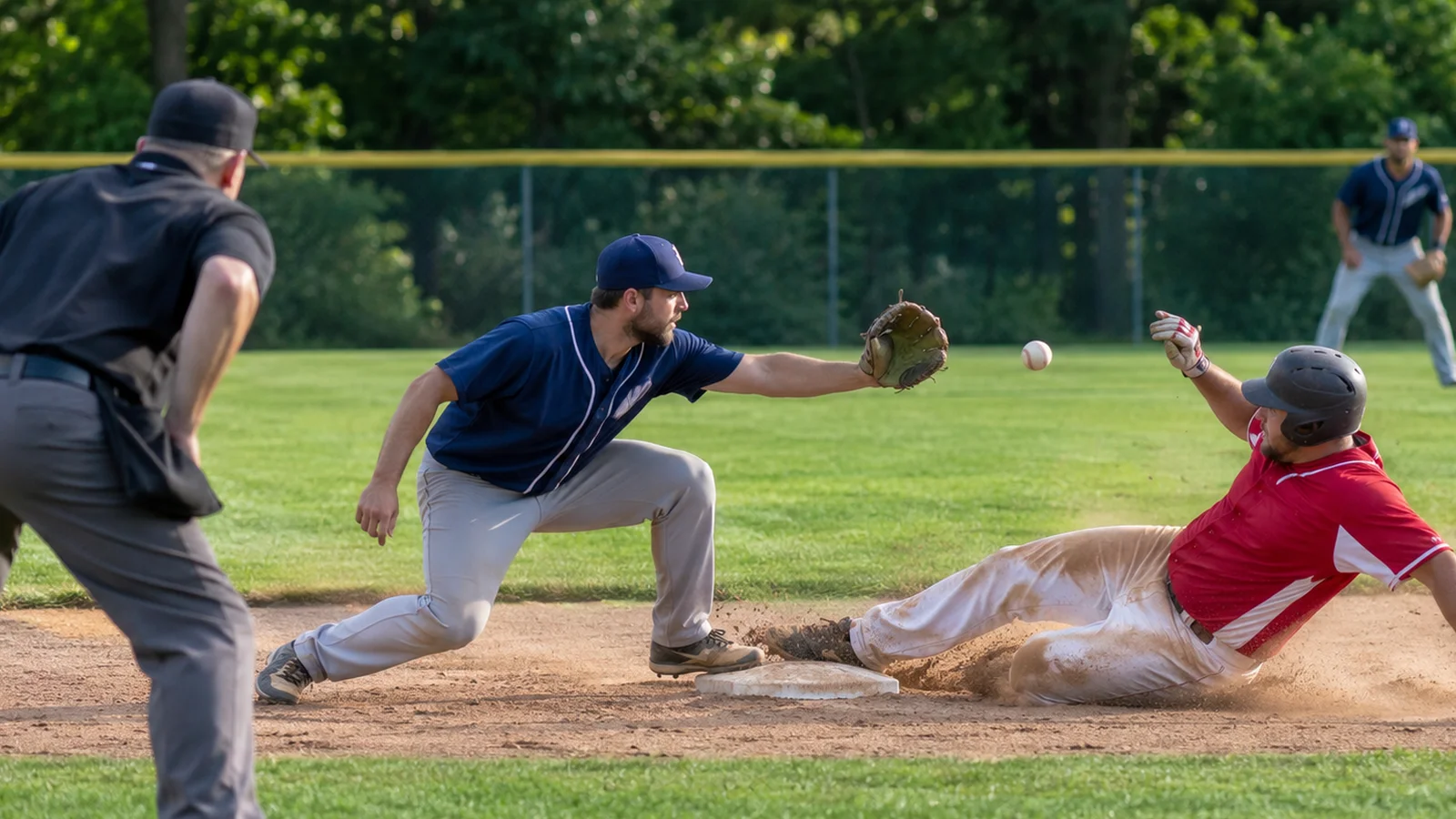
The Major Division covers ages 9-12 and uses a diamond 60 feet (18 m) on each side with a 46-foot (14 m) pitching distance. On a diamond that short, there are plenty of close plays at first and second, and a runner who slips leaving the box can be out by a step.
Molded cleats are a practical choice here: they grip dirt and grass without the upkeep of detachable studs. Check the studs every few games, because worn tips round off and stop biting. Little League equipment guidance is blunt about damaged gear: anything cracked or questionable should be thrown away.
Intermediate, Junior and Senior: ages 11 to 16
The Intermediate 50/70 division, for league-age 11-13, uses a 50 feet (15 m) pitching distance and 70 feet (21 m) base paths. Junior (12-14) and Senior (13-16) then move to a conventional 90-foot (27 m) diamond with a pitching distance of 60 feet, 6 inches (18.4 m).
Longer base paths mean longer throws and more sliding, so traction matters more than it did in tee ball. The division chart does not settle footwear, so ask the league whether metal spikes are allowed at these ages before buying; the AAP still lists rubber spikes as its safety recommendation for young players.
Turf fields, batting cages and dugouts
Cleats are built for dirt and grass. On artificial turf, concrete dugout floors and cage mats, studs can slip or wear flat, and metal studs can scratch surfaces that facilities protect. Carry flat athletic shoes in the gear bag for those areas.
A simple family rule: cleats go on at the field and come off at the edge of it. That keeps the studs sharp for the surface where they help and stops a player from walking to the car in spikes.
Fit, break-in and hand-me-downs
Try new cleats on with the socks the player wears in games, because a thick sock changes the fit. The heel should stay locked when the player walks, and the toes should not press the front. AAP guidance says safety gear should fit properly and be well maintained.
Break cleats in at a practice rather than in the car before a game. Hand-me-downs are fine if the sole is intact and the studs are not worn to nubs, but a cracked sole or loose stud belongs in the bin. Keep spare sneakers in the car for the ride home.
Frequently asked questions
Can a 7-year-old wear metal cleats?
Only if the local league allows them. Little League Tee Ball covers ages 4-7, and youth safety guidance recommends rubber rather than metal spikes. For a 7-year-old, molded rubber cleats or grippy sneakers are the practical choice. Ask the league before spending money on metal.
Are baseball cleats required for tee ball?
It depends on the league. If your league allows athletic shoes while players learn to run and stop, grippy sneakers are fine. If it requires cleats, buy rubber molded ones and check the fit with game socks. The league footwear rule decides it, not a general age chart.
How do you know when cleats need replacing?
Look at the studs, not the calendar. When the tips are worn flat, the sole is cracked, or a detachable stud will not tighten, replace them. Little League equipment guidance says anything cracked or questionable should be thrown away. A child who plays twice a week may wear out a cheap pair in one season.
Do cleats make a young player faster?
They can improve grip when pushing off and stopping on dirt or grass, but they do not replace running form or practice. On hard turf or pavement they can be slower and less comfortable. Fit matters as much as the stud pattern, so try them on with game socks before a game.
Sources
Baseball questions · Find a baseball team
Running a club or league? See club management software, leaving SportsEngine, bracket generator, or league schedule maker.
Open Next Play