

In this guide
- Step 1 — agree the criteria before tryout day
- Step 2 — what goes on a tryout evaluation form
- Step 3 — run the day in stations
- Worked example — scoring thirty-six players
- Step 4 — place the teams and tell families kindly
- Tryout evaluation checklist
- How Play 2 Earn Sports supports tryout evaluations
- Frequently asked questions
- Related guides
Watch the video guide
Read the video transcript
Fair tryouts families can trust
0:00 By the end of this video, you will have a tryout evaluation form, a scoring method and a tryout day plan. Players get a fair look, and families can trust the result. We will cover the criteria to agree before tryouts and what goes on the form. Then we run the day in stations, work through a scoring example, and share the news kindly.
Before tryout day: criteria, evaluators, numbers
0:21 Agree the criteria before anyone steps on the field. Every evaluator uses the same form and the same scoring scale. When the standard is written down first, the result is easier to explain. Plan for at least two evaluators on every player, so one view never decides alone.
0:39 Give players a number to wear, and score by number. Evaluators then focus on what they see.
What goes on a tryout evaluation form
0:45 A good form has four groups. Technical skills, tactical understanding, physical ability for the player's age, and the mental side: coachability, effort, focus and teamwork. Keep each group to about six skills, and score each one from one to five. Write what each number means.
1:04 A three is solid for this age group. A five stands out on the day. Add a short note beside any score that needs it. Write what you saw, such as a strong first touch under pressure. Notes help at the placement meeting, and they help a player improve.
Run the day in stations
1:21 Run the session as stations. Four stations of fifteen minutes each, with five minutes to rotate between them. Each station tests one or two groups of the form. Here is how the time adds up.
1:33 Ten minutes for check-in and warm-up, sixty minutes of stations, fifteen minutes of rotations and five minutes to close. That is a ninety-minute session.
A worked scoring example
1:44 Here is a typical example. It is illustrative, not a specific club. Thirty-six players attend one session. They split into four groups of nine, and every group visits every station.
1:56 One player's scores from one evaluator average four in technical, three in tactical, three in physical and five in the mental group. Those four averages add up to fifteen, out of a possible twenty. A second evaluator's four averages add up to thirteen. Together, the player has twenty-eight out of forty.
2:15 Set one rule before the day. If two evaluators differ by one point or more, a third evaluator watches that player again. A small gap is normal. A big gap means someone saw something different.
Placing teams and telling families
2:29 Sort the players by combined score, then hold a short placement meeting. In the example, thirty-six players fill three teams of twelve. Discuss the players near each line, and use the notes. Share all placements on the same day.
2:44 Keep the message kind and short. Offer a time to talk, and give each player one strength and one thing to work on.
How Play 2 Earn Sports helps
2:52 Now, how Play 2 Earn Sports helps. There is a player evaluation form for each of the eighteen sports, and a player is scored on the form for their own sport. Each form has four groups of six skills, scored from one to five, with notes. An evaluation can be marked as a tryout.
3:09 Evaluations save as drafts. Sending one shares it to the player's record, with an in-app message and an email when the account has one. Club admins work with every player. Coaches work with players on their own teams, and with the evaluations they wrote.
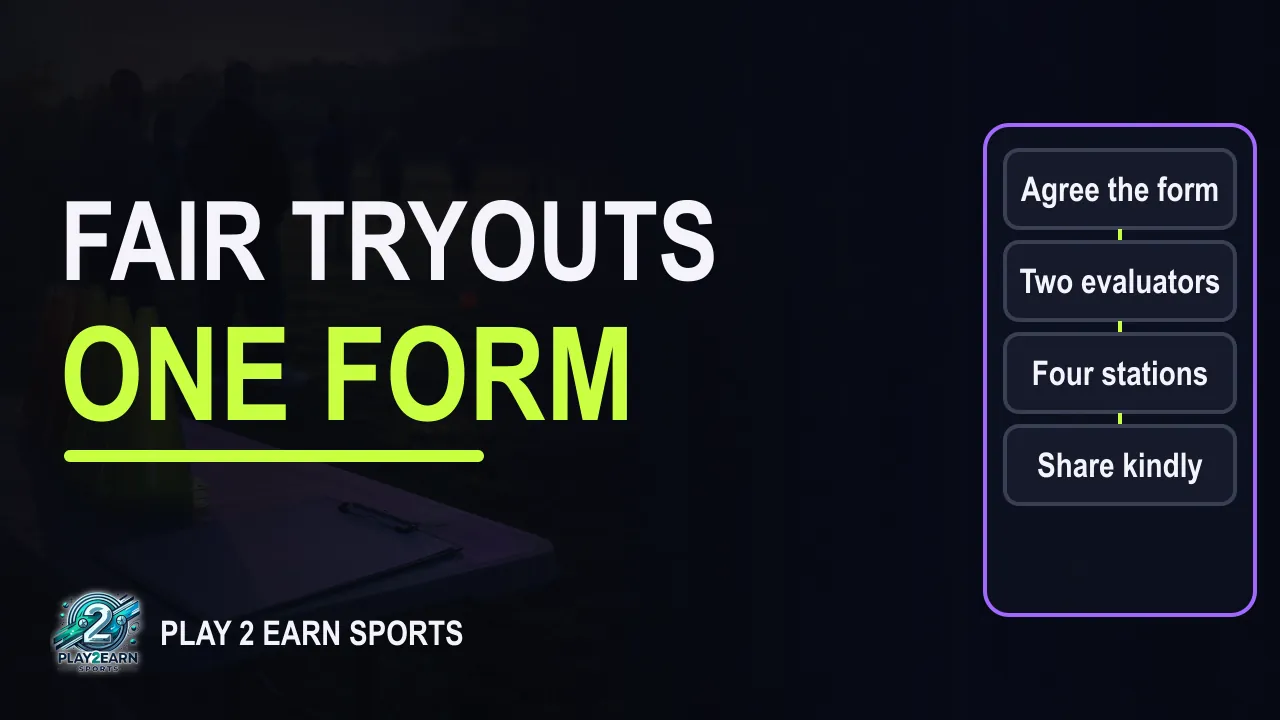
3:24 Agree the form, use two evaluators, run the day in stations, and share placements kindly. The full guide is on the page linked in the description. Try it with your own players: Starter is free for clubs with up to 10 teams. Thanks for watching.
Step 1 — agree the criteria before tryout day
Most tryout disagreements start before the first drill: two evaluators were looking for different things.
Write the criteria down
List the skills you will score, in four groups. Share the list with every evaluator a week before.
Define the scale
Say what a one, a three and a five mean for this age group. "A three is solid for this age; a five stands out on the day" keeps scores comparable.
Use at least two evaluators per player
One view should never decide alone. If you can, include one evaluator who does not coach any of the players.
Score by number, not by name
Give each player a number to wear (a bib or a number on a wristband), and keep the name list with the registrar. Evaluators then score what they see.
Plan the stations
Each station tests one or two groups of the form. Write the drill, the time and who scores it.
Tell families the plan
Share the date, the time, what to bring, how long the session lasts and the day placements will be shared. Calm families make calmer players.
Step 2 — what goes on a tryout evaluation form
A tryout evaluation form has four groups. Keep each to about six skills, so evaluators can score at the pace of the drill.
| Group | What it covers | Examples (adapt to your sport) |
|---|---|---|
| Technical | The sport's core skills | First touch, passing, shooting, ball handling, footwork |
| Tactical | Understanding of the game | Positioning, decision-making speed, reading the play, awareness off the ball |
| Physical (relative to age) | Movement for this age group | Speed, agility and balance, coordination, endurance |
| Mental, social and coachability | How the player learns and plays with others | Coachability, effort, focus, resilience, communication, teamwork |
The scale.
| Score | Meaning |
|---|---|
| 1 | Not yet shown on the day |
| 2 | Developing; shown sometimes |
| 3 | Solid for this age group |
| 4 | Strong; shown often and under pressure |
| 5 | Stands out on the day |
Notes. Add a short note beside any score that needs explaining. Write what you saw ("kept the ball under pressure twice", "talked to teammates in the small-sided game"), never a judgement of the child. Notes are the most useful part of the form at the placement meeting, and the most useful part for the player afterwards.
Physical scores are relative to age. Players of the same age can differ a lot in growth. Score movement against the age group, and weight the technical, tactical and mental groups at least as much as the physical one.
Step 3 — run the day in stations
A station plan keeps every player moving and gives every evaluator the same view.
| Block | Time | What happens |
|---|---|---|
| Check-in and warm-up | 10 minutes | Players collect their numbers; a coach leads a warm-up |
| Station 1 | 15 minutes | Technical: passing and receiving |
| Rotation | 5 minutes | Groups move; evaluators finish notes |
| Station 2 | 15 minutes | Technical and physical: dribbling and agility |
| Rotation | 5 minutes | |
| Station 3 | 15 minutes | Tactical: small-sided game |
| Rotation | 5 minutes | |
| Station 4 | 15 minutes | Tactical and mental: game with coaching points |
| Close | 5 minutes | Thank the players; repeat the date placements will be shared |
| Total | 90 minutes | 10 + 60 + 15 + 5 = 90 |
Put the small-sided games late in the session: players are warm and settled, and coachability shows when a coach gives a point and the player tries it.
Worked example — scoring thirty-six players
Illustrative example, not a specific club.
Thirty-six players attend one ninety-minute session. They split into four groups of nine, and every group visits all four stations. Two evaluators score each player on the full form.
One player, one evaluator. Each group has six skills scored one to five.
| Group | Six scores | Total | Group average |
|---|---|---|---|
| Technical | 4, 4, 5, 3, 4, 4 | 24 | 24 ÷ 6 = 4.0 |
| Tactical | 3, 3, 3, 3, 3, 3 | 18 | 18 ÷ 6 = 3.0 |
| Physical | 3, 3, 3, 3, 3, 3 | 18 | 18 ÷ 6 = 3.0 |
| Mental and coachability | 5, 5, 5, 5, 5, 5 | 30 | 30 ÷ 6 = 5.0 |
| Overall | 4.0 + 3.0 + 3.0 + 5.0 = 15.0 | 15.0 ÷ 4 = 3.75 |
Two evaluators. The second evaluator's overall score for the same player is 3.25. The combined score is (3.75 + 3.25) ÷ 2 = 3.5. The two scores differ by 0.5, which is under the club's one-point rule, so no third look is needed.
The one-point rule. If two evaluators differ by 1.0 or more on a player's overall score, a third evaluator watches that player again in the last station. A small gap is normal. A big gap means someone saw something different, and that is worth a second look before a placement.
Placing the teams. The club places thirty-six players in three teams of twelve: 3 × 12 = 36. Sort players by combined score. Then hold a short placement meeting and discuss the players near each line, using the notes, the positions each team needs, and any player who had an off day for a reason the club knows about.
Step 4 — place the teams and tell families kindly
Scores first, then the discussion
Combined scores sort the list. The discussion handles the players near each line. Keep the meeting to the players who need it.
Same day for everyone
Share all placements on the same day, at the time you promised.
Short and kind
Name the team, the first practice and the coach. Thank the player for coming.
One strength, one next step
Give each player one thing they did well and one thing to work on. It turns a placement into a plan.
Offer a time to talk
Families who want to ask a question can book a short call with the coaching lead. Keep the conversation about what was seen on the day and what comes next.
Keep the records
A saved evaluation helps the next coach, and helps the player see progress next season. The youth player pathway shows how to explain levels to families, and player development updates for parents shows how to keep the conversation going during the season.
Tryout evaluation checklist
Tryout evaluation checklist
- Criteria written in four groups and shared with evaluators a week before.
- Scale defined: what a one, a three and a five mean for this age group.
- At least two evaluators per player; one from outside the teams if possible.
- Players wear numbers; evaluators score by number.
- Station plan written, with drills, times and scorers.
- Session time adds up, including check-in, rotations and close.
- The one-point rule agreed for a third look.
- Combined scores calculated the same way for every player.
- Placement meeting held for the players near each line.
- All placements shared on the same day.
- Each player given one strength and one next step.
- Evaluations saved for next season.
How Play 2 Earn Sports supports tryout evaluations
Play 2 Earn Sports is club management software for youth and amateur clubs, with player evaluations built into the club's tools.
A form for each sport
There is a player evaluation form for each of the 18 sports. A player is scored on the form for their own sport, decided from the player's sport, so a soccer player is scored on the soccer form.
Four groups of six skills
Each form has Technical Ability, a tactical group, Physical Profile (relative to age), and Mental, Social and Coachability, with six skills in each, scored from one to five, with a note on each skill. The form shows each group's average and an overall average.
Tryouts and the rest of the season
An evaluation can be marked as a Tryout. Other types are Match Performance, Training Session, Mid-Season Review and End-Season Review.
Your club's own sections
Club administrators can add the club's own sections to a sport's form, up to eight sections of up to twenty metrics each.
Drafts, then send
Evaluations save as drafts on the server, not only in one coach's browser. Sending one shares it to the player's record, with an in-app message and an email when the account has an email address. A sent evaluation stays on the player's record.
The right people
Club administrators work with every player in the club. Coaches work with players on their own teams, and with the evaluations they wrote. Staff with the Evaluations (view) permission can read the team's player evaluations.
Staff notes stay with staff
The projection, the evaluator's confidence, the ready-for flag, the area limiting advancement, the impact description and the signature are not shown to the player.
For one team, too
Coaching one team? Start a free club account for your team at club starter.
Score your next tryout on one form.
Frequently asked questions
Use one agreed form for every player, with four groups: technical, tactical, physical for the player's age, and mental and coachability. Score about six skills in each group from one to five, with at least two evaluators per player. Average the scores, discuss the players near each line, and share all placements on the same day.
Basic details (the player's number, age group and position tried), four groups of about six skills each, a one-to-five score for each skill, a short note where it helps, and space for one strength and one next step. Keep it short enough to score at the pace of a drill.
A one-to-five scale is simple to use during fast drills. Define it in writing before the day: for example, three is solid for this age group and five stands out on the day. A scale with clear meanings keeps two evaluators' scores comparable.
Plan for at least two evaluators on every player, so no single view decides. If two evaluators differ by one point or more on a player's overall score, a third evaluator watches that player again. One evaluator from outside the teams helps families trust the result.
Yes, where you can. Players wear a number, evaluators score by number, and the registrar keeps the name list. Evaluators then focus on what they see on the day.
Ninety minutes suits many youth age groups: ten minutes of check-in and warm-up, four fifteen-minute stations, five-minute rotations and a short close. Shorten the stations for younger players, and keep the small-sided games near the end.
Share all placements on the same day, at the time you promised. Keep the message short and kind, name the team and the first practice, give one strength and one next step, and offer a time to talk with the coaching lead.
Starter is free for clubs with up to 10 teams. Pro is $49.67 USD a month for 11 to 25 teams. Unlimited is $99.67 USD a month for 26 or more teams. Every organization feature is on every plan. See pricing.
Related guides
Keep teams, schedules and family messages together with software built for running a youth club, compare current plans and pricing, or request a demo.
