

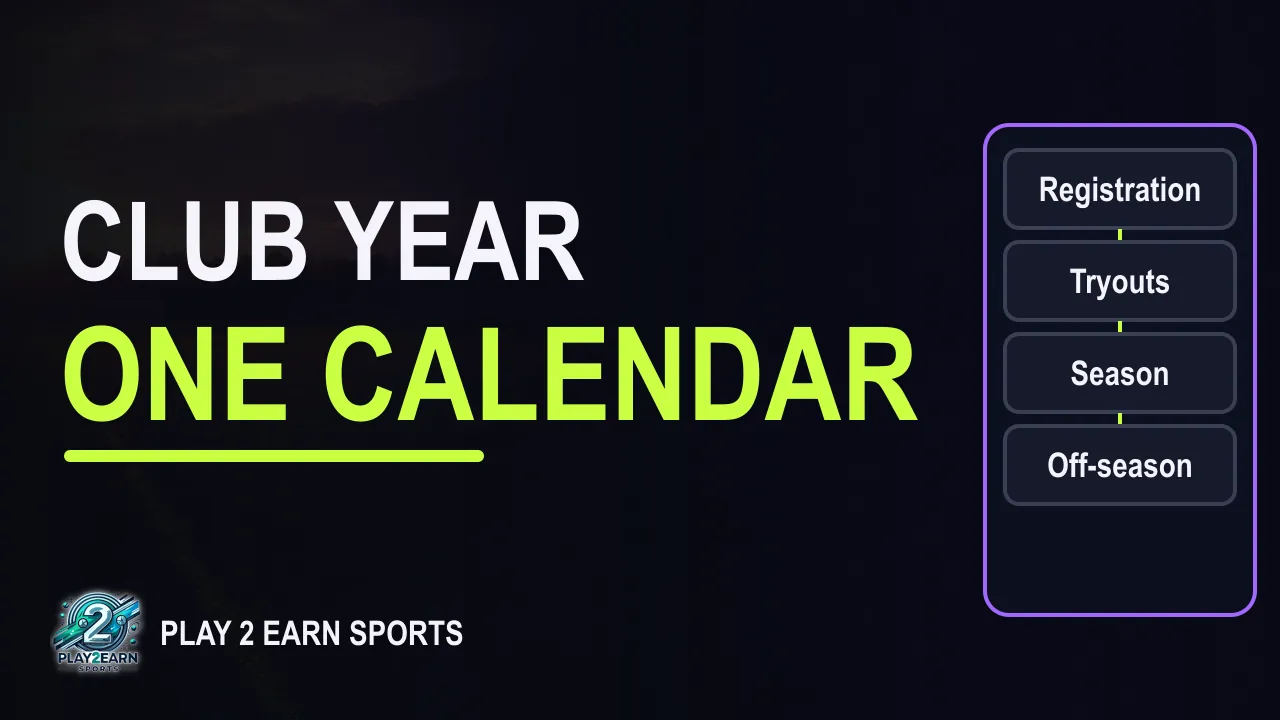
In this guide
- Why a club needs one season calendar
- Step 1 — plan backwards from the first game
- Step 2 — the seven blocks of a club year
- Worked example — a fifty-two week club year
- Step 3 — publish five dates before registration opens
- Step 4 — give every block one owner
- Checklist for your club season calendar
- How Play 2 Earn Sports supports your club year
- Frequently asked questions
- Related guides
Watch the video guide
Read the video transcript
A year plan your families can follow
0:00 By the end of this video, you will have a club season calendar for the whole year. It runs from registration and tryouts to the season, tournaments and a calm off-season. We will cover the seven blocks of a club year, the dates that matter most, a worked example, and a checklist you can use this week.
Why a club needs one season calendar
0:20 A club calendar is one shared plan for fields, coaches and families. When the big dates are set early, parents can plan their year. Coaches can say yes with confidence, and field requests go in on time. Start with one date: the first game of the season.
0:37 Then plan backwards. Registration, tryouts and practices all land in the weeks before it. Everything after it follows the season.
The seven blocks of a club year
0:47 A club year has seven blocks. Plan, registration, tryouts and teams, preseason, the season, the wrap-up, and the off-season. Each block has one owner and one or two dates that families need. The planning block sets the dates and requests the fields.
1:05 Ask the permit holder early, because field time is borrowed. Registration then stays open for about six weeks, with a clear closing date. Tryouts and team placement take about four weeks, including a day to announce teams. Preseason takes four more.
1:22 Practices start, the parent meeting happens, and the game schedule is published. The season block holds the games. Leave room inside it for holidays, a tournament weekend and a makeup week. A season with no spare week turns one rainout into a long string of messages.
1:39 The wrap-up holds the last tournament, player evaluations, a celebration and a coaches' meeting. The off-season is for rest, optional skills sessions and the retention plan for next year.
A worked club year
1:52 Here is a typical example. It is illustrative, not a specific club. A club plans a fifty-two week year in seven blocks, counted from week one of its planning year. Weeks one to six are planning.
2:05 Weeks seven to twelve are registration. Weeks thirteen to sixteen are tryouts and teams. Weeks seventeen to twenty are preseason. Weeks twenty-one to thirty-six are the season.
2:17 That is sixteen weeks: twelve game weeks, one tournament weekend, two holiday weeks and one makeup week. Twelve plus one plus two plus one is sixteen. Weeks thirty-seven to forty are the wrap-up. Weeks forty-one to fifty-two are the off-season. Add the blocks together: six, six, four, four, sixteen, four and twelve make fifty-two weeks.
Five dates to publish before registration opens
2:40 Publish five dates before registration opens. The first game, the tryout days, the holiday breaks, the tournament weekends and the last game. Families decide on these dates, so give them early. Name one owner for each block.
2:55 The registrar owns registration, a coach lead owns tryouts, and the scheduler owns the season. Keep every date in one place, not in five different messages.
How Play 2 Earn Sports helps
3:05 Now, how Play 2 Earn Sports helps. The team and club calendar shows games, practices and events on web and phone. Clubs block holidays, closures and tournament weekends on their teams, venues and fields. Practices can be created with a location.
3:21 Repeating practices are set up through the club's event tools. Clubs send announcements as in-app notices, and by email when mail is connected. When a team event or game changes, affected families get in-app, email and push notices by default, and can opt out of event email and push. Clubs post volunteer jobs, such as scorekeeper or snack table.
3:45 Families can add a single event to Google or Apple Calendar. Plan backwards from the first game, publish the five big dates early, and keep one calendar for the whole club. The full guide is on the page linked in the description. Try it with your own fields: Starter is free for clubs with up to 10 teams. Thanks for watching.
Why a club needs one season calendar
Families plan their year around you
A parent deciding between two sports, or between your club and a camp, decides on dates. The tryout day and the first game matter more to them than any other detail.
Coaches say yes with confidence
A volunteer coach can commit to a season when they know the practice start, the tournament weekends and the last game.
Field time is borrowed
Most clubs request fields, gyms or ice from someone else. Requests that go in early are easier to fill than requests made a week before practice starts.
One date list avoids five versions
When dates live in group messages, a registration email and a printed flyer, they drift apart. One calendar keeps one answer.
The off-season is part of the plan
Clubs that plan the quiet months keep more families for next year. The off-season retention plan covers that block in detail.
Step 1 — plan backwards from the first game
Pick one anchor date: the first game of the season. Then count backwards.
Preseason
sits directly before the first game. Practices start, the parent meeting happens and the game schedule is published.
Tryouts and team placement
sit before preseason. Teams need to be announced before practices begin.
Registration
closes before tryouts, so you know who is coming.
Planning
comes first: board approval, field requests and the date list.
Count forwards from the first game for everything else: the season, the tournament weekends, the wrap-up and the off-season. This works for a fall season, a spring season or a winter indoor season. Only the anchor date moves.
Step 2 — the seven blocks of a club year
| Block | What happens | Owner | Dates families need |
|---|---|---|---|
| 1. Plan | Set the season dates, request fields, confirm coaching leads | Club president or board | None yet; publish at the end of this block |
| 2. Registration | Registration opens and closes; returning players first, if your club does that | Registrar | Opening date, closing date |
| 3. Tryouts and teams | Tryout or evaluation days, placement, team announcements | Coaching lead | Tryout days, team announcement day |
| 4. Preseason | First practices, parent meeting, schedule published | Coaches and scheduler | First practice, parent meeting |
| 5. Season | Games, practices, holiday breaks, tournament weekend, makeup week | Scheduler | First game, holiday breaks, tournament weekends, last game |
| 6. Wrap-up | Last tournament, player evaluations, end-of-season celebration, coaches' meeting | Coaching lead and board | Celebration date |
| 7. Off-season | Rest, optional skills sessions, retention plan, next year's planning | Board | Optional session dates; next year's registration opening |
Not every club runs tryouts. A recreational club can rename block 3 "teams" and use it for balanced team placement and coach assignment. Keep the block: teams still need to be formed before preseason.
Keep holidays inside the season block. A season that ignores holidays ends up with empty games. Mark the holiday weeks first, then count the game weeks that remain.
Hold a makeup week. One weather week or a lost field is normal. A makeup week near the end of the season absorbs it without moving the last game.
Worked example — a fifty-two week club year
Illustrative example, not a specific club.
A club plans its year in seven blocks, counted from week one of its planning year. The first game falls in week twenty-one.
| Weeks | Block | Length | What happens |
|---|---|---|---|
| 1–6 | Plan | 6 weeks | Board sets dates; field requests go in; coaching leads confirmed |
| 7–12 | Registration | 6 weeks | Registration opens at the start of week 7 and closes at the end of week 12 |
| 13–16 | Tryouts and teams | 4 weeks | Tryout days in weeks 13 and 14; placement in week 15; teams announced in week 16 |
| 17–20 | Preseason | 4 weeks | Practices start in week 17; parent meeting in week 18; game schedule published by week 19 |
| 21–36 | Season | 16 weeks | 12 game weeks, 1 tournament weekend, 2 holiday weeks, 1 makeup week |
| 37–40 | Wrap-up | 4 weeks | Last tournament in week 37; player evaluations in week 38; celebration in week 39; coaches' meeting in week 40 |
| 41–52 | Off-season | 12 weeks | Rest weeks, optional skills sessions, retention plan, next year's planning starts |
The season block, week by week. Sixteen weeks hold twelve game weeks, one tournament weekend, two holiday weeks and one makeup week: 12 + 1 + 2 + 1 = 16. Place the holiday weeks where your local calendar puts them. Put the tournament weekend near the middle of the season, and the makeup week two weeks before the last game, so a lost week can still be made up.
The arithmetic in one line. 6 + 6 + 4 + 4 + 16 + 4 + 12 = 52 weeks. Weeks 1–20 are before the first game (20 weeks), weeks 21–36 are the season (16 weeks), and weeks 37–52 are after it (16 weeks): 20 + 16 + 16 = 52.
What families see, and when. At the end of week 6, the club publishes the five big dates: the first game (week 21), the tryout days (weeks 13 and 14), the holiday breaks (two weeks inside the season), the tournament weekends (one in the season, one in week 37) and the last game. Registration opens a week later, so families register knowing the year.
Step 3 — publish five dates before registration opens
Families decide on dates. Publish these five before the registration form opens:
The first game
The anchor of the season.
The tryout or evaluation days
Families with two sports need these most.
The holiday breaks
Name the weeks with no games or practices.
The tournament weekends
Travel and work shifts need weeks of notice.
The last game
It tells families when the commitment ends.
Add the practice nights when you know them. If the practice nights are still waiting on a field answer, say so, and give the date when they will be confirmed. The practice schedule template shows how to share fair practice time between teams.
Step 4 — give every block one owner
A calendar stays right when someone owns each part of it.
Plan
the club president or board.
Registration
the registrar. Set the closing date and the late-registration rule together; the late registration policy guide has a template.
Tryouts and teams
a coaching lead or technical director.
Preseason and season
the scheduler, with coaches for practices.
Wrap-up
the coaching lead for evaluations, the board for the celebration.
Off-season
the board, with whoever runs optional sessions.
Each owner changes dates in one place. A date that changes in a group message but not in the calendar is a date two families will miss.
Checklist for your club season calendar
Checklist for your club season calendar
- Anchor date chosen: the first game of the season.
- Seven blocks laid out: plan, registration, tryouts and teams, preseason, season, wrap-up, off-season.
- Block lengths add up to the full year.
- Field, gym or ice requests sent in the planning block.
- Holiday weeks marked inside the season before game weeks are counted.
- Tournament weekends placed and shared with coaches.
- A makeup week held near the end of the season.
- Five dates published before registration opens.
- Registration opening and closing dates set, with the late rule.
- One owner named for each block.
- One calendar for every date; group messages link to it.
- Off-season sessions and next year's registration opening on the calendar.
How Play 2 Earn Sports supports your club year
Play 2 Earn Sports is club management software for youth and amateur clubs, with one connected schedule for every team.
One calendar
The team and club calendar shows games, practices and events on web and phone.
Blocked dates
Clubs block holidays, closures and tournament weekends on their teams, venues and fields, so the schedule keeps games out of those periods.
Practices
Practices can be created with a location. Repeating practices are set up through the club's event tools.
Announcements
Clubs send announcements as in-app notices, and by email when mail is connected. Coaches message their own team in team chat.
When a date moves
When a team event, team game or club game changes, affected families get in-app, email and push notices by default, and can opt out of event email and push.
Volunteer jobs
Clubs post volunteer jobs for events, such as scorekeeper or snack table, and team volunteers can take them.
Personal calendars
Families can add a single event to Google or Apple Calendar with an .ics link. Today, a whole-team calendar feed is not part of Play 2 Earn Sports; families add the events they need one at a time, and the club calendar stays the full schedule.
For one team, too
Coaching one team? Start a free club account for your team at club starter.
Put your whole year in one calendar.
Frequently asked questions
Start from the first game and plan backwards: planning, registration, tryouts and teams, and preseason all come before it. Then lay out the season, a wrap-up and the off-season. Mark holidays and tournament weekends inside the season, hold a makeup week, and publish the five big dates before registration opens.
Set the next season's big dates before registration opens, which for most clubs is several months ahead. In the worked example on this page, the dates are published at the end of week 6, fourteen weeks before the first game in week 21. Field requests go in even earlier, in the planning block, because field time is usually borrowed.
Open registration once the five big dates are published, and close it before tryouts or team placement begin. In the example, registration runs for six weeks and closes the week before tryouts. Set the late-registration rule at the same time, so the closing date means something.
It depends on the sport, the age group and the fields you hold. The example uses a sixteen-week season block: twelve game weeks, one tournament weekend, two holiday weeks and one makeup week. Count the holiday weeks first, then the game weeks that remain.
Five dates: the first game, the tryout or evaluation days, the holiday breaks, the tournament weekends and the last game. Add practice nights when they are confirmed, and say when they will be confirmed if the field answer is still pending.
Rest comes first. Then offer optional skills sessions, run the retention plan for returning families, and start next year's planning. The off-season retention plan has a step-by-step version.
Starter is free for clubs with up to 10 teams. Pro is $49.67 USD a month for 11 to 25 teams. Unlimited is $99.67 USD a month for 26 or more teams. Every organization feature is on every plan. See pricing.
Related guides
Explore league and club scheduling software, compare current plans and pricing, or request a scheduling demo.
