
In this guide
The question club leaders ask: "We have a great season, then nothing until registration opens again. By then some families have signed up somewhere else, or just drifted away. How do we keep them?"
Why families drift away between seasons
- The club goes silent. The last message of the season is the last message for months.
- Another club asks first. Whoever reaches a family first in the off-season may win the next registration.
- Nobody says thank you. Families spent a season of early mornings and late drives, and the season just stops.
- Re-registration is a cold start. Returning families get the same generic notice as strangers.
- Nobody asks why. A family that leaves is never asked, so the same problem repeats next year.
An example: the quiet summer
Illustrative example, not a specific club.
Here is an example. A volleyball club ends its season in April with a final tournament. Coaches say goodbye in the gym. Then nothing until a registration email in August. Over the summer, a nearby club runs an open-gym night and invites everyone. When the August email arrives, a handful of families have already committed elsewhere. None of them were unhappy. They just heard from the other club first.
The off-season calendar
Adjust the timing to your sport and your seasons. The order matters more than the dates.
| When | What | From | Purpose |
|---|---|---|---|
| Last week of the season | End-of-season wrap-up | Coach, then club | Close the season properly |
| Within a week of the end | Thank-you message | Club | Families feel valued |
| Two to four weeks after | Awards and highlights | Club | Every player recognized |
| Middle of the off-season | One or two touchpoints | Club | Stay present, lightly |
| Before public registration | Early re-registration window | Club | Returning players first |
| Early re-registration | Returning-player check-in | Coach or club | Catch problems early |
| After registration closes | "Why didn't you return?" | Club, privately | Learn and fix |
What to send, and when
1. End-of-season wrap-up. A final game or practice with something a little special: a short team gathering, a thank-you to volunteers, a team photo that follows your club's photo policy. Tell families when they will hear from the club next.
2. The thank-you. One short club message, not a newsletter. For example:
Thank you for a great season with [club]. [Team] grew a lot this year, and that happened because families showed up. We'll be in touch on [date] with off-season plans and early registration for returning players. Enjoy the break.
3. Awards and highlights. Give every player something to remember the season by, not only the top scorer. Effort, teamwork, most improved, best teammate.
4. Off-season touchpoints. One or two, not ten. A skills clinic, an open gym or open ice, a summer social, a volunteer thank-you event, or a camp. Put each on the schedule like any other event and ask families to RSVP.
5. The early re-registration window. Give returning families a window before public registration opens. Say so plainly: "Returning players can register from [date] to [date] before spots open to new families." This is a club policy; set it and communicate it.
6. The returning-player check-in. A short message from the coach or club: "We'd love to have [player] back. Anything we should know about next season?" It surfaces schedule clashes, cost worries or a player thinking of trying another sport, while there is still time to help.
Ask why families don't return
When a family doesn't re-register, ask once, privately, and make it easy:
Hi [name], we noticed [player] isn't registered for next season, and we'd love to understand why. Was it timing, cost, the team, or something else? Any answer helps us improve. No pressure either way.
Keep a simple list of the reasons you hear. Read it as a board once a year. Group the answers into what the club can change (communication, scheduling, coaching consistency, cost options) and what it cannot (a move, a new sport, a busy school year), and pick one change for next season. If a family says something about a specific coach, handle it privately with the director, not in the board summary. For the communication side of why families leave, see why families leave youth sports clubs.

Worked example — a month-by-month off-season plan
Illustrative example, not a real club. Shift the months to fit your sport.
A club's fall season ends in mid-November and spring registration opens to the public on March 1. Here is its plan for the gap, with one owner for each line.
| Month | What happens | Channel | Owner |
|---|---|---|---|
| November, last week of season | Last practice: every player hears one specific thing they did well; next contact date announced | In person, then club announcement | Coaches, then club secretary |
| November, within a week | Thank-you message from the club | Club announcement | Club president |
| Early December | Awards and season highlights, every player included | Club announcement; awards on player cards | Coaches + club secretary |
| January | One touchpoint: an indoor skills clinic or open gym, on the schedule with an RSVP | Schedule + club announcement | Head coach |
| Early February | Early re-registration window for returning players opens (Feb 1–28) | Club announcement + email | Registrar |
| Mid-February | Returning-player check-in from each coach to families not yet registered | Direct message | Coaches |
| March 1 | Public registration opens | Website, club announcement | Registrar |
| April, after registration closes | Private "why didn't you return?" message to families who did not re-register | Direct message or email | Club secretary |
| May | Board reads the reasons list and picks one change | Board meeting | Club president |
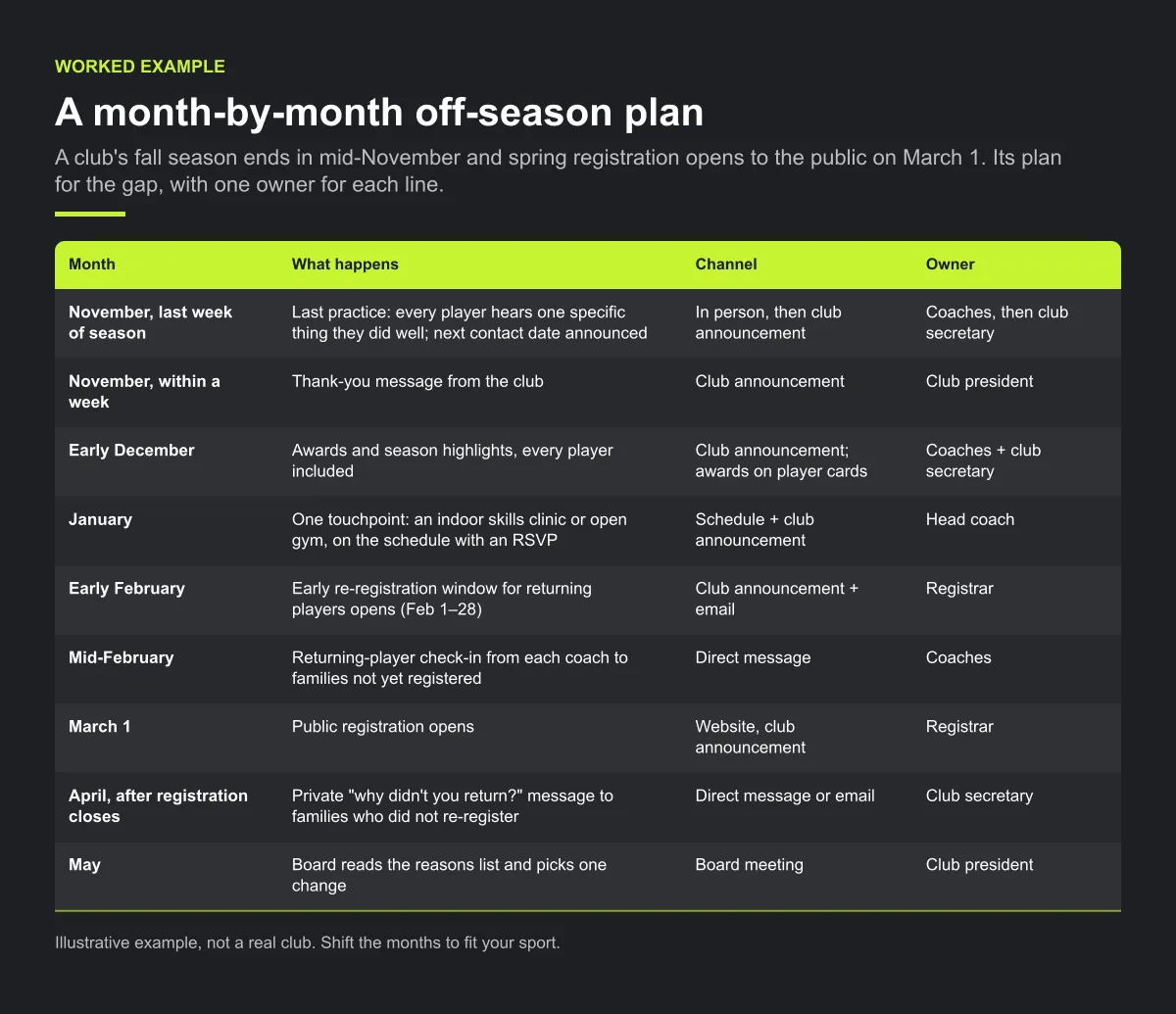
For a spring sport like baseball or lacrosse, the same plan runs from July to January. For a winter sport like hockey or basketball, it runs over spring and summer, when a summer social or outdoor clinic can stand in for the January open gym.
Checklist: off-season plan
- Next contact date announced at the last practice.
- Thank-you message sent within a week of the season's end.
- Every player included in awards or highlights.
- One or two touchpoints on the schedule with RSVPs.
- Early re-registration dates set and announced.
- Coaches have the check-in message and a list of families to contact.
- A private "why" message sent to families who did not return, and the answers recorded.
Common mistakes
- Too many touchpoints. Ten off-season emails can feel like noise. One or two meaningful ones are enough.
- A generic re-registration notice. Returning families who get the same message as strangers may feel the club forgot them. Address them as returning players.
- Asking "why" too late. A family that left in March has already settled in somewhere else by September. Ask soon after registration closes.
- Defensive replies. When a family gives a reason, thank them. Arguing the point can end the conversation for good.
How Play 2 Earn Sports supports this
- Club announcements for the thank-you, off-season news and the re-registration window, in one club voice.
- Player profiles that continue across seasons. Each player's journey can continue across seasons, so a returning player isn't starting from nothing.
- Awards. Coaches can give awards to players, and each player sees their award cards.
- Off-season events on the schedule. Clinics, open gyms and socials go on the same connected schedule as games and practices.
- RSVPs with reminders, so you know who is coming to an off-season event and coaches see "No reply".
The calendar, the messages and the follow-up are club decisions. Play 2 Earn Sports gives you one place to send them and to keep each player's journey going.
See how a club stays in touch between seasons.
Frequently asked questions
Follow an off-season calendar: a proper wrap-up, a thank-you within a week, awards, one or two touchpoints, an early re-registration window for returning players, a check-in, and a private question for families who don't return.
A short thank-you from the club, recognition for every player, and a date for when families will hear from you next.
Lightly. One or two useful touchpoints, such as a clinic or social, plus the re-registration messages. Silence is the problem, not frequency.
Many clubs give returning players a window before public registration opens. It rewards loyalty and helps you plan teams. Set the dates as club policy and announce them clearly.
Once, privately, with a short message that offers simple options (timing, cost, the team, something else) and makes clear there is no pressure.
Starter is free for clubs with up to 10 teams. Pro is $49.67 USD a month for 11 to 25 teams. Unlimited is $99.67 USD a month for 26 or more teams. Every feature is on every plan, and players and parents are always included. See pricing.
