

In this guide
A planning scenario: Several families still have fees due. The club needs a respectful way to follow up without asking the coach to collect or posting names in a team group chat.
Why fee reminders go wrong
- The coach is asked to chase money. That can put the coach in an awkward position with the family.
- It happens in public. "Reminder: 6 families still owe fees!" in the team chat embarrasses people who may be struggling.
- The rules are unclear. Without due dates or a known process, a reminder can feel personal.
- There's no quiet way to ask for help. Families who cannot pay may avoid asking about options.

What can go wrong
- Late dues complicate the budget for fields, rinks, courts, referees and equipment. A club that books ice or gym time in advance may have paid for it before half the fees are in.
- Volunteers spend time repeating one-to-one follow-ups without a clear process. Without a record of who was reminded and when, two volunteers can chase the same family while another family hears nothing.
- Public reminders may discourage families from asking about help privately. A family that feels singled out may stop replying at all, which makes the conversation harder for everyone.
- Inconsistency feels unfair. If one family is chased in week one and another is never asked, families notice. A written schedule means everyone gets the same treatment.
Step 1 — a fee policy families see at registration
Five lines, on the registration page and in the welcome email:
- What the fee covers (season, uniform, referees, fields).
- When it's due, with any instalment dates.
- How to pay (whatever methods your club accepts).
- What happens if it's late, stated calmly and consistently with the club's participation and assistance policies.
- How to ask for help, privately. A named contact, and fee assistance if your club or your area offers it (in Canada, programs such as KidSport and Canadian Tire Jumpstart can help eligible families; in the US, check with your sport's state association or local community programs).
Step 2 — the four-step reminder schedule
| When | From | How | Tone |
|---|---|---|---|
| 7 days before the due date | Club office | Private message to the family | Friendly heads-up |
| On the due date | Club office | Private message | Simple reminder |
| 7 days after | Club office | Private message | Clear, with the help contact |
| 14 days after | Treasurer or registrar | Phone call | Personal, problem-solving |
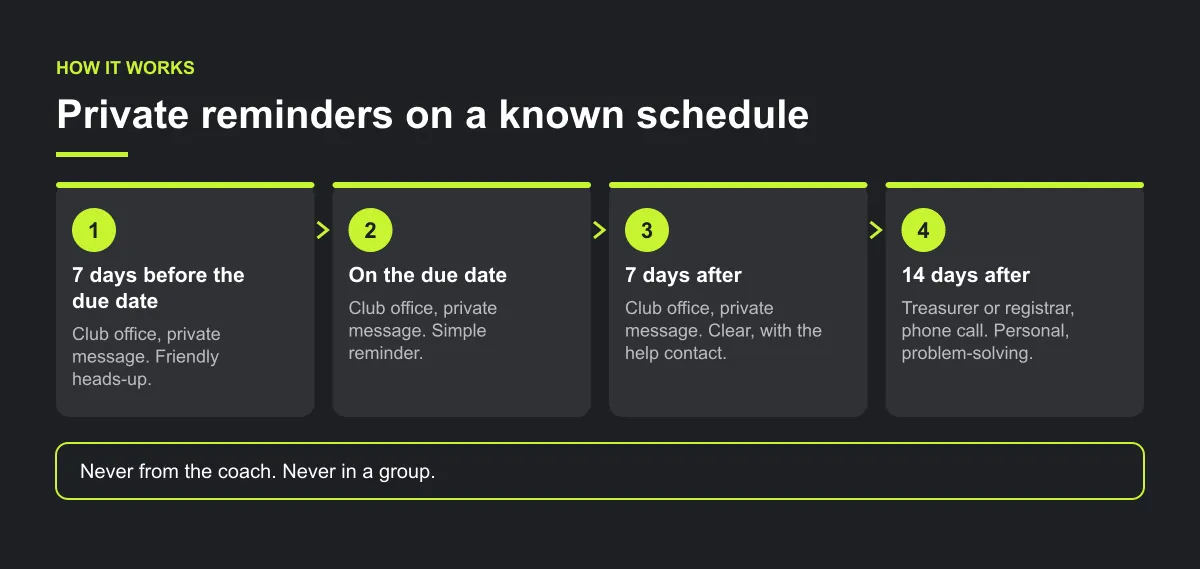
Never from the coach. Never in a group.

Step 3 — three message templates
Before the due date
Hi [name], a quick heads-up that [child]'s [season] fee of [amount] is due on [date]. You can pay by [methods]. If anything about the fee is a problem, reply to this message and we'll sort it out privately. Thanks for being part of [club]!
On the due date
Hi [name], just a reminder that [child]'s fee of [amount] is due today. If you've already paid, thank you, please ignore this. If you need a different payment plan, reply and we'll help.
Seven days late
Hi [name], our records show [child]'s fee of [amount] is still outstanding. Could you let us know when you expect to pay, or if you'd like to talk about options? You can reach [contact] directly at [email/phone]. We want [child] on the team.
Worked example — a season's fee-reminder cadence
Illustrative example, not a real club. Copy only: this is a messaging plan, not a payment system.
A club runs a fall season with a registration fee in two instalments: the first due September 1 and the second due October 15. Here is the whole season's reminder plan on one page, so the registrar is never deciding what to send on the day.
| Date | Who it goes to | Message | Sent by |
|---|---|---|---|
| At registration | Every family | The five-line fee policy, with both due dates and the help contact | Registrar |
| August 25 | Families with instalment 1 unpaid | "Before the due date" template | Club office |
| September 1 | Families with instalment 1 unpaid | "On the due date" template | Club office |
| September 8 | Families still unpaid | "Seven days late" template, with the help contact | Club office |
| September 15 | Families still unpaid | Phone call, to agree a plan | Treasurer |
| October 8 | Families with instalment 2 unpaid | "Before the due date" template | Club office |
| October 15 | Families with instalment 2 unpaid | "On the due date" template | Club office |
| October 22 | Families still unpaid | "Seven days late" template | Club office |
| October 29 | Families still unpaid | Phone call | Treasurer |
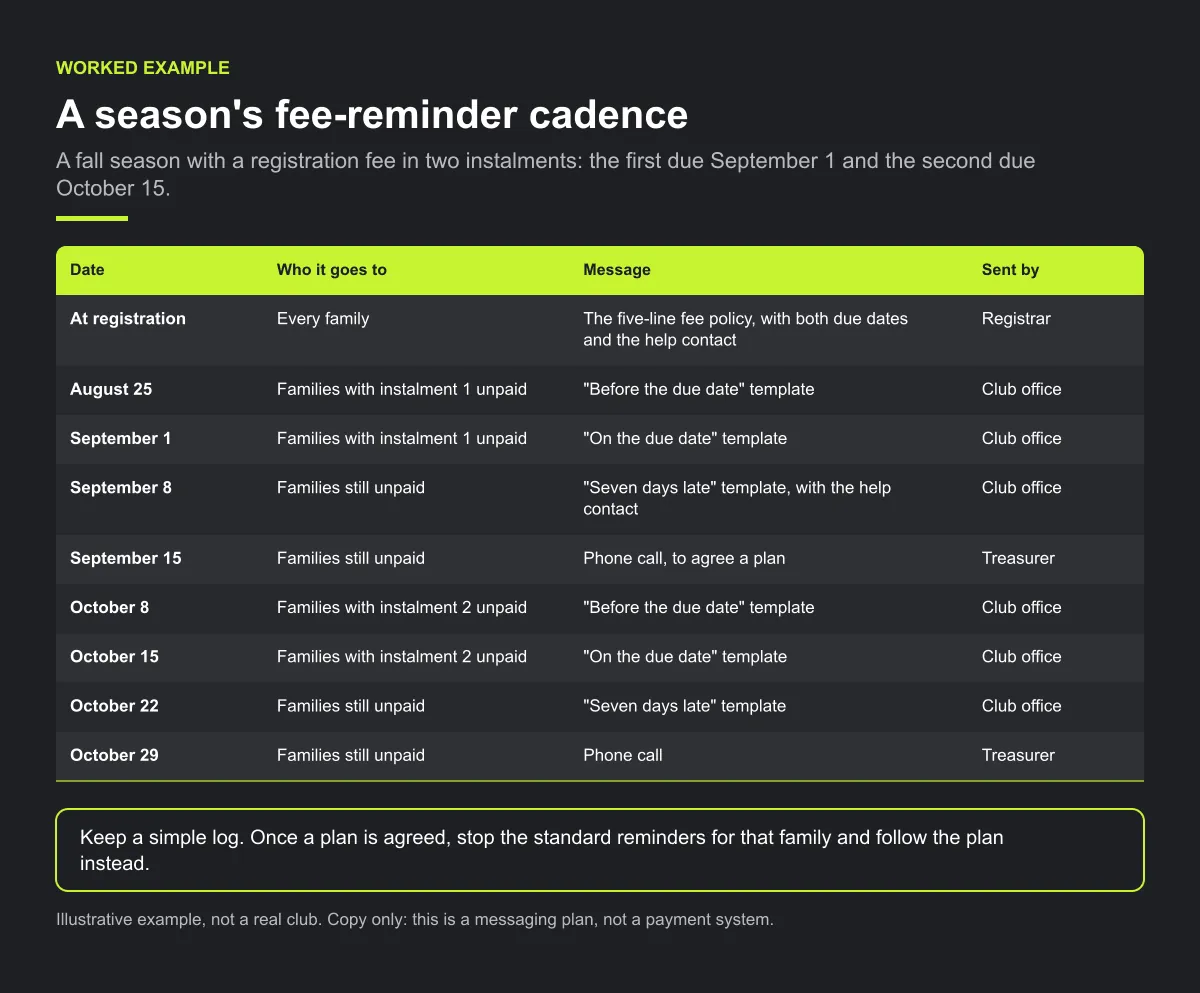
Keep a simple log. For each family: date of each reminder, how it was sent, and any agreed plan ("paying $50 on the 1st and 15th"). Once a plan is agreed, stop the standard reminders for that family and follow the plan instead. Nothing feels worse than an automatic-sounding "you're late" message after you have already agreed a plan with the treasurer.
A reply for families who ask for help:
Hi [name], thanks for letting us know. That's exactly what this contact is for. We can split the fee into [two/three] smaller payments, and we can also check whether [child] qualifies for [assistance program]. Nothing changes for [child] at practice or games while we sort it out. When is a good time for a quick call?
Checklist: before the first due date
- The fee policy is on the registration page and in the welcome email.
- Every player's dues are recorded with amount and due date.
- The reminder dates for the season are in the registrar's calendar.
- A named help contact is in every template.
- Coaches know they never collect or chase fees.
- There is a log of reminders sent and plans agreed.
- Reminders for under-14 players go to the parent or guardian.
Common mistakes
- Sending a reminder to a family who has already paid. Check the record before each round. A "please ignore if paid" line helps, but a correct list helps more.
- Changing the tone halfway. A friendly first message followed by a stern second one, from a different person, feels like a threat. Keep the voice the same.
- Letting the coach mention it at practice. Even a kind word in front of other parents can embarrass a family.
- Hiding the help contact. If assistance is only mentioned in the third reminder, families who needed it in week one may not ask.
How Play 2 Earn Sports supports this
- Club dues recorded per player. The club sets the amount and due date for each player's dues.
- A private reminder, in one click. From the club's finances, the club can send a reminder for an unpaid due. It goes to the family in the app and by email; repeat reminders for the same due are limited to one every 24 hours.
- To the right adult. For players under 14, dues reminders go to the linked parent or guardian.
- Paid and unpaid at a glance. The club's financial dashboard totals what's paid and what's outstanding.
- Never from the coach. Dues live with the club office, not in team chat.
How families pay stays with your club's existing methods; Play 2 Earn Sports records the dues and sends the reminders.
See how a club records dues and reminds families privately.
Frequently asked questions
Publish a fee policy at registration, send reminders from the club office (not the coach) on a known schedule, always privately, and include a named contact for anyone who needs help.
No. It puts the coach in an awkward spot with the family and the player. Fees belong with the club office or treasurer.
No. It can embarrass families who may be struggling. Remind privately.
State the amount and the original due date, ask when they expect to pay, offer a private conversation about options, and give a named contact.
Have a private route to ask for help and point families to fee assistance programs where available (in Canada, for example, KidSport and Canadian Tire Jumpstart). Many clubs also offer instalments.
Starter is free for clubs with up to 10 teams. Pro is $49.67 USD a month for 11 to 25 teams. Unlimited is $99.67 USD a month for 26 or more teams. Every feature is on every plan, and players and parents are always included. See pricing.
Related guides
- Player retention guides: every player retention guide in one place.
- Club communication standards
- Coaches getting late-night parent messages
- Sports club management software
- Pricing
