

In this guide
- Why families feel disconnected
- What it costs
- The development rhythm: three touch points a season
- What good feedback to families looks like
- Keep it about development, not playing time
- Make it a club standard, not a coach's habit
- Worked example — a three-touch-point development calendar
- How Play 2 Earn Sports supports this
- Frequently asked questions
- Related guides
The question club leaders ask: "The only time some parents hear from us is when a payment is due. They don't know how their child is doing, and then they're surprised when their child isn't moved up."
Why families feel disconnected
- Every club message is logistics or money. Schedules, fees, uniform orders. Nothing about their child.
- Feedback happens in passing, in the parking lot after a game, if it happens at all.
- Evaluations exist but stay in a notebook. Coaches assess players, but families never see what was written, or what their child's goals are.
- Team decisions arrive as surprises. Without a picture of the path, a selection decision feels personal.
What it costs
- Silence gets filled with assumptions, and they may be the worst ones.
- Coaches get ambushed at the field, rink or court after a loss.
- Families may start looking elsewhere, toward clubs that seem to care more, even when the coaching is no better.
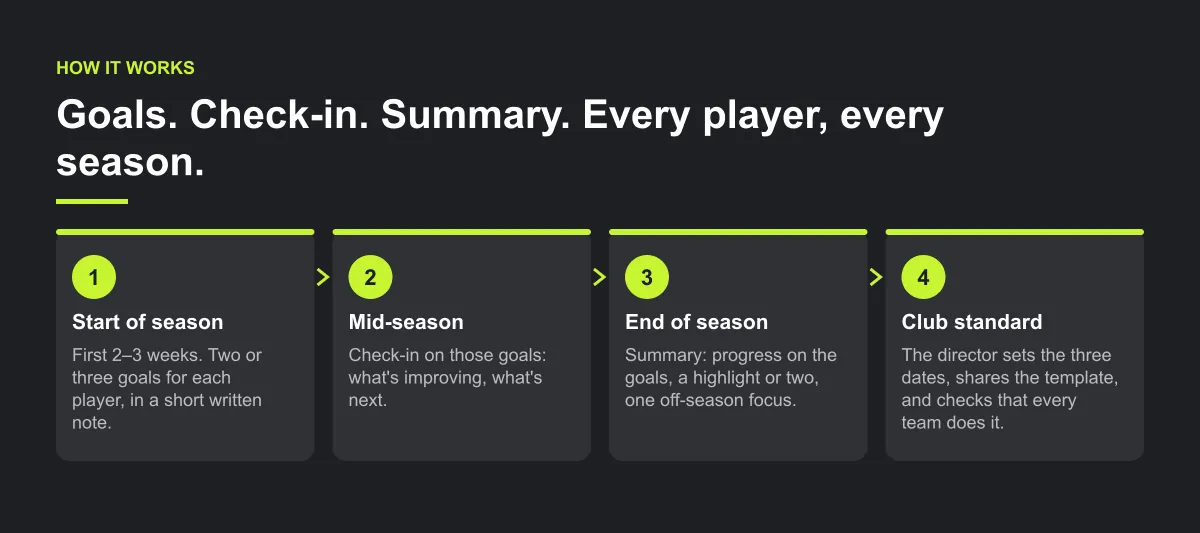
The development rhythm: three touch points a season
| When | What | Who | Format |
|---|---|---|---|
| Start of season (first 2–3 weeks) | Two or three goals for each player | Coach with the player; share with the parent for younger players | A short written note |
| Mid-season | Check-in on those goals: what's improving, what's next | Coach | A short note or a five-minute conversation after practice |
| End of season | Summary: progress on the goals, a highlight or two, one off-season focus | Coach | A written summary the family keeps |
Three touch points can be manageable for a volunteer coach with a full roster. Goals should be small, specific and within the player's control: "call for the ball every time I'm open", not "score more".
What good feedback to families looks like
- Specific. "Keeps her head up before passing", not "good player".
- About what the player controls: effort, skills, decisions, attitude.
- Balanced. Name real strengths alongside one clear thing to work on. One approach is a simple habit of two strengths for each focus area.
- Forward-looking. One thing to practise, and an easy way to do it at home.
- Readable by the player. Write it so the child could read it too, and be proud of it.
A four-line template every coach can use:
[Child] has worked hard on [goal]. We've seen [specific improvement]. Something [he/she/they] does really well is [strength]. Next focus: [one thing], and an easy way to practise at home is [idea].
Illustrative example, not a specific club.
Here is an example. A U11 volleyball coach sends a mid-season note: "Sam has worked hard on calling the ball. We've seen far fewer balls dropping between players. Something Sam does really well is encouraging teammates after a mistake. Next focus: getting low earlier on serve receive; ten minutes of wall passes a few times a week will help." The parent replies with a thank-you, not a complaint.

Keep it about development, not playing time
Playing time and team selection are separate conversations, with a club policy behind them. A development note should never become a negotiation.
If a parent raises playing time in response to feedback, thank them, point to the club's published playing-time policy, and book a separate conversation with the coach or director. One approach is to ask parents to wait 24 hours after a game before raising it, so the conversation happens calmly, away from the field, rink or court.
Coaches can keep a one-line reply ready: "Thanks for raising it. Playing time is a separate conversation, and I'd like to give it proper time. Can we talk on [day] at [time]?" The development note stays about the player's progress, and the family still gets a real conversation.
Make it a club standard, not a coach's habit
The director sets the three dates for the season, shares the template, and checks that every team does it. This gives teams a shared baseline, whoever the coach is, and new coaches know exactly what's expected.
Three practical supports make it stick: a short coaches' session at the start of the season with two example notes (one good, one too vague), a reminder to coaches a week before each touch point, and a quick check after each deadline of which teams are done. Coaches with large rosters can split the mid-season check-in across two weeks.

Worked example — a three-touch-point development calendar
Illustrative example, not a real club.
A club runs a fall season from early September to mid-December. The director puts these dates in every coach's calendar before the first practice.
| Week | Touch point | Coach's job | What the family receives |
|---|---|---|---|
| Week 1–2 | Observe | Watch each player in two practices; jot one strength and one gap | Nothing yet |
| Week 3 (by Sept 20) | 1. Goals | Agree two or three goals with each player; share with the parent for younger players | A short written note with the goals |
| Week 7 | Coach reminder | Director reminds coaches the mid-season check-in is due | Nothing |
| Week 8 (by Oct 25) | 2. Check-in | Short note or five-minute chat after practice: progress on each goal, what's next | A short note, or a conversation and a one-line follow-up |
| Week 13 | Coach reminder | Director reminds coaches the end-of-season summary is due | Nothing |
| Week 14 (by Dec 13) | 3. Summary | Progress on the goals, one highlight, one off-season focus | A written summary the family keeps |
| After the season | Handover | The club keeps the summaries for next season's coach | Nothing new |
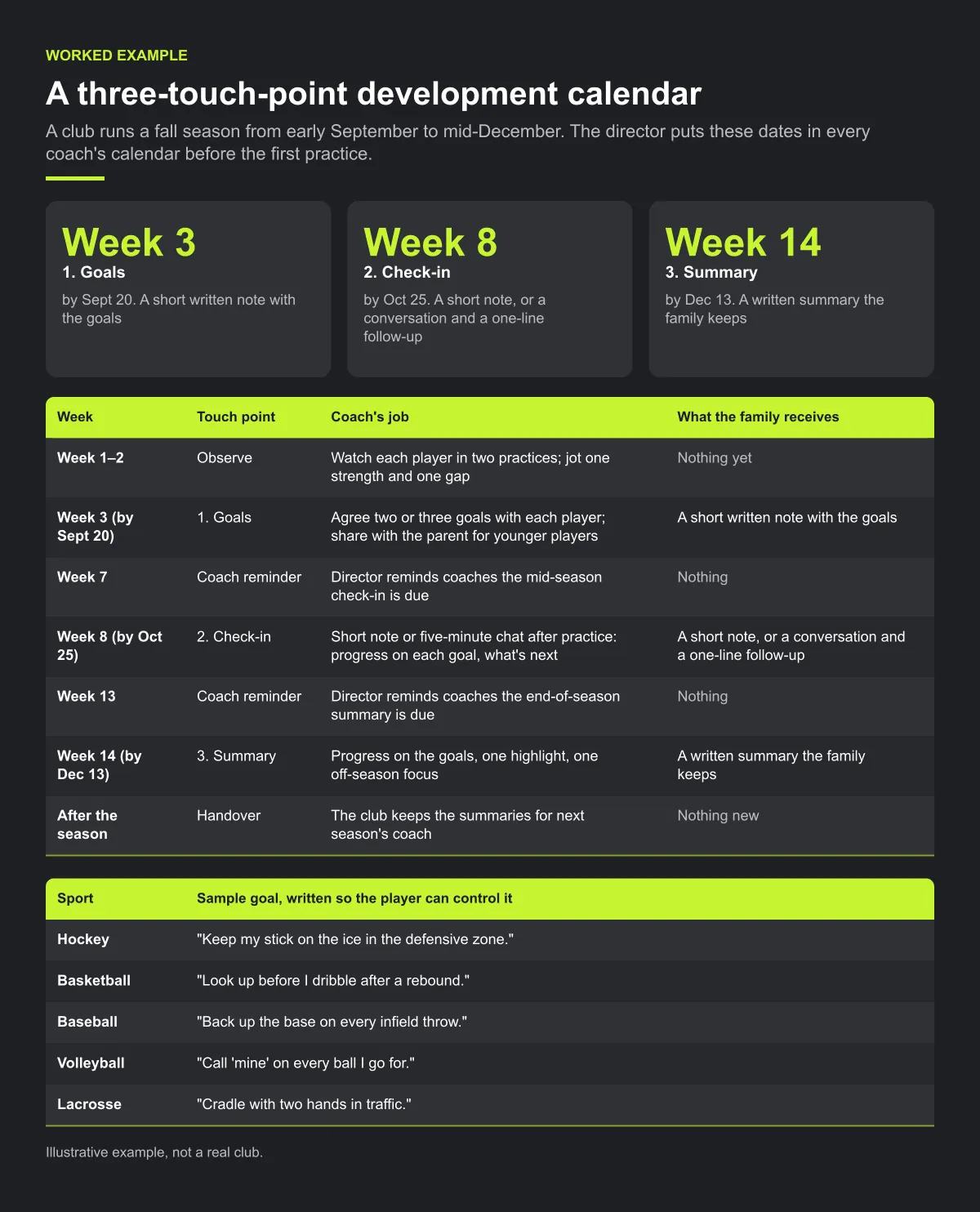
Sample goals by sport, written so the player can control them:
- Hockey: "Keep my stick on the ice in the defensive zone."
- Basketball: "Look up before I dribble after a rebound."
- Baseball: "Back up the base on every infield throw."
- Volleyball: "Call 'mine' on every ball I go for."
- Lacrosse: "Cradle with two hands in traffic."
Checklist: development rhythm for one season
- The three dates are set by the club and in every coach's calendar.
- Coaches have the four-line template and two example notes.
- Every player has two or three goals they can control.
- Notes are written so the player could read them too.
- The playing-time policy is published separately.
- Someone checks after each deadline which teams are done.
- End-of-season summaries are kept for next season's coach.
Common mistakes
- Goals about results. "Score more goals" or "win the starting spot" depends on others. Pick goals the player controls.
- Only writing about weaknesses. A note with one criticism and no strength can read as a warning. Name real strengths first.
- Letting the check-in slide. Missing the mid-season touch point leaves a long silence before the summary. Book it, even as a five-minute chat.
- Mixing feedback with selection. A development note that hints at team placement invites a negotiation. Keep them apart.
How Play 2 Earn Sports supports this
- Shared evaluations, where your club turns them on. A coach can share an evaluation with a player. The family sees only the evaluations that were shared, and private staff fields stay hidden, so coaches decide what families see.
- Awards coaches can give. Coaches can give awards to players, and the player sees them on their award cards. Use them for effort and improvement, not only results.
- Player profiles that continue across seasons. Each player's journey can continue across seasons, so next year's coach isn't starting from zero.
- The parent sees their own child. A linked parent or guardian opens their child's dashboard, and a child can be linked to more than one guardian.
The rhythm, the goals and the words still come from your coaches. Play 2 Earn Sports doesn't write feedback or send progress reports automatically.
See how coaches share evaluations and awards with families.
Frequently asked questions
Plan three touch points a season: goals at the start, a mid-season check-in and an end-of-season summary. Keep feedback specific and balanced, and keep it separate from playing-time conversations.
Wherever your club decides to share them. Some clubs email a written summary; in Play 2 Earn Sports, where the club turns on evaluations, coaches can share an evaluation with a player and the family sees it. Private staff notes stay private. See also what parents should see about their child's games.
Three planned times a season is a realistic minimum for volunteer coaches, plus a quick word whenever something is worth celebrating.
No. Share a clear, written evaluation or summary. Internal staff notes about selection and planning should stay with staff.
Thank them, point to the club's playing-time policy, and book a separate conversation with the coach or director. Keep the development note about development.
Starter is free for clubs with up to 10 teams. Pro is $49.67 USD a month for 11 to 25 teams. Unlimited is $99.67 USD a month for 26 or more teams. Every feature is on every plan, and players and parents are always included. See pricing.
