
In this guide
The question club leaders ask: "We lose kids every season and we're not sure why. The ones who leave often aren't the stars. They're the ones who were on the edge of the group all year."
Why players drift away
- Recognition only goes to the best players. Everyone else learns they are not the point.
- Some kids are on the edge of the group: new, quiet or outside a friendship circle.
- They can't see their progress. Without a way to measure it, a player who is improving can feel stuck.
- The season just stops. No moment that says "you belong here, see you next season".
Some reasons a family leaves are outside your control: a move, cost, a new interest. This guide is about the ones you can control.
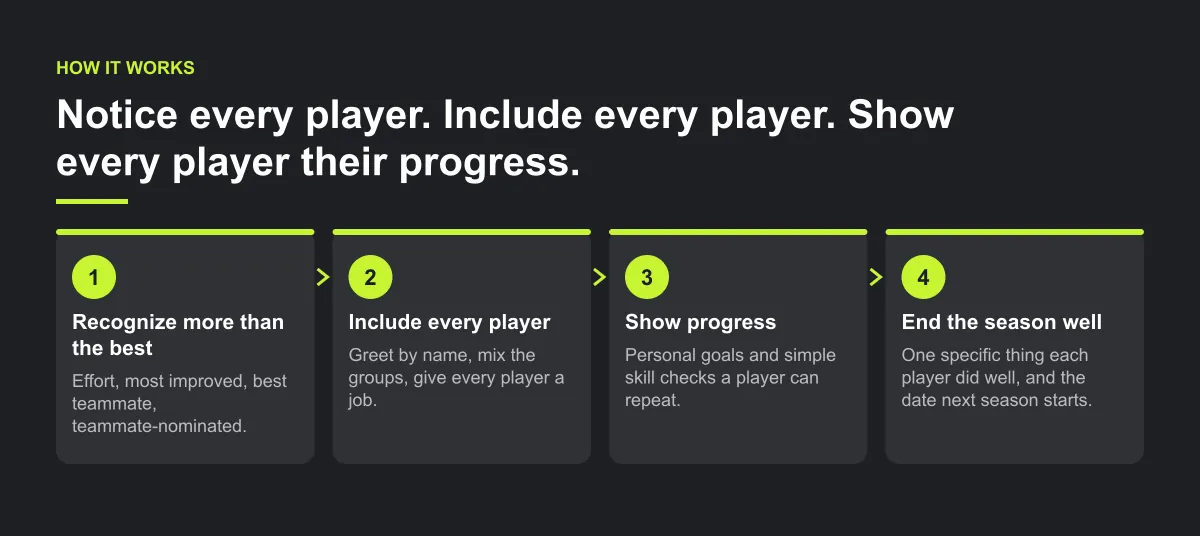
Recognition that isn't only for the best players
Give awards that every type of player can win through what they do:
- Effort: the player who works hardest at practice
- Most improved: measured against where they started, not against teammates
- Best teammate: the one who encourages others, picks people up after mistakes, includes the new kid
- Teammate-nominated: let players vote for each other sometimes; teammates can see who is kind and who works hard
One rule for every coach: each player is recognized for something specific and true at least once a season. The coach keeps a simple list so nobody is missed. This isn't the same trophy for everyone. It's a real reason, said out loud, in front of the team.

Inclusion habits for every practice
- Greet every player by name when they arrive.
- Mix the groups and rotate partners, so cliques don't set the teams.
- Never let captains pick sides in front of everyone. The coach makes the groups.
- Give every player a job: leading the warm-up, looking after equipment, keeping score in a drill.
- Have a plan for new and quiet players. Pair a new player with a buddy for the first few weeks. Check in with quiet players for thirty seconds at the end of practice.
- Notice absences early. If a player starts missing sessions, the coach has a friendly, private word with the parent. Ask, don't assume.
Show progress over a season
- Set two or three personal goals with each player at the start of the season, revisit them halfway, and celebrate them at the end.
- Compare players to their own past selves, not to teammates.
- Use simple skill checks a player can repeat: passes against a wall in thirty seconds, free throws out of ten, clean catches in a row. Do one in week two and again near the end. When their own number goes up, a player can see the progress for themselves.
Hypothetical example, not a specific club.
Here is a hypothetical example. A quiet U12 lacrosse player doesn't see much of the ball in games. In week two she catches eight passes in a row against the wall; by the last month it's twenty. The coach mentions it in front of the team and gives her the most improved award. She asks her parent when registration opens for next season.
End-of-season moments
- A last practice or team gathering where every player hears one specific thing they did well.
- A short note to each family, with the player's progress and one off-season idea.
- The date next season starts, shared before everyone leaves, so goodbye becomes "see you soon".
- A team photo or a shared moment, taken with the club's photo-consent rules in mind, that families can keep.
Plan the last practice on purpose. Ten minutes at the end is enough for every player to hear their one thing. Coaches can write the list the week before, so nobody is forgotten on the day.
Make it a club standard
A great coach does much of this by instinct. A club makes it the standard. The director shares the award ideas, the inclusion habits and the end-of-season plan with every coach before the season starts, so every player on every team gets the same chance to feel they belong.
A club standard also protects coaches. A new volunteer coach does not have to invent an awards plan; they follow the calendar. And families with two children on different teams see the same care on both.
Worked example — a season recognition calendar
Illustrative example, not a real club.
Here is a recognition plan for a 14-week season. It fits a hockey, basketball, soccer or volleyball team the same way. The coach keeps one list of players with a column for each moment, and ticks names off.
| Week | Moment | What the coach does | Who is recognized |
|---|---|---|---|
| 1 | Welcome | Greets every player by name; pairs each new player with a buddy | Every new player |
| 2 | First skill check | Records each player's starting number on one simple drill | Every player (private) |
| 3–5 | Team jobs | Rotates warm-up leader, equipment and drill scorekeeper | Every player has a job at least once |
| 4 | First shout-out | One specific, true thing said in front of the team | Five or six players |
| 7 | Mid-season goals check | Short private chat on each player's two or three goals | Every player |
| 8 | Teammate vote | Players nominate a teammate for being kind or working hard | One or two players |
| 9 | Second shout-out | Same as week 4 | Players not yet recognized |
| 12 | Second skill check | Same drill as week 2; each player sees their own change | Every player (private) |
| 13 | Coach awards | Effort, most improved, best teammate, given by the coach | Three or more players |
| 14 | Last practice | Every player hears their one specific thing; next season's start date shared | Every player |
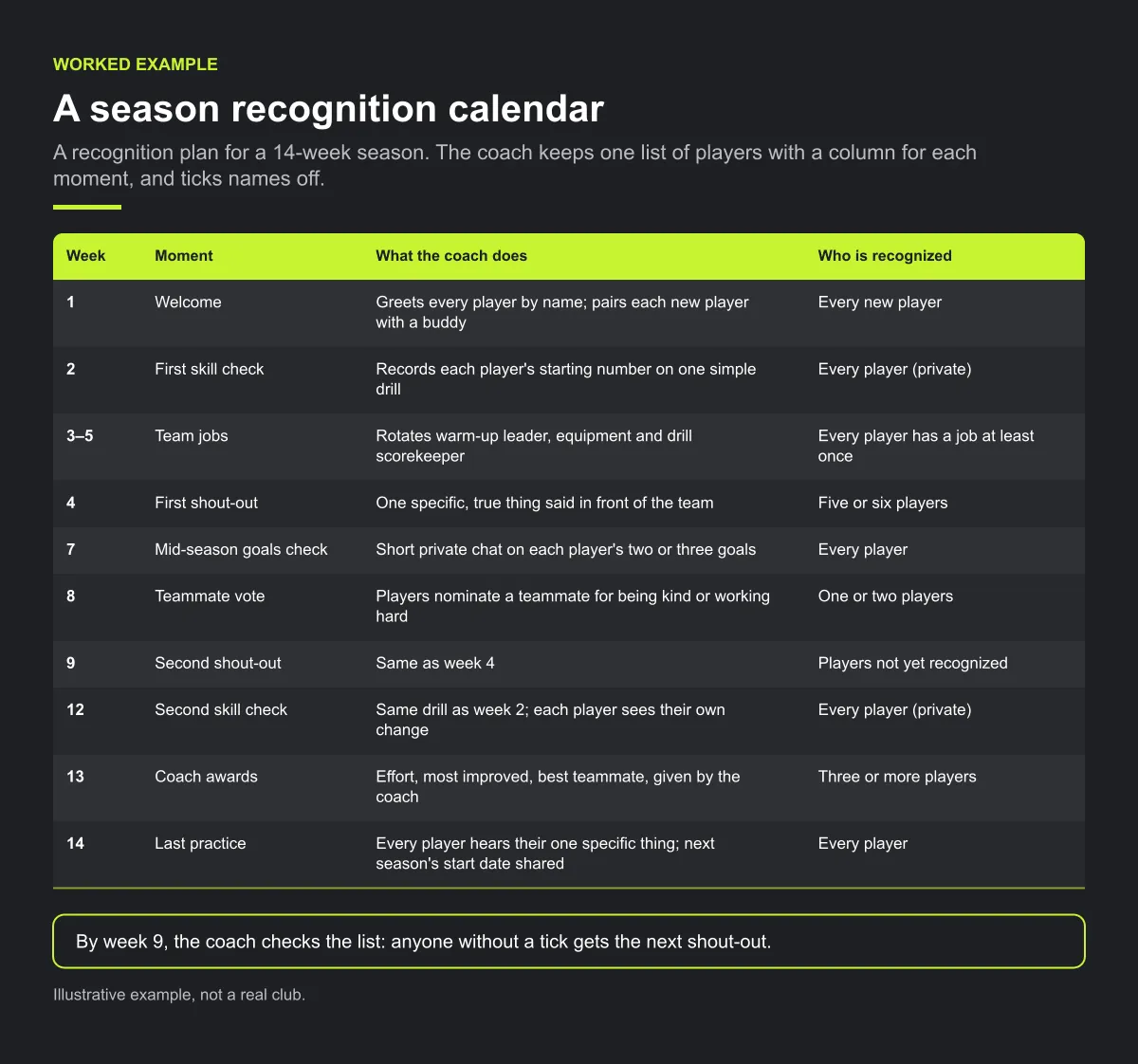
By week 9, the coach checks the list: anyone without a tick gets the next shout-out. The point is not that everyone gets the same award. It is that nobody reaches the end of the season unnoticed.
Checklist: recognition for one season
- A list of every player with a column for each recognition moment.
- Award categories set before the season: effort, improvement, teammate.
- Week-2 skill check recorded, so improvement can be measured later.
- Every player recognized for something specific at least once.
- New and quiet players have a buddy or a short check-in.
- Last-practice plan written the week before.
- Next season's start date shared before the season ends.
Common mistakes
- Vague praise. "Great job, everyone" is kind but forgettable. Name the player and the specific thing.
- The same few names every time. Without a list, recognition can drift toward the loudest or most skilled players.
- Public comparisons. Posting every player's skill-check numbers side by side turns progress into a ranking. Keep numbers private to each player and family.
- Saving it all for the last week. One award night does not undo a season of feeling unnoticed. Spread the moments out.
How Play 2 Earn Sports supports this
- Coach awards on the player's own award cards. Coaches can give awards to players, for effort, improvement or being a great teammate, and the player sees them on their award cards.
- Shared evaluations, where your club turns them on. Coaches can share an evaluation with a player; the family sees only what was shared, and private staff fields stay hidden.
- Player profiles that continue across seasons. Each player's journey can continue across seasons, instead of starting from zero every year.
- Attendance taken by coaches. Coaches and staff take attendance, and staff can see attendance records, so a coach can notice a player who has started missing sessions.
There is no dropout alert and no guarantee anyone stays. Noticing and caring is still the coach's job; the tools make the recognition visible and the history continuous.
See how coaches recognize players across seasons.
Frequently asked questions
Recognize more than the best players, build inclusion habits into every practice, help each player see their own progress over the season, and end the season with a moment that points to the next one.
Every player should be recognized for something real at least once a season. That's different from giving everyone the same trophy. The reason should be specific and true.
Use effort, most improved and best-teammate awards, and let teammates nominate each other sometimes.
Set personal goals at the start of the season, repeat simple skill checks, and compare each player to their own starting point. Shared evaluations help where your club uses them. See keeping parents connected to development.
Have a friendly, private conversation with the parent early. Ask what's going on before assuming anything.
Starter is free for clubs with up to 10 teams. Pro is $49.67 USD a month for 11 to 25 teams. Unlimited is $99.67 USD a month for 26 or more teams. Every feature is on every plan, and players and parents are always included. See pricing.
Related guides
- Player retention guides: every player retention guide in one place.
- Keeping parents connected to their child's development
- What parents should see about their child's games
- Club communication standards
- Sports club management software
- Pricing
