

In this guide
- Why families switch clubs when the coaching is similar
- An example: the slow drift away
- What "professional" means to a parent
- A one-hour communication audit
- Quick wins you can make this month
- Worked example — a club communication standards card
- How Play 2 Earn Sports supports this
- Frequently asked questions
- Related guides
The question club leaders ask: "We lost families this year to a club down the road. Their coaching isn't better than ours. Parents just said the other club 'seemed more organized.' What does that actually mean, and how do we fix it?"
Why families switch clubs when the coaching is similar
Parents may find it hard to judge coaching quality from the stands. They can judge whether they knew where to be on Saturday, whether that's a field, a rink or a court. So when two clubs coach about the same, families compare what they can see:
- Did we hear about the time change before we left the house?
- Did someone answer when we asked a simple question?
- Did fees, forms and news come from one clear place?
- Did it feel like the club knew who our child was?
The club that wins those small moments can look more professional, and families may move toward it, even when the coaching is no better.
An example: the slow drift away
Illustrative example, not a specific club.
Here is an example. A family joins in the fall. In the first month, a game moves and they hear about it in a group chat they weren't added to. A fee email arrives with a different amount than the registration page. Their question about uniforms goes unanswered for a week. Nobody did anything wrong on purpose. But by spring the parents feel the club is "a bit chaotic," and when a friend mentions another club, they sign up there.

What "professional" means to a parent
Parents don't mean polished graphics. They mean six things:
Predictable.
News arrives in the same place, at roughly the same time each week.
Consistent.
Every team works the same way, so a family with two children learns it once.
Accurate.
Times, venues and amounts are right the first time, and corrections are clear.
Private where it should be.
Fees, evaluations and personal matters never go in a group chat.
Responsive within stated times.
Not instantly. Within the times the club said it would.
One voice.
Official news comes from the club, not from whichever volunteer saw it first.
A one-hour communication audit
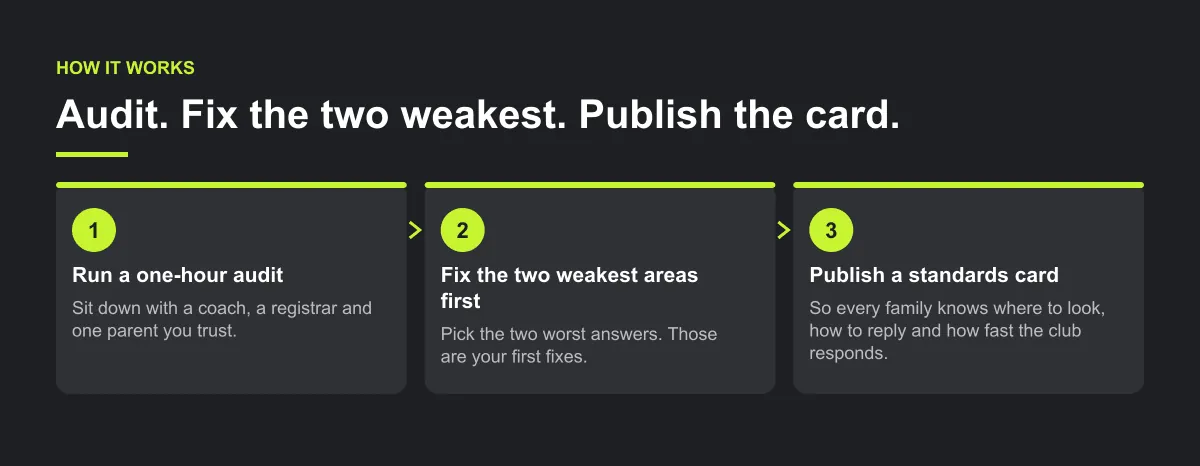
Sit down with a coach, a registrar and one parent you trust. Spend an hour on these questions and write down honest answers.
| Area | Question to ask | Warning sign |
|---|---|---|
| Schedule | Where does a family look to know where to be this week? | "It depends on the team." |
| Changes | How did families hear about the last moved game? | Some heard in a chat, some didn't hear. |
| Official news | Where did the last club-wide message go? | Facebook, email and three group chats. |
| Fees | Who reminds families about money, and where? | The coach, or the team chat. |
| Questions | Who answers which questions, and how fast? | Everything goes to the coach's phone. |
| Consistency | Would a family with two teams get the same experience? | Two completely different systems. |
| Continuity | If a coach left tomorrow, what would the club still have? | The coach's personal phone holds it all. |
| New families | What does a new family receive in its first week? | Nothing until the first practice. |
Pick the two worst answers. Those are your first fixes.
Quick wins you can make this month
- Name one home for the schedule. If it isn't there, it isn't happening.
- Publish response times. For example, "Coaches reply to messages within one day, not after 9 pm."
- Separate official news from chat. Club announcements for news; team chat for conversation.
- Move money out of team chats. Fee reminders come privately from the club office.
- Send a welcome message to every new family: where to look, how to reply, who to ask.
- Fix mistakes in the open. A short "correction: the game is at 10, not 9" can build more trust than silence.
For the full rollout, see club communication standards.
Worked example — a club communication standards card
Illustrative example, not a real club. Replace every detail with your own.
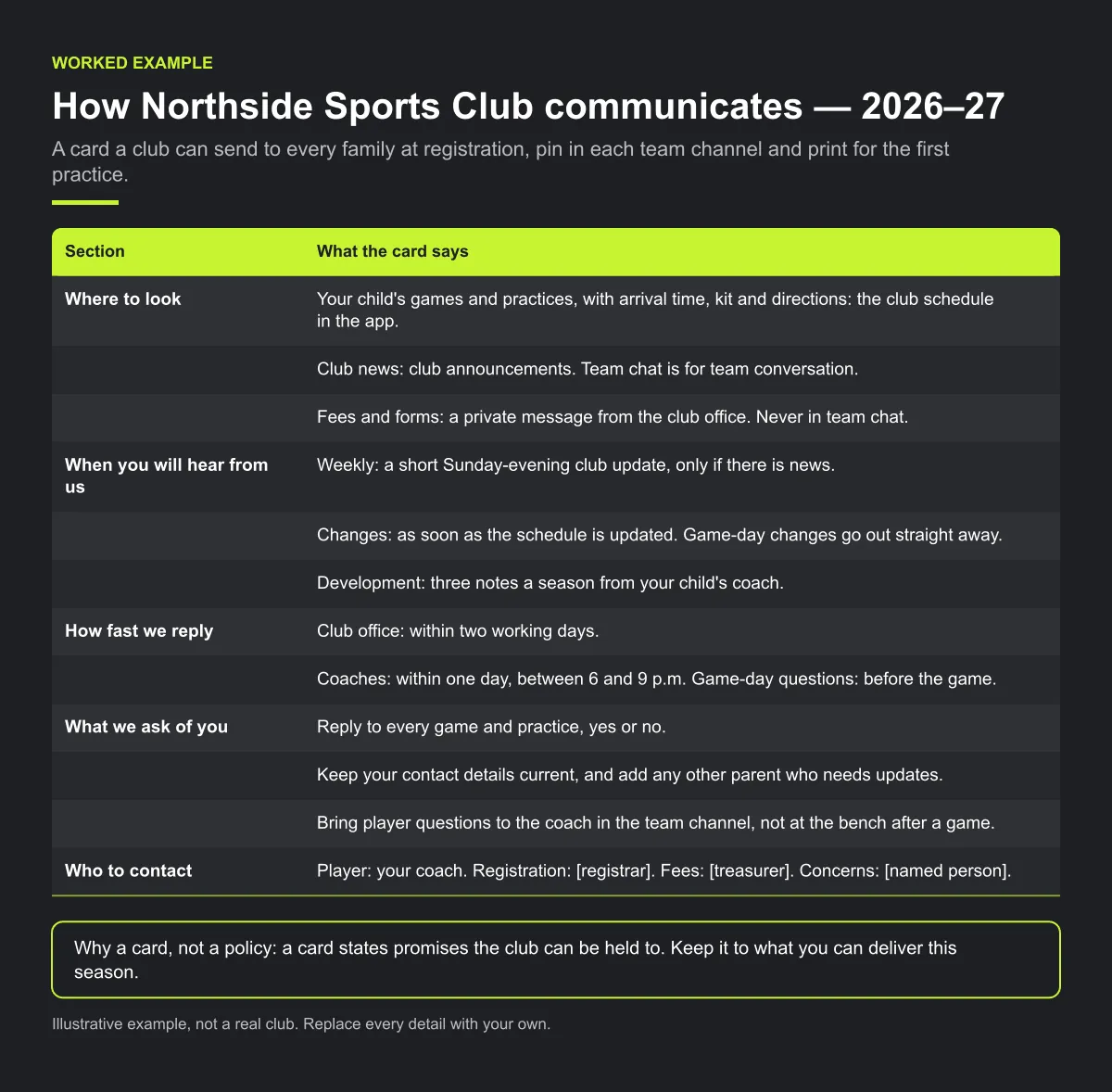
Here is a card a club can send to every family at registration, pin in each team channel and print for the first practice. It turns the six "professional" habits into promises a family can check.
How Northside Sports Club communicates — 2026–27
Where to look
Your child's games and practices, with arrival time, kit and directions: the club schedule in the app.
Club news: club announcements. Team chat is for team conversation.
Fees and forms: a private message from the club office. Never in team chat.
When you will hear from us
Weekly: a short Sunday-evening club update, only if there is news.
Changes: as soon as the schedule is updated. Game-day changes go out straight away.
Development: three notes a season from your child's coach.
How fast we reply
Club office: within two working days.
Coaches: within one day, between 6 and 9 p.m. Game-day questions: before the game.
What we ask of you
Reply to every game and practice, yes or no.
Keep your contact details current, and add any other parent who needs updates.
Bring player questions to the coach in the team channel, not at the bench after a game.
Who to contact: Player: your coach. Registration: [registrar]. Fees: [treasurer]. Concerns: [named person].
Why a card, not a policy. A card states promises the club can be held to. If the club says "within two working days" and takes a week, families can point to it, and that is the point: the card keeps the club honest, too. Keep it to what you can deliver this season.
Checklist: before you publish the card
- Every promise on it is one your volunteers can keep this season.
- Reply times are agreed with each coach and the club office.
- The schedule, announcements and fee channels named on it are the real ones.
- Contacts are roles with current emails, not personal phone numbers.
- It goes to every family at registration and to new families when they join.
- Someone owns updating it each season.
Common mistakes
- Promising instant replies. "We're always available" sets up a promise volunteers cannot keep. Publish realistic times.
- Fixing everything at once. Pick the two weakest areas from the audit and fix those first.
- Polish over accuracy. A beautifully designed email with the wrong game time can do more damage than a plain one that is right.
- Leaving coaches out of the audit. Coaches see the gaps first. Include at least one in the hour.
How Play 2 Earn Sports supports this
- One schedule for every team. Families see their own child's games and practices in one connected calendar.
- Change notices that reach the right people. When a game is moved, the people in that game are told in the app, by email, by push where enabled and in team chat.
- Details on each game. A description on each game (up to 2,000 characters) for arrival time, uniform and directions.
- Club announcements, separate from team chat. One voice for official news; team, coaches and parents channels for conversation.
- RSVPs on events, with reminders and "No reply" visible to coaches.
- No personal numbers needed, with youth-safety guards in team chat.
- Private dues reminders from the club, not the coach.
- Team records belong to the club. Rosters stay with the team and coaches can be reassigned.
See what a family sees when a club communicates in one voice.
Watch why families switch clubs
Frequently asked questions
Reasons vary: cost, time, friends, playing time, and how the club feels to deal with. Communication is the part a club controls most. Late changes, mixed messages and unanswered questions make a club feel disorganized, even when the coaching is good.
Parents judge what they can see: whether they knew where to be, whether questions were answered, and whether news came from one clear place. A better-organized club looks more professional.
Predictable, consistent, accurate, private where it should be, responsive within stated times, and in one voice. None of it needs paid staff.
Run a one-hour audit with a coach, a registrar and a parent you trust. Ask where families look for the schedule, how they heard about the last change, who handles fees, and what a new family receives.
Within the times you publish. A stated window, such as one day, and kept consistently, builds more trust than instant replies some days and silence on others.
Starter is free for clubs with up to 10 teams. Pro is $49.67 USD a month for 11 to 25 teams. Unlimited is $99.67 USD a month for 26 or more teams. Every feature is on every plan, and players and parents are always included. See pricing.
Related guides
- Parent communication guides: every parent communication guide in one place.
- Parents keep missing schedule changes
- Coaches getting late-night parent messages
- What parents should see about their child's games
- Club fee reminders that aren't awkward
- Club communication standards
- Sports club management software
- Pricing
