

In this guide
- An example: the coach who only talks about Saturday
- Why connection slips
- Four habits that take minutes, not hours
- Boundaries that keep coaches and families safe
- How clubs support their coaches
- Worked example — a coach's four-habit season plan
- How Play 2 Earn Sports supports this
- Frequently asked questions
- Related guides
The question club leaders ask: "Our coaches are good volunteers, but every message is about the next game. Families only hear from them when something changes, and players only get attention when they're starting. How do we help coaches build a real connection without asking for hours they don't have?"
An example: the coach who only talks about Saturday
Illustrative example, not a specific club.
A U11 hockey coach is organised and well liked. Every message is logistics: time, rink, gear. By November, one family realises the coach has never said a word to them about their son, who mostly comes off the bench late in games. Nothing is wrong. But nothing is right either, and the family isn't sure the club notices their child at all.
The habits below are one way to close that gap.
Why connection slips
- The schedule fills every message. When the only contact is logistics, families may not know what the coach sees in their child.
- Quieter players can be easier to miss. Newer or quieter players may get less attention, without anyone meaning it.
- Coaches don't have much time. If you coach around a full-time job, "build relationships" can sound like a second job.
- Nobody showed them how. Volunteer coaches may need a small, repeatable routine for the people side, not just drills.
Four habits that take minutes, not hours
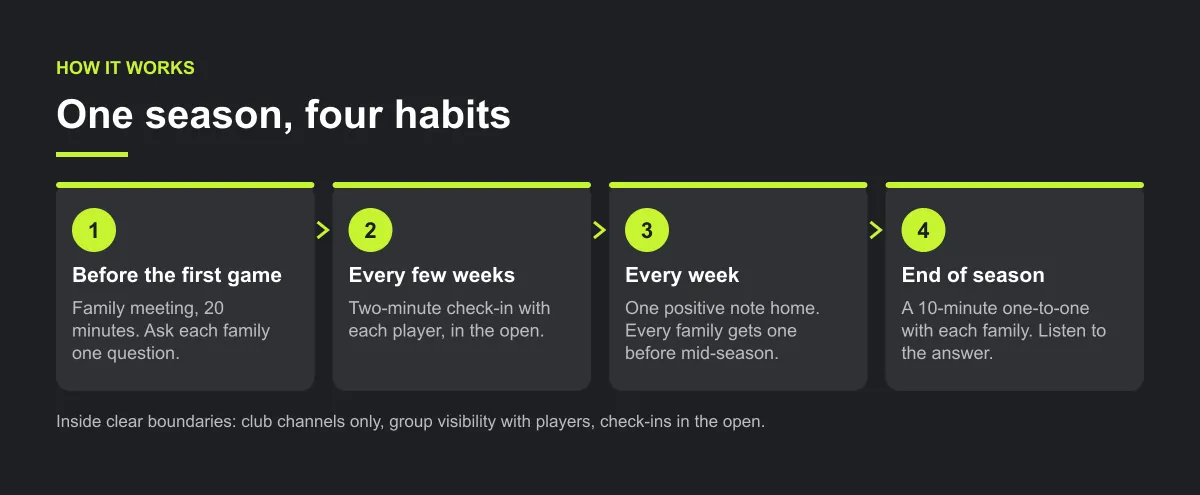
A season-start family meeting (20 minutes, once).
Before the first game, meet families as a group, in person or by video. Cover how you coach, how playing time works, how and when you communicate, and the one channel you use. Ask each family one question: "What do you hope your child gets out of this season?" Write the answers down.
A two-minute check-in with each player, every few weeks.
At practice, in the open, with other people around. Two questions are enough: "What's going well?" and "What do you want to get better at?" With 15 players, plan for two or three short chats a week, including players beyond the starters. Keep a simple list to track who has had a check-in.
One positive note home a week.
Pick one or two players each week and send their family a short, specific note: "[Player] kept talking to her teammates all game, even when we were behind." Rotate so every family gets one before mid-season. Specific beats general; effort beats results.
An end-of-season one-to-one with each family (10 minutes).
A short conversation with the parent or guardian, with the player there if they're old enough. What went well, one thing to work on over the break, and "Are you thinking about next season?" Listen to the answer.
Boundaries that keep coaches and families safe
- Club channels only. Coaches use the club's team channels, not personal numbers or personal social media.
- Group visibility with players. Messages to young players go where a parent or another adult can see them. No private one-to-one messages between a coach and a minor.
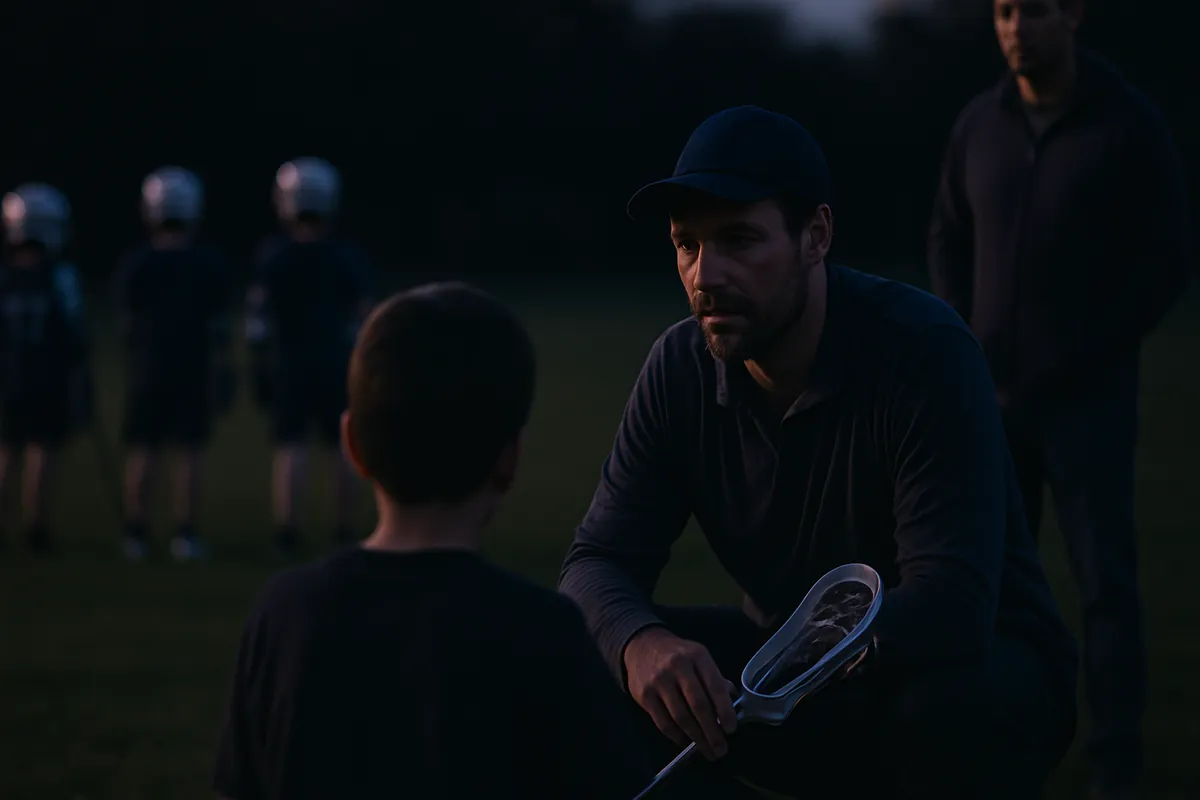
- In the open. Check-ins happen at the field, rink or court, with others nearby, never alone in a car or a closed room.
- Hours. Agree a quiet-hours window and say it at the family meeting.
- Families talk to coaches about their own child. Concerns about another player or about playing time go through the agreed route, not at the game.
How clubs support their coaches
- Templates. A family-meeting agenda, a check-in list, three positive-note examples and an end-of-season conversation guide. One page each.
- A coach coordinator. One volunteer who checks in with coaches monthly ("Have you done your notes? Anything worrying you?") and handles difficult family conversations.
- A short training slot. Ten minutes at the pre-season coach meeting on these habits and the boundaries.
- Recognition. Thank coaches who keep the habits, publicly, at the end of the season.
Worked example — a coach's four-habit season plan
Illustrative example, not a real club.
A volunteer basketball coach has 12 players and a 16-week season. Here is the plan they print and keep in their bag. The time column is the point: the whole plan fits in the minutes around practice.
| Week | Habit | What the coach does | Time |
|---|---|---|---|
| Before week 1 | 1. Family meeting | 20-minute video call: how I coach, playing time, the one channel I use, my reply hours; ask each family what they hope for | 20 min, once |
| Weeks 2–5 | 2. Check-ins | Three players a practice, two minutes each, at the side of the court with others around | 6 min a practice |
| Weeks 2–13 | 3. Positive notes | One specific note to one family a week, sent to the parent through the club's channels; rotate so all 12 families get one by week 13 | 5 min a week |
| Weeks 6–9 | 2. Check-ins | Second round, same two questions | 6 min a practice |
| Weeks 10–13 | 2. Check-ins | Third round; note anyone who seems to be drifting and tell the coach coordinator | 6 min a practice |
| Weeks 15–16 | 4. End-of-season chats | 10 minutes with each family after the last two practices or by video call | About 2 hours across two weeks |
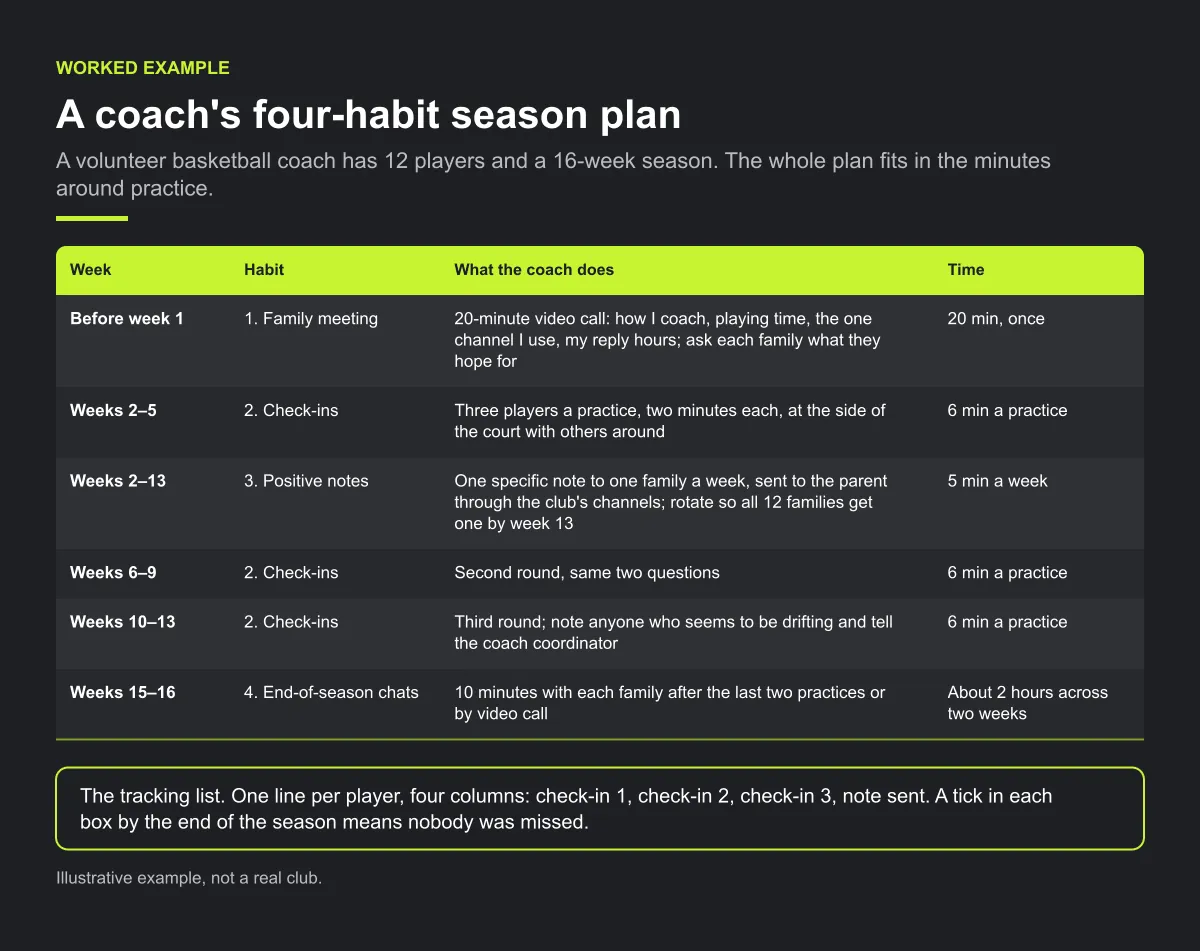
The tracking list. One line per player, four columns: check-in 1, check-in 2, check-in 3, note sent. Review any blank boxes before the season ends and follow up with those players or families.
Three positive notes a coach can adapt:
"[Player] called for the ball every time she was open today. That's exactly what we worked on Tuesday."
"[Player] was first to pick up a teammate after a mistake tonight. That kind of thing makes a team."
"[Player] stayed after practice to help pack up without being asked. Thank you for raising a great teammate."
The same plan works for a hockey coach with ice-time limits (do check-ins during water breaks) or a baseball coach with long games (do them between innings in the dugout, with others around).
Checklist: four habits for one season
- Family meeting booked before the first game, with the agenda ready.
- Tracking list with every player's name and four columns.
- Check-in rounds scheduled across the season.
- One positive note a week, rotated so every family gets one.
- End-of-season chats booked in the last two weeks.
- Reply hours shared at the family meeting.
- Every message to players goes through club channels where another adult can see it.
Common mistakes
- Notes only for the stars. If the same three families hear good news, the others notice. Rotate.
- Check-ins in private. A one-to-one in a car or a closed room breaks the boundary that protects everyone. Stay in the open.
- Generic praise. "Great game!" sent to everyone is not a note home. Name one specific thing.
- Skipping the end-of-season chat. It can be the moment a family decides about next season. Ten minutes is worth protecting.
How Play 2 Earn Sports supports this
- Team chat with the right channels. Each team has team, coaches and parents channels, plus polls and direct messages, with youth-safety guards built in. Coaches don't need to share personal numbers.
- Club announcements. Official club messages go out through a separate announcements feature, so team channels stay for the team.
- Shared evaluations, where the club turns them on. Coaches can share an evaluation with a player; the family sees only what is shared, and private staff fields stay hidden. Useful for the end-of-season conversation.
- Awards. Coaches can give awards to players, and the player sees their award cards. A simple way to recognise effort, not just scoring.
- RSVPs and attendance. Events carry RSVPs with reminders, and coaches see who hasn't replied. Coaches take attendance, and staff can see attendance records and counts, which helps a coach notice a player who has gone quiet.
- A player profile that continues. Each player's journey can continue across seasons, so next year's coach isn't starting from zero.
The habits are still people's work. The tools keep it in club channels and make it easier to keep up.
See how coaches stay connected through club channels.
Frequently asked questions
Four small habits: a season-start family meeting, a two-minute check-in with each player every few weeks, one positive note home a week, and a short end-of-season conversation with each family.
Not privately. Use the club's team channels, keep messages to young players where a parent or another adult can see them, and avoid personal numbers.
A group meeting at the start, a positive note at least once before mid-season, regular updates in the team channel, and a short one-to-one at the end. Concerns can be raised anytime through the agreed route.
One specific thing the player did, ideally about effort or attitude rather than results. Two sentences is plenty.
Give them one-page templates, a coach coordinator who checks in monthly, a short training slot before the season, and recognition at the end.
Starter is free for clubs with up to 10 teams. Pro is $49.67 USD a month for 11 to 25 teams. Unlimited is $99.67 USD a month for 26 or more teams. Every feature is on every plan, and players and parents are always included. See pricing.
Related guides
- Player retention guides: every player retention guide in one place.
- Club communication standards
- Coaches getting late-night parent messages
- What parents can see: attendance and availability
- Sports club management software
- Pricing
