

In this guide
- An example: the family who went quiet
- Six warning signs to review every month
- How to run the monthly review (30 minutes)
- A respectful family check-in
- When a family does leave: a short exit conversation
- Track the reasons, not just the numbers
- Worked example — a monthly review sheet and a check-in call script
- How Play 2 Earn Sports supports this
- Frequently asked questions
- Related guides
The question club leaders ask: "Every September, families we thought were happy just don't register. Nobody told us anything was wrong. How do we know which players are at risk of leaving while there's still time to help?"
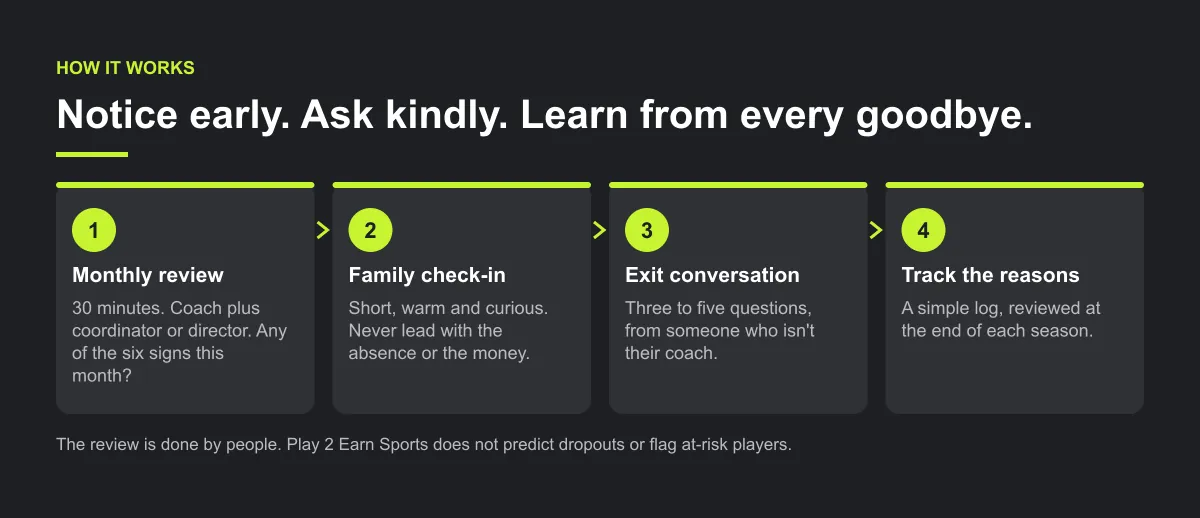
An example: the family who went quiet
Illustrative example, not a specific club.
Here is an example. A U13 volleyball player misses two practices in October. The parent used to answer RSVPs the same day; now most events show no reply. Her two closest friends moved to another club in the summer. Dues for the winter session are still unpaid. Each sign on its own means nothing. Together, nobody put them side by side, and in spring the family simply doesn't come back.
Six warning signs to review every month
Missed practices.
Two or more unexplained absences in a month, or a pattern that's new for this player.
RSVP changes.
A family that always replied now leaves events unanswered, or switches from "Yes" to "No" more often.
A family going quiet.
Fewer replies in the team channel, no questions, no one watching at games anymore.
Unpaid dues.
Sometimes it's money worries, sometimes it's a family already half out the door. Either way, it's a reason to talk privately.
A change in the player's role.
Less playing time, a new position, a move down a team, or a new coach.
Friends leaving.
Players may join for friends and leave with them. When a group moves on, check on the ones who stayed.
One sign is noise. Two or three together are worth a conversation.
How to run the monthly review (30 minutes)
- Who: the coach of each team, with the coach coordinator or a director. People who know the players.
- What: go through the roster. For each player, ask: "Any of the six signs this month?" Use attendance, RSVPs and dues records as prompts, not verdicts.
- Output: a short list of families to check in with, and who will do it this week.
- Privacy: keep the list among the people doing the review. It's not shared with the team and never with players.

A respectful family check-in
Keep it short, warm and curious. Never lead with the absence or the money.
Hi [name], I just wanted to check in on how the season is going for [player] and for your family. We've missed seeing [player] at a few practices, and I wanted to make sure everything's OK. Is there anything we could do differently, or anything that would make it easier? No pressure at all, I'd just like to know.
Then listen. Answers can include schedule clashes, cost, a friend leaving, playing time or the player losing interest. Some of those the club can help with; some it can't. Either way, the family knows they were noticed.
When a family does leave: a short exit conversation
Ask every leaving family three to five questions, by a short form or a five-minute call from someone who isn't their coach:
- What was the main reason you decided to leave?
- Was there a moment when things changed?
- Is there anything we could have done differently?
- Would you consider coming back in the future?
- Anything else you'd like us to know?
Thank them, wish the player well, and keep the door open. Keep the questions the same for every family, so the answers can be compared across teams and seasons. Someone outside the team asking can make it easier for a family to be honest about a coach or a team culture problem.
Track the reasons, not just the numbers
Keep a simple log: date, team, age group, main reason (cost, schedule, playing time, coach, friends, moved, lost interest, other) and any notes. Review it at the end of each season. If "playing time" shows up in one age group again and again, that's a club decision to make, not a family problem.
Worked example — a monthly review sheet and a check-in call script
Illustrative example, not a real club. Players are fictional and identified by number only.
The review sheet. A U12 hockey coach and the coach coordinator spend 30 minutes at the end of October. They tick the signs for each player and stop at anyone with two or more.
| Player | Missed practices | RSVP change | Family quiet | Dues unpaid | Role change | Friends left | Action |
|---|---|---|---|---|---|---|---|
| Player 4 | ✓ | ✓ | ✓ | Coach calls this week | |||
| Player 9 | ✓ | ✓ | Coach has a two-minute chat at practice, then a note home | ||||
| Player 13 | ✓ | Watch; one sign only | |||||
| Everyone else | No action |
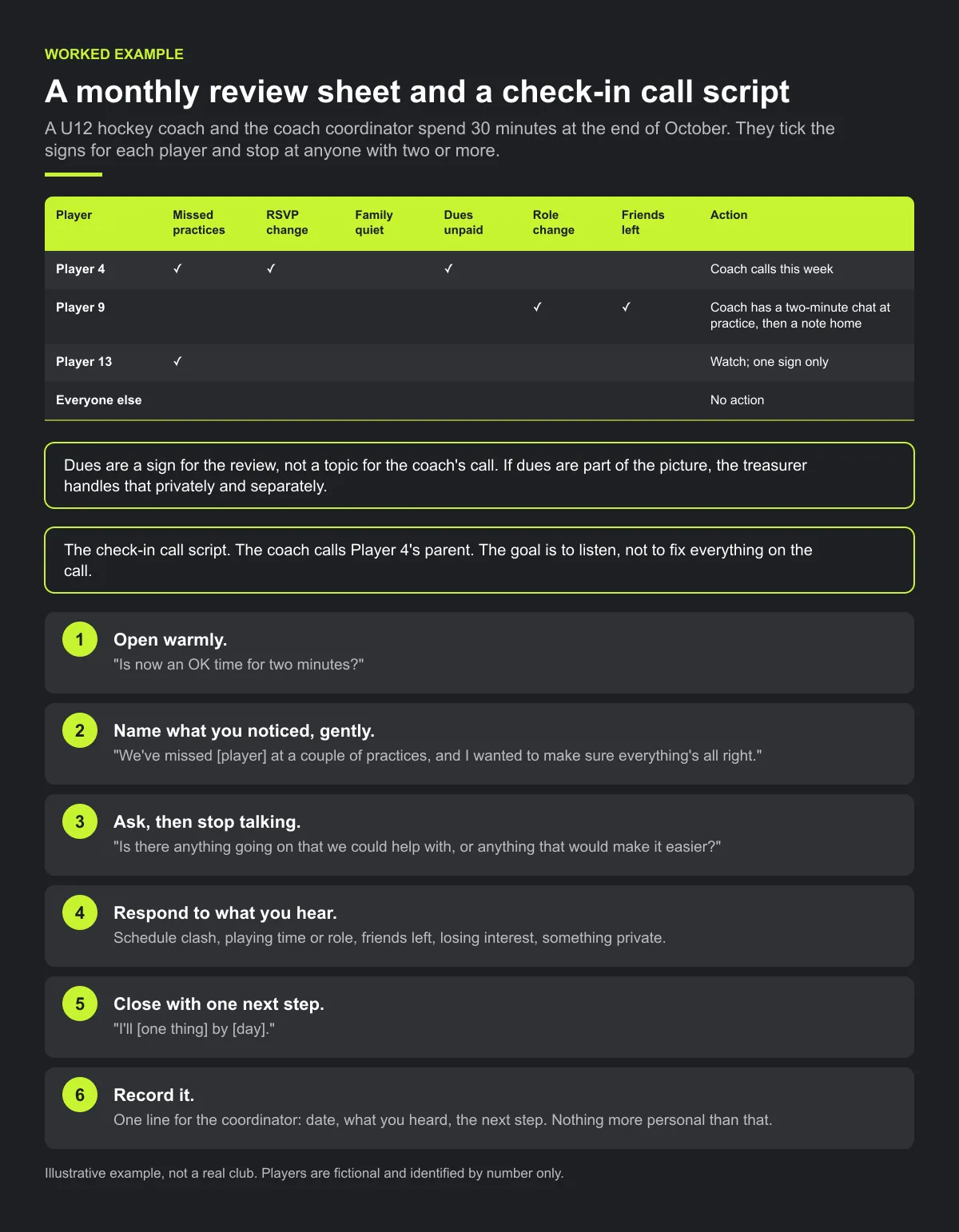
Dues are a sign for the review, not a topic for the coach's call. If dues are part of the picture, the treasurer handles that privately and separately.
The check-in call script. The coach calls Player 4's parent. The goal is to listen, not to fix everything on the call.
Open warmly.
"Hi, it's [coach] from [team]. Is now an OK time for two minutes? I'm just checking in on how the season's going for [player] and for you."
Name what you noticed, gently.
"We've missed [player] at a couple of practices, and I wanted to make sure everything's all right."
Ask, then stop talking.
"Is there anything going on that we could help with, or anything that would make it easier?"
Respond to what you hear:
- Schedule clash: "Thanks for telling me. Would the Thursday practice work better? I can check with the club."
- Playing time or role: "That's fair to raise. Can we book a proper conversation on [day], so I can explain how I'm thinking about it?"
- Friends left: "That makes sense. Can I pair [player] with someone for the next few practices?"
- Losing interest: "Thanks for being honest. Is there anything about the sport [player] still enjoys? Some players like a different role or position."
- Something private: "Thank you for telling me. No pressure at all. We're here if anything changes."
Close with one next step.
"I'll [one thing] by [day]. And whatever you decide, we're glad [player]'s been part of the team."
Record it.
One line for the coordinator: date, what you heard, the next step. Nothing more personal than that.
Checklist: monthly warning-sign review
- Review booked for the same week each month, 30 minutes per team.
- Attendance, RSVPs and dues records open as prompts.
- Every player on the roster looked at, not only the ones who come to mind.
- Anyone with two or more signs has a named person to check in this week.
- Dues follow-up goes to the treasurer, privately, not to the coach.
- The list stays with the reviewers and is never shared with the team.
- Each check-in is noted in one line, with its next step.
Common mistakes
- Leading with the problem. "Why has she missed three practices?" can sound like an accusation. Start with how the season is going.
- Treating one sign as a verdict. One missed practice is a busy week. Wait for a pattern before you call.
- Mixing money into the coach's call. Talking about unpaid dues and playing time in the same call can make a family feel chased. Keep dues with the treasurer.
- Never closing the loop. If the coach promised to check the Thursday practice, do it, and tell the family. A check-in with no follow-up can do more harm than none.
How Play 2 Earn Sports supports this
Play 2 Earn Sports does not predict dropouts or flag at-risk players. The review is done by people. What it gives your reviewers is the information they'd otherwise chase:
- Attendance records. Coaches take attendance, and staff can see attendance records and counts.
- RSVPs with "No reply". Events carry RSVPs with reminders, and coaches can see who hasn't replied. RSVPs show intent, not attendance, so use both.
- Dues paid and unpaid. The club records per-player dues and sees a paid/unpaid dashboard; a private reminder can be sent to the family, in the app and by email.
- Team chat in club channels. Check-ins happen through the club's team channels or direct messages, with no personal numbers needed.
- A player profile that continues. Each player's journey can continue across seasons, so a returning family isn't starting from scratch.
See the attendance, RSVP and dues records your monthly review can use.
Frequently asked questions
Missed practices, RSVPs going unanswered, a family going quiet, unpaid dues, a change in the player's role and friends leaving. One sign on its own may not mean much; two or three together are worth a check-in.
Common reasons include cost, schedule clashes, playing time, friends leaving and losing interest. The only way to know your club's reasons is to ask leaving families and track the answers.
Privately, warmly and with curiosity. Ask how the season is going and whether anything would help. Don't lead with absences or money.
Yes. A short exit form or a five-minute call from someone who isn't their coach. Three to five questions, then thank them and keep the door open.
No. There is no at-risk report or automatic alert. Staff can see attendance records and counts, RSVP replies and dues paid/unpaid, and people use those in the monthly review.
Starter is free for clubs with up to 10 teams. Pro is $49.67 USD a month for 11 to 25 teams. Unlimited is $99.67 USD a month for 26 or more teams. Every feature is on every plan, and players and parents are always included. See pricing.
