

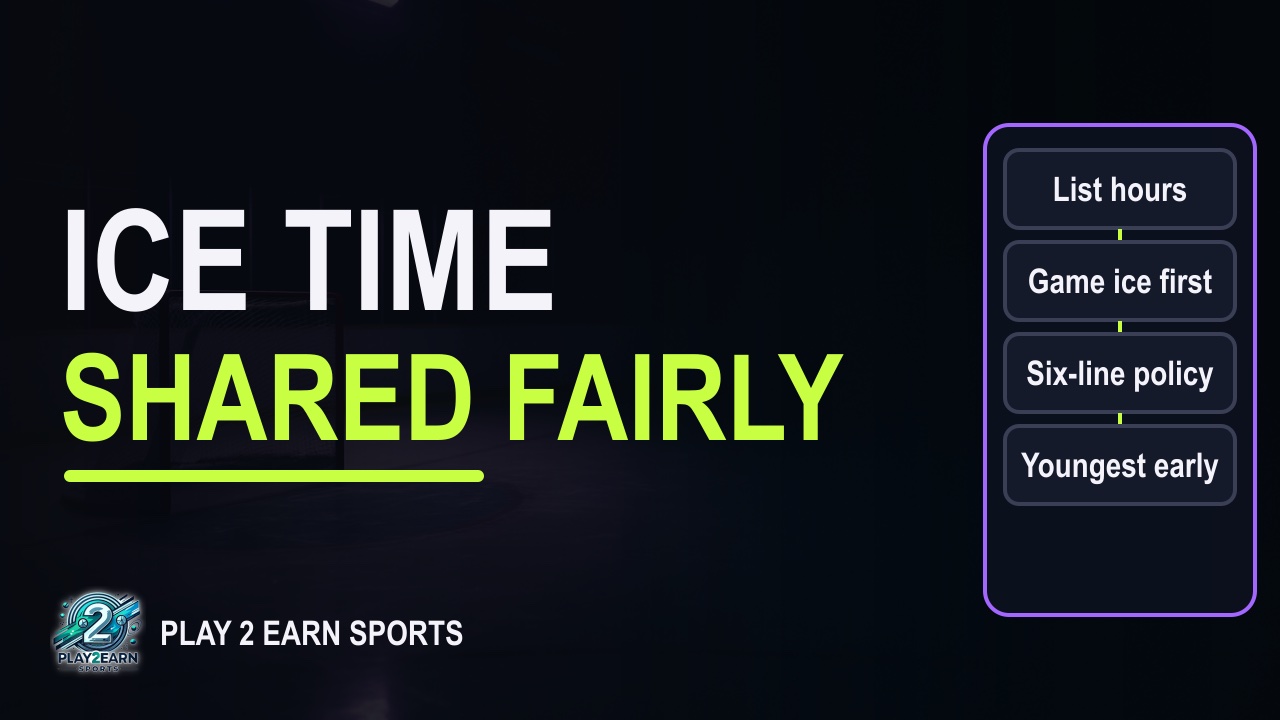
In this guide
- Step 1 — list every hour of contracted ice
- Step 2 — split game ice from practice ice
- Step 3 — write the allocation policy in six lines
- Worked example — 20 hours of contracted ice, 10 teams
- Sharing late and early ice among the older teams
- Returned ice and closures
- How Play 2 Earn Sports supports this
- Frequently asked questions
- Related guides
Watch the video guide
Read the video transcript
Ice that works for every team
0:00 By the end of this video, you will have a simple way to share your contracted ice. Every team gets game ice and practice ice, and the youngest players stay off late ice. We will list your hours, split game ice from practice ice, write a six-line policy, and work through a full example. Then we show how Play 2 Earn Sports helps.
How is ice time allocated in minor hockey?
0:22 Start by listing every hour you hold. Write the rink, the day, the start time and the length. Note whether the hour can be split into half ice or cross-ice. Then grade each hour.
0:34 Prime ice is weekday early evenings and weekend daytime. Late ice ends after the youngest players' bedtime. Early ice is the first weekend hours of the morning. Mark the weeks the rink is closed, and the time each flood takes. The flood comes out of every hour, so plan games and practices around it.
Game ice first, then practice ice
0:53 Next, split game ice from practice ice. Give the league its game ice first, because the season schedule needs those hours before practices are placed. A common base is one game hour and one practice hour per team each week. Older and higher-level teams often get more practice. Check your association's rules for each age group.
A six-line ice allocation policy
1:14 Now write the policy in six short lines. Here is a typical example. It is illustrative, not a specific association. Game ice goes to the league first.
1:25 Every team gets one base practice. The youngest age groups stay off late ice. Extra hours are shared by age and level. Late and early hours rotate among older teams. And one hour a week is held back.
A worked example: 20 hours, 10 teams
1:38 Here is the worked example. One sheet, twenty hours a week. Fifteen hours are prime, four are late, and one is early. There are ten teams: four under nine, and two each at under eleven, under thirteen and under fifteen.
1:53 The four Saturday hours become game ice for the league, including the one early hour. That leaves sixteen weekday hours for practice ice. The under nine teams share half ice, two teams to an hour, so four teams need two hours. Under eleven gets two practices each, all in prime time.
2:12 That is four more hours. Under thirteen and under fifteen also get two practices each: one prime, and one late. So the four late hours go only to the oldest teams. One skills hour is shared, and one hour is held.
2:29 Add it up. Four game hours and sixteen practice and held hours make twenty. Every hour is used once, every team has game ice and practice ice, and the youngest stay off late ice.
Rotating late and early ice
2:42 At the half-season, rotate the late nights among the older teams. The early Saturday game hour comes from the league schedule, so count each team's early games after every draft.
How Play 2 Earn Sports helps
2:54 Now, how Play 2 Earn Sports helps. Clubs set each rink's weekly availability and date-specific closures in the league workspace. The league sets the allowed days and the earliest and latest game times, so the game draft stays inside your game ice. Clubs can add team preferences, like preferred days and rest time.
3:14 The scheduler weighs them as soft preferences. Today, it does not rotate early and late slots, so count each team's hours after each draft. A published schedule is not regenerated over.
When a league game moves
3:25 Coaches add practices to the team schedule, so families see their own child's games and practices in one place. When a published, upcoming league game moves, a notice is queued for both clubs' staff, affected coaches, rostered players, linked parents and any assigned referee with an account, and updates go to existing team chats. Email and push depend on each account's settings.
Try it with your own ice
3:50 List your hours, give the league its game ice, write the six lines and publish the table. The full worked example is on the page linked in the description. Try it with your own ice: Starter is free for clubs with up to 10 teams. Thanks for watching.
Step 1 — list every hour of contracted ice
Before anyone talks about fairness, write down exactly what you hold.
Each slot.
Rink, day, start time and length. Note whether the hour is full ice, or can be split into half or cross-ice.
The grade of each hour.
Most associations use three grades:
- Prime: weekday early evenings and weekend daytime.
- Late: weekday hours that end after the youngest players' bedtime.
- Early: weekend hours before most families are awake.
The contract dates.
First and last week, plus every week the rink is closed for a holiday or an event.
The flood.
How long the resurfacing takes between bookings. It comes out of every hour.
Step 2 — split game ice from practice ice
Game ice is the hours your league plays games in. Practice ice is everything else. Decide the split first, because the league schedule needs its game ice before practices are placed.
A simple rule many associations use is one game hour and one practice hour per team per week as the base, then extra practice for older and higher-level teams. Check your association's rules for each age group, especially for the youngest players, where half-ice and cross-ice formats are common.
Step 3 — write the allocation policy in six lines
A short policy is easier to follow than a long one. Here is a typical example. It is illustrative, not a specific association.
Illustrative example, not a specific association.
- Game ice goes to the league first.
- Every team gets one base practice a week.
- The youngest age groups never get late ice.
- Extra hours are shared by age and level, using a table published with the schedule.
- Late and early hours rotate among the older teams each half-season.
- One hour a week is held back for returned ice, make-up games or a skills session.
Worked example — 20 hours of contracted ice, 10 teams
Illustrative example, not a specific association.
A small association holds one sheet for 20 hours a week. It has ten teams: four at the youngest level (U9), two U11, two U13 and two U15. The U9 teams play and practise on half ice, two teams to an hour.
The hours it holds.
| Day | Hours | Grade |
|---|---|---|
| Monday to Thursday | 5:30, 6:30, 7:30 pm | Prime (12 hours) |
| Monday to Thursday | 8:30 pm | Late (4 hours) |
| Saturday | 7:00 am | Early (1 hour) |
| Saturday | 8:00, 9:00, 10:00 am | Prime (3 hours) |
| Total | 20 hours: 15 prime, 4 late, 1 early |
Step 1: game ice to the league. All four Saturday hours become game ice. The league schedule decides who plays in them.
Step 2: practice ice by team.
| Team group | Teams | Practices a week, each team | Hours | Grade |
|---|---|---|---|---|
| U9 (half ice, two teams an hour) | 4 | 1 | 2 | Prime |
| U11 | 2 | 2 | 4 | Prime |
| U13 | 2 | 2 (1 prime, 1 late) | 4 | 2 prime, 2 late |
| U15 | 2 | 2 (1 prime, 1 late) | 4 | 2 prime, 2 late |
| U9 and U11 shared skills session | 6 | 1 | 1 | Prime |
| Held for returned or make-up ice | — | — | 1 | Prime |
| Practice and held ice | 16 | 12 prime, 4 late |
Check the numbers.
| Check | Count | Fits? |
|---|---|---|
| Game ice | 4 Saturday hours | 4 of 4 |
| Practice and held ice | 2 + 4 + 4 + 4 + 1 + 1 = 16 | 16 of 16 weekday hours |
| Whole week | 4 + 16 = 20 | 20 of 20 contracted hours |
| Late ice | 4 hours, one per U13 and U15 team | The youngest never skate late |
| Early ice | 1 Saturday game hour | Rotates through the league schedule; count it per team |
Every team has game ice and at least one practice. The older teams have two practices each, one prime and one late. One hour stays free for the week something changes.
Sharing late and early ice among the older teams
- Rotate by half-season. In the example, each U13 and U15 team holds one late hour. At the half-season, swap the nights, so no team keeps the latest Thursday all winter.
- Count early game ice after each draft. The early Saturday game hour depends on the league schedule. Count each team's early games before you publish, the same way you would for any early or late game time. See how to make game times fair across a season.
- Write the exception down. If one team must keep a late hour for a coach's work schedule, say so in the table.
Returned ice and closures
- Returned ice goes to the held hour first, then to the team group lowest on the table for that week.
- Rink closures come off the budget in the week they happen. Note them in the contract list before the season, so families see them early.
- When a league game moves, follow your league's process for the new time. For a broader permit process, see when the rink or field changes.
Checklist: before you publish the ice allocation
- Every contracted hour listed with its rink, day, time and grade.
- Closure weeks marked on the contract list.
- Game ice set aside for the league first.
- One base practice for every team.
- Youngest age groups kept off late ice.
- Extra hours shared by a published table.
- Late and early hours rotated among the older teams.
- One hour held for returned or make-up ice.
- Ice formats for each age group checked against your association's rules.
Common mistakes, and the easy fix
- Allocating practices before game ice. Set the league's game hours first, then fill practices around them.
- Grading hours by feel. Write the prime, late and early grades into the policy, so the table is easy to check.
- Giving the same team every late hour. Rotate at the half-season.
- Filling every hour. One held hour makes returned ice and make-up games simple.
How Play 2 Earn Sports supports this
Play 2 Earn Sports builds your league season from the ice you really hold. For the hockey side, see scheduling a season on contracted ice, and for the full league workflow, build the league season automatically.
Hockey and skating clubs can hold every team's ice in club management software for youth clubs, and coaches see who is coming in the team app.
- Ice windows and closures. Clubs set each rink's weekly availability and date-specific exceptions in the league workspace. Clubs can also block holidays, closures and tournament weekends on their teams, venues and fields, and the league scheduler keeps games out of those periods.
- League game hours. The league sets the allowed days and the earliest and latest game times, so the game draft stays inside your game ice.
- Team preferences. Clubs can set each team's preferred days, kickoff window, rest time and spacing. The scheduler weighs those when it picks times. They are soft preferences, so check the draft.
- Early and late is a count you do. Today, the scheduler does not rotate early and late slots. When two times score the same, it picks the earlier one. Count each team's early and late games after each draft.
- Drafts and published schedules. The league can regenerate the draft until it publishes. A published schedule is not regenerated over.
- Practices on the same schedule. Coaches add practices and events to the team's schedule, and families see their own child's games and practices in one place. Events have RSVPs, and coaches can see who has not replied.
- When a league game moves. When a published, upcoming league game is moved, postponed or cancelled, a notice is queued for both clubs' staff, the affected coaches, rostered players, linked parents and any assigned referee with an account, and each team's existing chat gets an update. Email and push depend on each person's settings.
See your season built from the ice you hold.
Frequently asked questions
Most associations list their contracted hours, set aside game ice for the league, then give each team a base practice and share the extra hours by age and level. A short written policy and a published table make the result easy to check.
It depends on the age group, level and your association's rules. A common base is one game hour and one practice hour a week, with extra practice for older and higher-level teams.
The hours most families want: weekday early evenings and weekend daytime. Late weekday hours and early weekend hours are usually graded separately and shared on a rotation.
Write it into the policy, then give late hours only to the older teams. In the league schedule, the league can also set the earliest and latest game times.
Hold one hour a week in the plan. Returned ice goes there first, then to the team group lowest on the table that week.
Software helps you keep games inside your ice and see each team's schedule. The fairness rule is your policy. Today, Play 2 Earn Sports does not rotate early and late slots, so count each team's hours after each draft.
Starter is free for clubs with up to 10 teams. Pro is $49.67 USD a month for 11 to 25 teams. Unlimited is $99.67 USD a month for 26 or more teams. For leagues, Starter is free for up to 10 clubs, League Pro is $97.85 USD a month for 11 to 25 clubs, and League Unlimited is $196.35 USD a month for 26 or more clubs. Every feature is on every plan, and players and parents are always included. See pricing.
Related guides
- League scheduling guides: every league scheduling guide in one place.
- Fair game times across a season
- When the rink or field changes: permits and schedule changes
- Blackout dates for league schedules
- Running one hockey team's week
