

In this guide
- Why venue changes hurt so much
- Step 1 — keep a venue tracker, and build only on confirmed times
- Step 2 — hold spare slots on purpose
- Step 3 — set a permit deadline and a publish date
- Step 4 — when a permit changes mid-season
- Worked example — a rink takes back two Sundays
- Step 5 — keep clubs in the loop on permits
- How Play 2 Earn Sports supports this
- Frequently asked questions
- Related guides
The question league organizers ask: "The city confirmed our fields three weeks after we needed them, the rink took back two Sunday slots in November, and the school gym is closed for exams. Every change means rebuilding half the schedule. How do we schedule when venue times keep changing?"
Why venue changes hurt so much
- The schedule is built on hoped-for times. A verbal "should be fine" becomes ten games that have nowhere to go.
- Every slot is used. With no spare time, one lost evening has no landing place.
- The whole season gets rebuilt. Re-running everything moves games that were never affected, and families lose trust in the schedule.
- The venue record is never updated. The next person to move a game puts it straight back into the closed slot.
Step 1 — keep a venue tracker, and build only on confirmed times
One line per venue and field:
- Status: confirmed in writing, requested, or verbal only.
- Days, start and end times, and the date the permit was confirmed.
- The venue contact, and any known closures (exams, maintenance, other bookings).
Only confirmed times go into the schedule. Requested and verbal times wait.

Step 2 — hold spare slots on purpose
Don't fill every confirmed slot. Illustrative example, not a rule: keep roughly one spare slot for every ten games, or one open weekend every four or five weeks. Spare slots are where games go when a permit changes, a field floods or a rink is double-booked by the venue.
Step 3 — set a permit deadline and a publish date
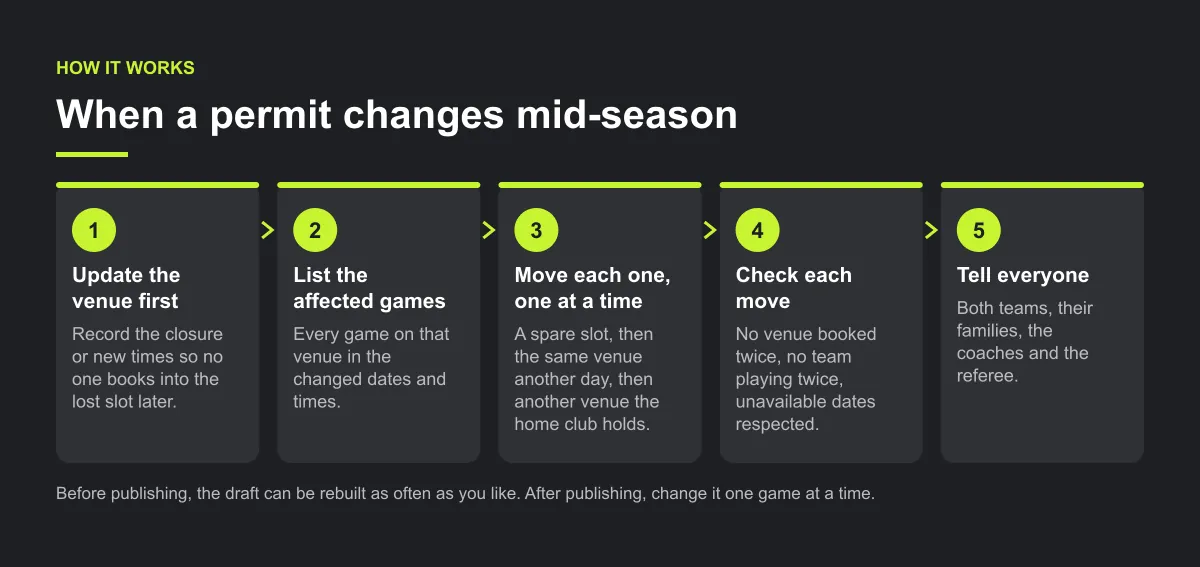
Tell clubs the date by which their venue times must be confirmed, and the date the schedule will be published. Until publishing, the draft can be rebuilt as often as you like. After publishing, it is the only version, and you change it one game at a time.
Step 4 — when a permit changes mid-season
Update the venue first.
Record the closure or the new times where the schedule lives, so no one books into the lost slot later.
List the affected games.
Every game on that venue in the changed dates and times.
Move each one, one at a time.
First choice: a spare slot. Then the same venue on another day, then another venue the home club holds.
Check each move.
No field, rink, court or diamond booked twice, no team playing twice, unavailable dates respected.
Tell everyone in each moved game.
Both teams, their families, the coaches and the referee.
Illustrative example, not a specific league.
A rink takes back two Sunday evenings in November. If the league re-runs the whole season, forty games move instead of six. With spare slots and one-at-a-time moves, only six games need a new time; the other games keep their schedule.
Worked example — a rink takes back two Sundays
Illustrative example, not a specific league.
A league has 120 games in its season and holds 12 spare slots (one for every ten games), six of them in November. Rink A tells the league it needs Sunday 9 and Sunday 16 November back. Each of those evenings had 3 games (17:00, 18:15, 19:30), so 6 games need a new home. The other 114 games stay where they are.
The league updates Rink A first, then moves the six games one at a time. November's spare slots are Saturday 15 Nov at 16:00 and 17:15, Saturday 22 Nov at 16:00 and 17:15, and Sunday 30 Nov at 17:00 and 18:15. The rule: try a spare slot first, then the home club's other venue.
| Game | Was | First try | Result | Final slot |
|---|---|---|---|---|
| 1 | Sun 9 Nov 17:00, Rink A | Sat 15 Nov 16:00, Rink A | Clear | Sat 15 Nov 16:00 |
| 2 | Sun 9 Nov 18:15, Rink A | Sat 15 Nov 17:15, Rink A | Clear | Sat 15 Nov 17:15 |
| 3 | Sun 9 Nov 19:30, Rink A | Sat 22 Nov 16:00, Rink A | Home team already plays at 13:00 that day | Wed 19 Nov 19:00, Rink B (home club's other venue) |
| 4 | Sun 16 Nov 17:00, Rink A | Sat 22 Nov 16:00, Rink A | Clear | Sat 22 Nov 16:00 |
| 5 | Sun 16 Nov 18:15, Rink A | Sat 22 Nov 17:15, Rink A | Clear | Sat 22 Nov 17:15 |
| 6 | Sun 16 Nov 19:30, Rink A | Sun 30 Nov 17:00, Rink A | Clear | Sun 30 Nov 17:00 |
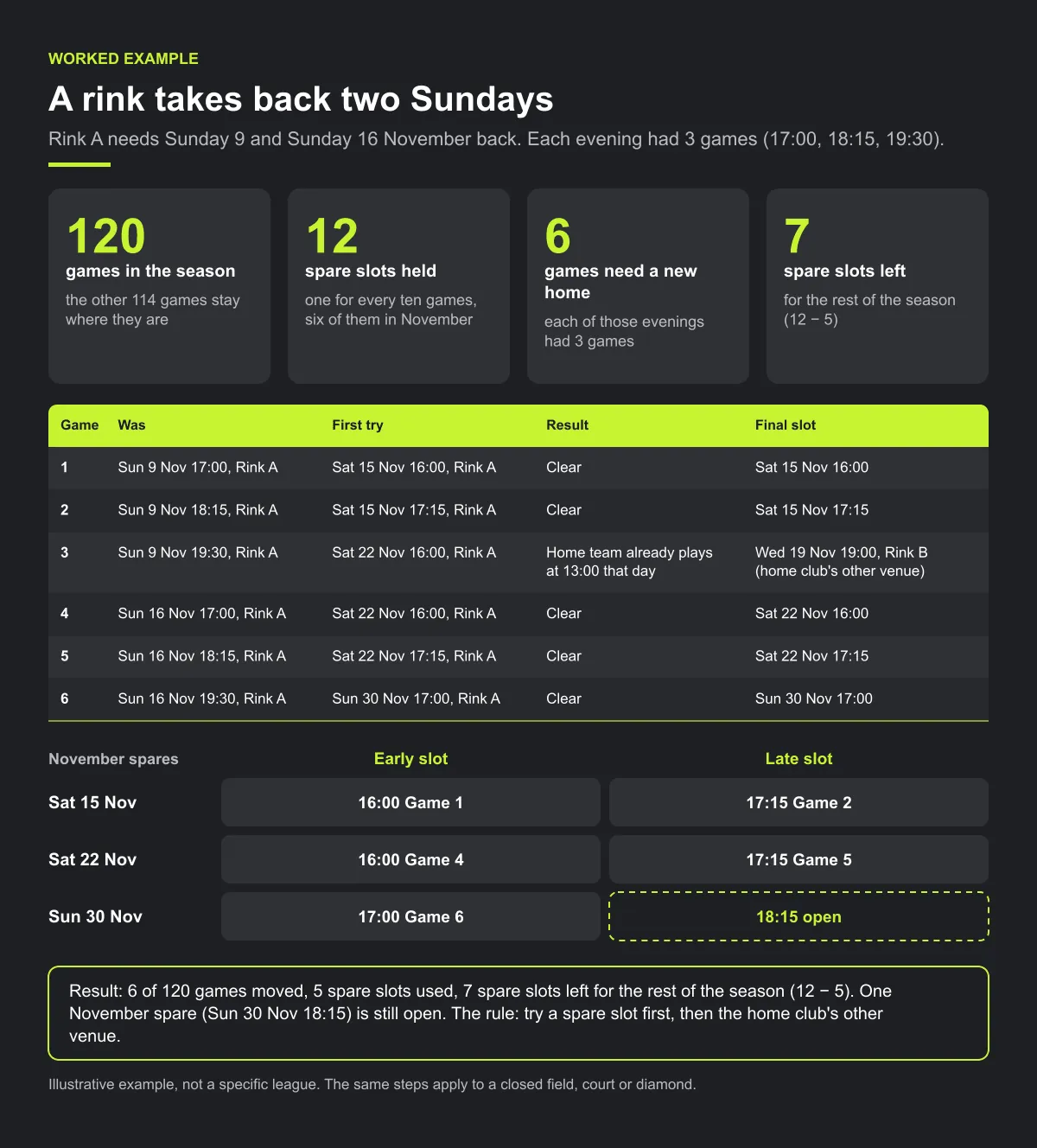
Result: 6 of 120 games moved, 5 spare slots used, 7 spare slots left for the rest of the season (12 − 5). One November spare (Sun 30 Nov 18:15) is still open. A full rebuild would have reopened every game; this way only the families in six games get a change notice. The same steps apply to a closed field, court or diamond.
Step 5 — keep clubs in the loop on permits
Ask clubs to report venue changes the day they hear, not the week of the game. Keep a short change log: date, venue, games moved, spare slots used and who was told. Review the spare-slot count after each change. When it drops low, ask clubs for more venue time early, while venues still have openings, rather than waiting for the next closure.
Checklist: when a venue time changes
- Change recorded on the venue first, with dates and times.
- Affected games listed: only games in the lost times.
- Each game moved one at a time: spare slot, then same venue another day, then the home club's other venue.
- Each move checked: venue, both teams, unavailable dates.
- Everyone in each moved game told, including the referee.
- Change log and spare-slot count updated.

Common mistakes
- Moving games before updating the venue. The next person to move a game can put it straight back into the closed slot.
- Re-running the whole season. It moves games the closure never touched and resets families' plans.
- Spending every spare slot in one month. Keep some for later closures and weather.
- Building on verbal permits. A "should be fine" is not a confirmed time.
How Play 2 Earn Sports supports this
- Clubs keep venue times up to date. In the league workspace, clubs manage weekly field availability, field-specific times and date-specific exceptions: a full-day closure, a partial closure, added times or replaced times. The league sees each field's windows and how many exceptions it has.
- Draft until it's real. The league can regenerate the draft as often as needed until it publishes. Regenerating replaces only unpublished drafts. A locked schedule must be unlocked first.
- A published schedule is not regenerated over. After publishing, games are moved one at a time, and each move runs the same clash checks against the latest venue times.
- Existing games don't move by themselves. Updating a venue's times does not reschedule games already in it, so list and move the affected games yourself.
- Change notices. When the league approves a club's request, the clubs and the referee are told. Tell everyone else in the game yourself. Nobody is told just because a venue's availability changes.
Keep venue times and the schedule in the same place.
Frequently asked questions
Build only on times confirmed in writing, hold spare slots, set a permit deadline and a publish date, and after publishing move affected games one at a time into spare slots, telling everyone in each moved game.
Build the draft on confirmed times as they arrive, but don't publish until your permit deadline. Rebuilding a draft is cheap; rebuilding a published schedule is not.
There is no fixed rule. Roughly one spare slot for every ten games, or one open weekend every four or five weeks, gives a league somewhere to put moved games. A league that has already lost venue time this season may want more.
No. Update the venue, list the affected games and move them one at a time. Rebuilding moves games that were never affected.
No. Clubs update venue times and date-specific closures, and the league can regenerate the draft until it publishes. After that, games are moved one at a time with the same clash checks. When the league approves a club's request, the clubs and the referee are told. Tell everyone else in the game yourself.
Starter is free for clubs with up to 10 teams. Pro is $49.67 USD a month for 11 to 25 teams. Unlimited is $99.67 USD a month for 26 or more teams. For leagues, Starter is free for up to 10 clubs, League Pro is $97.85 USD a month for 11 to 25 clubs, and League Unlimited is $196.35 USD a month for 26 or more clubs. Every feature is on every plan, and players and parents are always included. See pricing.
Related guides
- League scheduling guides: every league scheduling guide in one place.
- Rainout and field closure process
- Parents keep missing schedule changes
- Sports league scheduling software
- League schedule maker
- Pricing
