

In this guide
- Why make-up games pile up
- Step 1 — reserve make-up windows before the season
- Step 2 — write a make-up policy
- Step 3 — keep one make-up list
- Step 4 — place each make-up with a full check
- Step 5 — tell everyone in the game
- Worked example — six rainouts, two make-up windows
- How Play 2 Earn Sports supports this
- Frequently asked questions
- Related guides
The question league organizers ask: "We had four rainouts in September and two ice cancellations in October. Now it's the last two weeks of the season, three teams have five games left, and every make-up we try clashes with something. How do I schedule make-up games?"
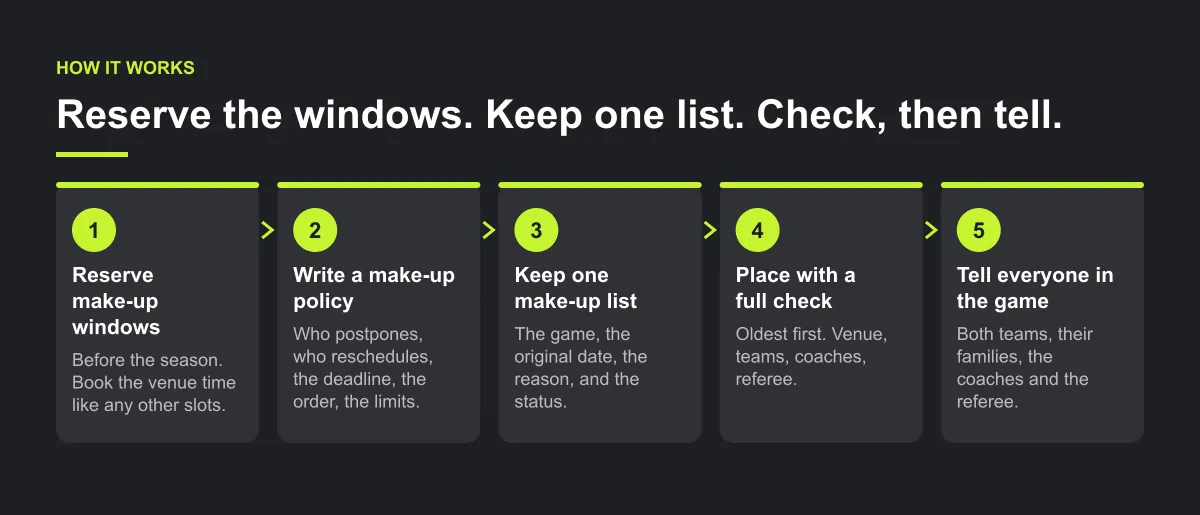
Why make-up games pile up
- No room was planned. Every weekend is full, so a postponed game has nowhere to go until the season ends.
- Nobody owns the list. Postponed games live in texts between coaches and get forgotten.
- Coaches reschedule between themselves. Two coaches agree a time that clashes with a field booking or a third team.
- No deadline. Make-ups drift to the last week, where some teams end up with three games in a week.

Step 1 — reserve make-up windows before the season
Illustrative example, not a rule:
keep one open weekend every four or five weeks, plus one before the final week or playoffs. Book the venue time for those windows like any other slots. If they aren't needed, use them for friendlies or practices.
Step 2 — write a make-up policy
Keep it short and publish it with the league rules:
- Who postpones. Who can call a game off for weather or venue problems, and by when.
- Who reschedules. The league office, not the two coaches.
- The deadline. For example, the next make-up window, or within two weeks.
- The order. Oldest postponement first, and games that affect standings or playoff places before others.
- The limits. No more than a set number of games per team per week, with minimum rest between games.
- The end-of-season rule. What happens to a game that can't be made up: replayed in a set window, or recorded as not played. Decide before the season.
Step 3 — keep one make-up list
The day a game is postponed, add it to one list: the game, the original date, the reason, and the status. Mark it moved when it has a new date and time. One list, owned by one person, means nothing gets lost in a text thread.

Step 4 — place each make-up with a full check
For each game on the list, oldest first:
- Try the next make-up window first, then free slots on the home club's venues.
- Check the field, rink, court or diamond is open and not already booked, with setup and cleanup time.
- Check neither team is already playing, unavailable or blacked out, and the date is inside the season.
- Check coaches with teams in two divisions against your shared-coach list.
- Check a referee is available.
Illustrative example, not a specific league.
Imagine a league letting coaches rebook their own rainouts. By the last fortnight, three make-ups are stacked into one week for the same team and one lands on a field already booked for another division. Reserved windows and one list could have made earlier rescheduling easier, subject to venue and team availability.
Step 5 — tell everyone in the game
When a make-up is placed, tell both teams, their families, the coaches and the referee, in the place they already check for the schedule. Give the new date, time and venue, and say which game it replaces, so nobody mistakes it for an extra game. Update the make-up list the same day, marking the game moved. If a make-up cannot be placed before the deadline, apply your end-of-season rule and tell both clubs in writing.
Worked example — six rainouts, two make-up windows
Illustrative example, not a specific league.
A baseball league plays a 10-week season on two diamonds. It reserves two make-up windows: Saturday of week 5 and Saturday of week 10, with no regular games, and slots at 9:00 and 12:00 on each diamond. That is 2 windows × 2 diamonds × 2 slots = 8 make-up slots. Its policy allows one game per team per day.
Rain postpones 3 games in week 2 and 3 more in week 7: 6 games for 8 slots. The make-up list, placed oldest first:
| # | Game | Postponed | First try | Check result | Placed |
|---|---|---|---|---|---|
| 1 | A vs B | Week 2 | Week 5, Diamond 1, 9:00 | Clear | Week 5, Diamond 1, 9:00 |
| 2 | C vs D | Week 2 | Week 5, Diamond 2, 9:00 | Clear | Week 5, Diamond 2, 9:00 |
| 3 | A vs E | Week 2 | Week 5, Diamond 1, 12:00 | Team A already plays at 9:00 that day | Week 10, Diamond 1, 9:00 |
| 4 | F vs G | Week 7 | Week 10, Diamond 2, 9:00 | Clear | Week 10, Diamond 2, 9:00 |
| 5 | B vs C | Week 7 | Week 10, Diamond 1, 12:00 | Clear | Week 10, Diamond 1, 12:00 |
| 6 | D vs H | Week 7 | Week 10, Diamond 2, 12:00 | No umpire free | Week 8, Wednesday 18:00, Diamond 1 (home club's free slot) |
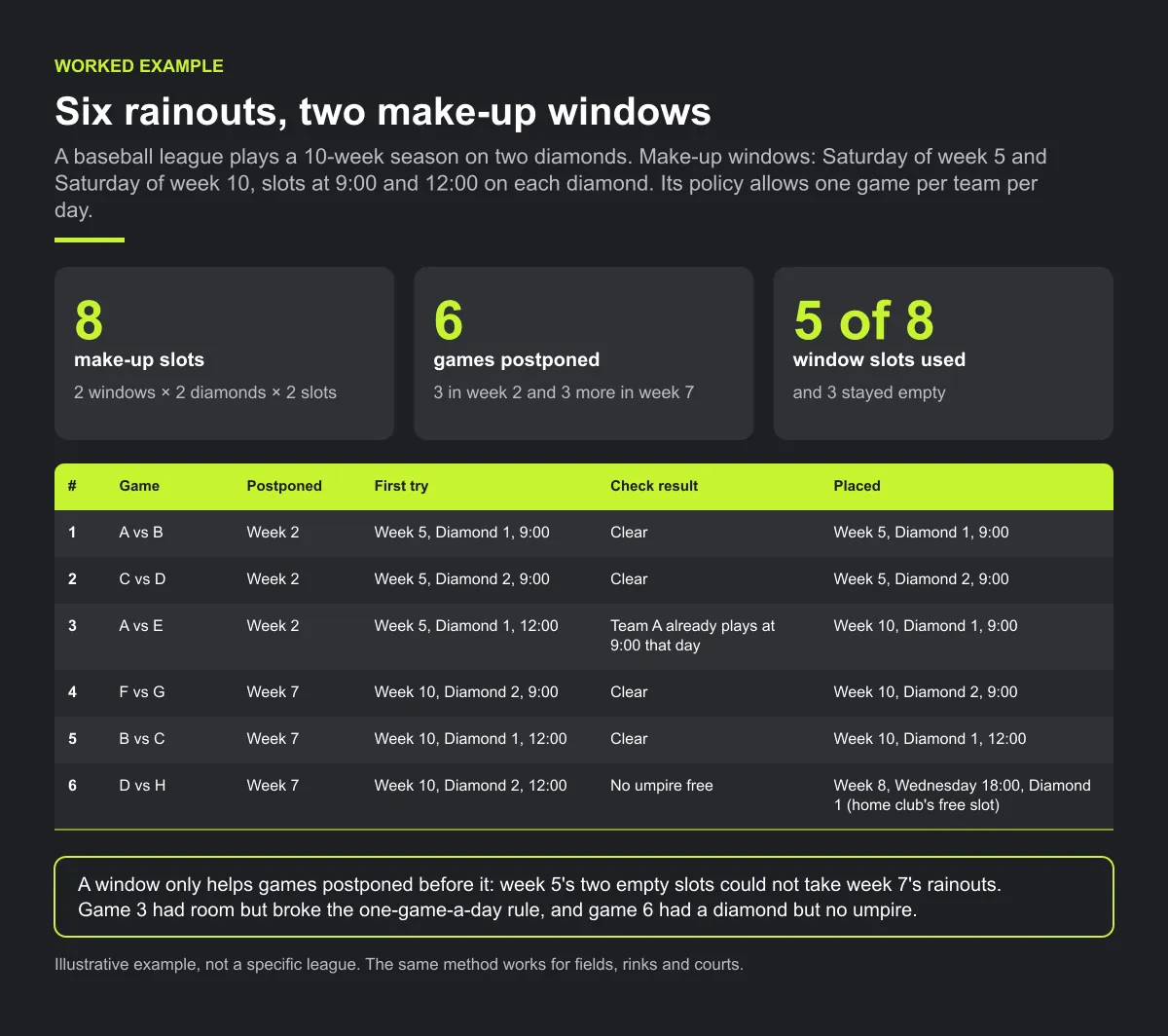
Week 5 used 2 of its 4 slots and week 10 used 3 of 4, so 5 of the 8 window slots were used and 3 stayed empty. Two lessons from the numbers. First, a window only helps games postponed before it: week 5's two empty slots could not take week 7's rainouts. Second, total slots are not the only limit. Game 3 had room but broke the one-game-a-day rule, and game 6 had a diamond but no umpire. Placing the games on one list, in order, made both problems visible in week 2 and week 7 rather than in week 10. The same method works for fields, rinks and courts.
Checklist: make-up games
- Make-up windows reserved and venue time booked before the season.
- Written policy: who postpones, who reschedules, deadline, order, limits, end-of-season rule.
- One list, one owner; every postponed game added the same day.
- Each make-up checked: venue, both teams, unavailable dates, shared coaches, referee.
- Games-per-day and rest limits applied.
- Everyone in the game told; list updated.
Common mistakes
- Letting coaches rebook their own games. Two coaches can't see the third team or the field booking their new time clashes with.
- Putting make-up windows only at the end. Early rainouts then wait months, and the last weeks overload.
- Checking the venue but not the referee. A free field with no official is not a free slot.
- Deciding the unplayed-game rule in the final week. Every club will read it in light of the standings.
How Play 2 Earn Sports supports this
- Postponing a game. A league game can be marked postponed. When the league approves a club's postponement or weather request, the game is set to postponed, and the clubs and the referee are told.
- Three ways to move it. The league can move the game directly, approve a club's request, or send a counter-offer, and the game moves only if the club accepts.
- The same clash checks every time. Before a game is saved at its new date, time and field, the system checks that the field is open and not double-booked (setup and cleanup time included), team availability, team blackouts, team-vs-team clashes, travel limits, season dates and the league's day and time rules. Hard conflicts can never be overridden.
- Free times on the field. If a field is already taken, the clash message lists that field's free times that day.
- Tell people after a move. An approved club postponement or weather request notifies the affected clubs and assigned referee. For a new date, time or field, confirm those people have the saved details, then each club tells its own players and parents through its normal channel. Do not assume every edit sends an automatic parent notice.
- What stays manual. There is no make-up button or make-up queue, and the system doesn't suggest make-up slots. Keep your own list and reserve your own windows. Coaches with teams in two divisions are a manual check.
Move a postponed game with the clash check built in.
Frequently asked questions
Reserve make-up windows before the season, write a make-up policy, keep one list of postponed games, and place each one oldest first in a slot where the venue, both teams and the referee are free. Then tell everyone in the game.
The league. Coaches can suggest times, but one person placing make-ups against the full schedule avoids new clashes.
There's no fixed number. One open weekend every four or five weeks, plus one before the final week, gives an outdoor league some room. An indoor league may need fewer.
Follow the end-of-season rule you wrote before the season: replay it in a set window or record it as not played. Don't decide it game by game.
There's no make-up button or queue. A league game can be marked postponed, then moved to a new date, time and field, and the system checks field, team, blackout and season clashes before it saves, then tells the people in the game.
Starter is free for clubs with up to 10 teams. Pro is $49.67 USD a month for 11 to 25 teams. Unlimited is $99.67 USD a month for 26 or more teams. For leagues, Starter is free for up to 10 clubs, League Pro is $97.85 USD a month for 11 to 25 clubs, and League Unlimited is $196.35 USD a month for 26 or more clubs. Every feature is on every plan, and players and parents are always included. See pricing.
Related guides
- League scheduling guides: every league scheduling guide in one place.
- Rainout and field closure process
- Parents keep missing schedule changes
- Sports league scheduling software
- Pricing
