

In this guide
- Why coaches get double-booked
- Step 1 — build a shared-coach list
- Step 2 — write a gap rule
- Step 3 — build the separation in before scheduling
- Step 4 — sort the draft by coach
- Step 5 — club review, then check every change
- Worked example — the coach sort, with the gap rule applied
- How Play 2 Earn Sports supports this
- Frequently asked questions
- Related guides
The question league organizers ask: "One of our volunteer coaches runs her daughter's under-10 team and her son's under-14 team. The schedule had both at 10 a.m. on the same Saturday, on fields across town, and nobody noticed until the Friday before. How do I stop coaches being double-booked?"
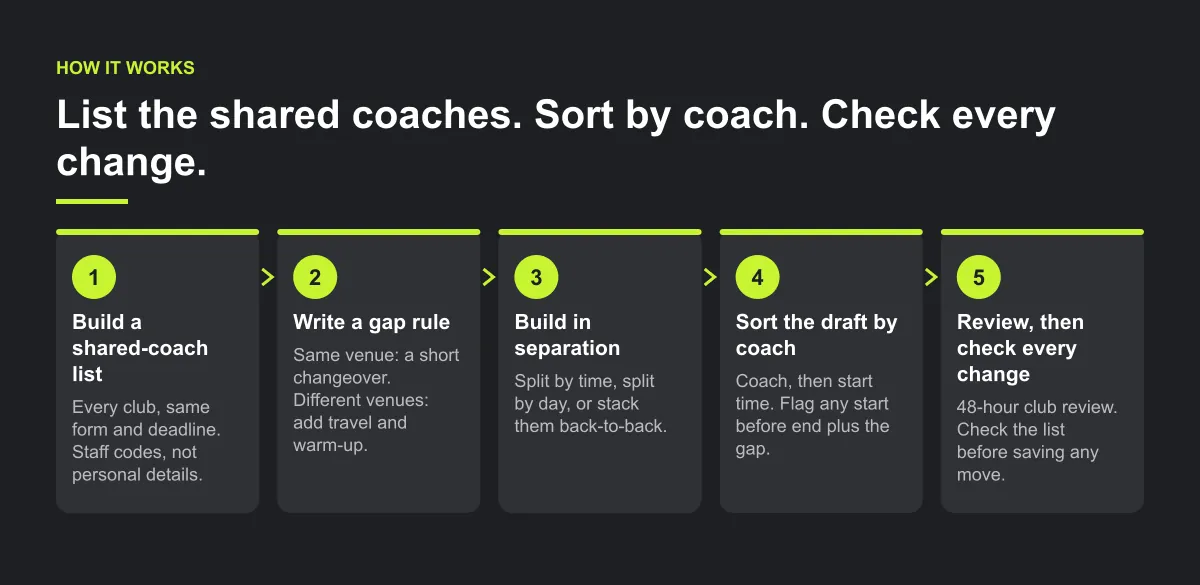
Why coaches get double-booked
- Schedules check teams, not people. The two teams are different teams, so nothing looks wrong.
- Divisions are built separately. They may be drafted by different volunteers who never see each other's drafts.
- Nobody has the list. The league doesn't know which coaches have two teams unless clubs tell it.
- Changes undo the fix. A rainout or a moved game puts the coach back into a clash after publishing.

Step 1 — build a shared-coach list
Ask every club, on the same form and deadline as team unavailability:
- Who is on more than one team in the league: head coaches, assistants and team managers.
- Which teams and divisions.
- Whether they must be at both games. A head coach running the team alone needs to be at both. An assistant may not.
Use a staff code or initials in the list. You don't need phone numbers or personal details to check a schedule. The same list can include players registered on two teams and referees who also coach.
Step 2 — write a gap rule
Decide what "not double-booked" means:
- Same venue: the second game starts no sooner than the end of the first, plus a short changeover (for example, 15 minutes).
- Different venues: the end of the first game, plus travel time, plus warm-up (for example, 45 to 60 minutes).
- Can't travel: both games must be at the same venue, or on different days.
These gaps are examples. Set your own in the league rules.
Step 3 — build the separation in before scheduling
The easiest double-booking to fix is the one that never gets drafted:
- Split by time. Put the coach's two teams in different windows, for example one plays mornings and one plays afternoons.
- Split by day. One team plays Saturdays, the other Sundays.
- Stack them. Back-to-back at the same venue, with the gap rule between.
Whatever you choose, tell the coach's clubs, and record it as a team-unavailable time for one of the two teams so the schedule can't use it.
Step 4 — sort the draft by coach
After the draft is built, before anyone sees it:
- Copy the games for every team on the shared-coach list into a sheet: coach code, team, venue, start, end.
- Sort by coach, then by start time.
- Compare each game with the next game for the same coach. If the next start is earlier than this end plus the gap rule, flag it.
- Fix each flag by swapping times within a round at the same venue, or moving one game. Re-check field and team clashes after each fix.
A league with a dozen shared coaches can run this check in under an hour. That time is an estimate, not a measurement.
Illustrative example, not a specific league.
Here is an example. A coach has an under-10 and an under-14 team. The two divisions are drafted by different volunteers, and both teams land at 10 a.m. in week three, across town. Sorting the draft by coach would have shown the clash in seconds. Instead it's found the Friday before, and an assistant coaches one game alone.
Step 5 — club review, then check every change
- Send each club the draft with its shared coaches highlighted, for a 48-hour review.
- After publishing, check the shared-coach list before saving any move. A rainout make-up is one way a coach can end up double-booked mid-season.
- Update the list when a coach joins or leaves a team.
Worked example — the coach sort, with the gap rule applied
Illustrative example, not a specific league.
A basketball league plays at two gyms, Northside and Eastview, about 30 minutes apart. Its gap rule: same gym, 15 minutes between one game's end and the next start; different gyms, 50 minutes (30 minutes' travel plus 20 minutes' warm-up). Four coaches on the shared-coach list each have two games on the first Saturday. Sorted by coach, then start time:
| Coach | Team | Gym and court | Start | End | Earliest allowed next start | Next game starts | Result |
|---|---|---|---|---|---|---|---|
| C1 | U10 | Northside, Court 1 | 9:00 | 10:00 | 10:15 (same gym) | 10:15 | OK |
| C1 | U14 | Northside, Court 2 | 10:15 | 11:45 | |||
| C2 | U12 | Northside, Court 1 | 11:00 | 12:15 | 13:05 (other gym) | 12:30 | Flag: 35 min short |
| C2 | U16 | Eastview, Court 4 | 12:30 | 14:00 | |||
| C3 | U10 | Eastview, Court 3 | 9:00 | 10:00 | 10:15 (same gym) | 13:00 | OK |
| C3 | U12 | Eastview, Court 1 | 13:00 | 14:15 | |||
| C4 | U16 | Northside, Court 3 | 10:00 | 11:30 | 11:45 (same gym) | 11:15 | Flag: starts before the first game ends |
| C4 | U12 | Northside, Court 4 | 11:15 | 12:30 |
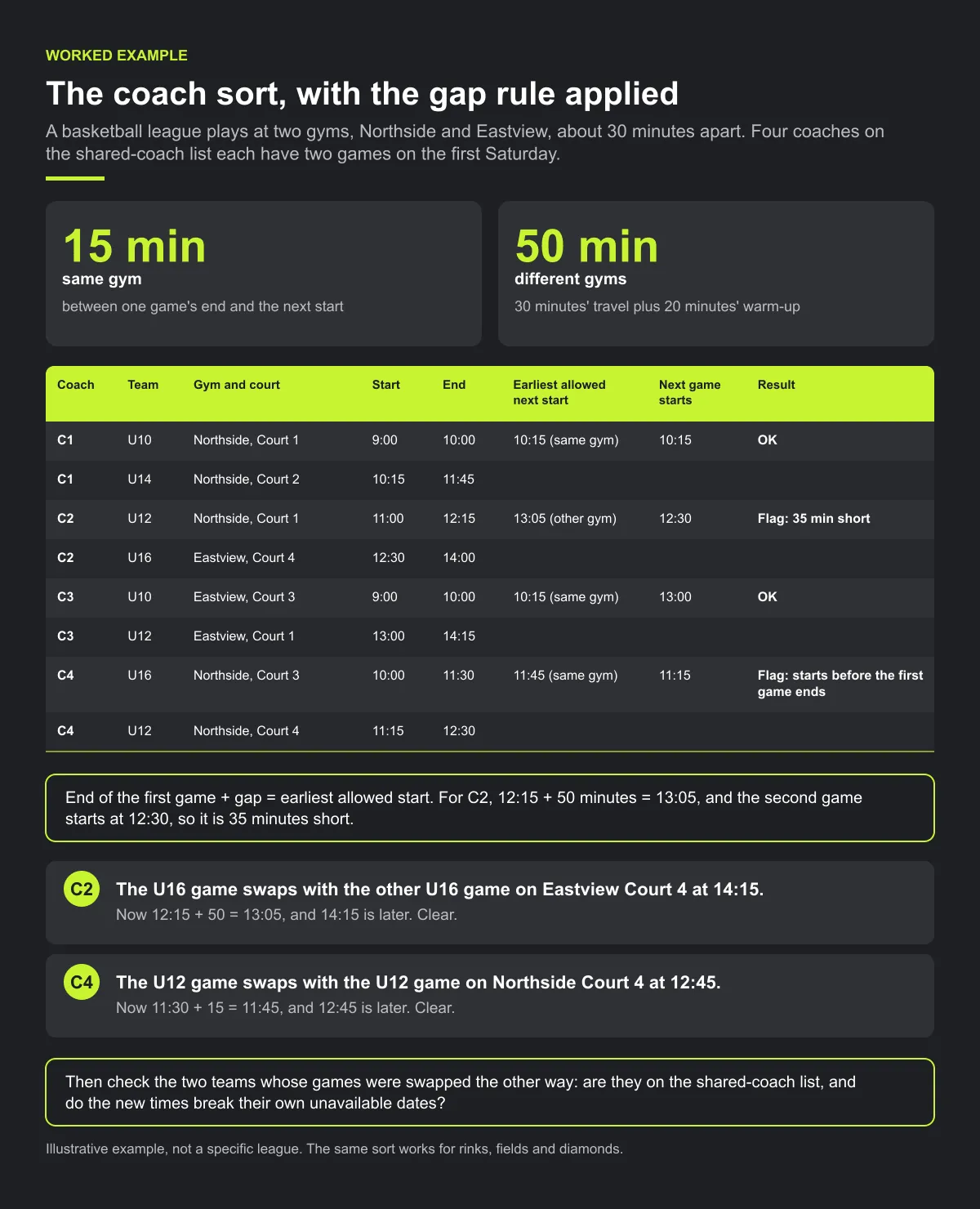
The arithmetic for each pair is: end of the first game + gap = earliest allowed start. For C2, 12:15 + 50 minutes = 13:05, and the second game starts at 12:30, so it is 35 minutes short.
The fixes, both by swapping times within the same round at the same gym:
- C2: the U16 game swaps with the other U16 game on Eastview Court 4 at 14:15. Now 12:15 + 50 = 13:05, and 14:15 is later. Clear.
- C4: the U12 game swaps with the U12 game on Northside Court 4 at 12:45. Now 11:30 + 15 = 11:45, and 12:45 is later. Clear.
Then check the two teams whose games were swapped the other way: are they on the shared-coach list, and do the new times break their own unavailable dates? The same sort works for rinks, fields and diamonds.
Checklist: shared coaches
- Shared-coach list collected from every club, by one deadline, using staff codes.
- Gap rule written: same venue and different venue, in minutes.
- Fixed separations (mornings and afternoons, Saturdays and Sundays) entered as team-unavailable times.
- Draft sorted by coach and start time; every pair checked against the gap rule.
- Each fix re-checked for field, team and unavailable-date clashes.
- List checked again before saving any move after publishing.
- List updated when a coach joins or leaves a team.
Common mistakes
- Checking only head coaches. An assistant who runs a team alone on some weekends needs the same protection.
- Using one gap for every venue pair. Travel between two venues across town takes longer than a walk between courts in one building.
- Fixing one clash and creating another. The team you swap with may have its own shared coach.
- Forgetting the list after publishing. Make-up games and moved games are placed in a hurry; check the list each time.
How Play 2 Earn Sports supports this
- No team in two places, no field booked twice. The league scheduler won't put the same team in two places at once or double-book a field, and the same checks run when a game is moved.
- Coach clashes are a manual check. The scheduler doesn't know that a coach runs two teams, so it doesn't check coaches. Use the shared-coach list and the sort in Step 4.
- Team blackouts protect a known busy time. To protect a coach who runs two teams, add a blackout on the other team for that coach's busy times. The scheduler treats team blackouts as hard limits. This narrows the times that team can play, so use it for fixed arrangements like "mornings for one team, afternoons for the other".
- Change notices. When the league approves a club's request, the clubs and the referee are told. Tell everyone else in the game yourself.
See how a league draft handles team and field clashes.
Frequently asked questions
Build a shared-coach list from every club, write a gap rule, build separation in before scheduling, sort the draft by coach and start time to find clashes, and check the list again before every change after publishing.
At the same venue, the end of the first game plus a short changeover. At different venues, add travel time and warm-up. Write the gap in your league rules.
Anyone who must be at more than one team's games: head coaches, assistants who run a team alone, team managers. The same list works for players on two teams and referees who also coach.
Copy the shared coaches' games into a sheet, sort by coach and then by start time, and flag any game that starts before the previous one ends plus the gap rule.
No. The league scheduler checks teams and fields: it won't put the same team in two places at once or double-book a field. Coaches with two teams are a manual check. A team blackout can protect a coach's known busy time.
Starter is free for clubs with up to 10 teams. Pro is $49.67 USD a month for 11 to 25 teams. Unlimited is $99.67 USD a month for 26 or more teams. For leagues, Starter is free for up to 10 clubs, League Pro is $97.85 USD a month for 11 to 25 clubs, and League Unlimited is $196.35 USD a month for 26 or more clubs. Every feature is on every plan, and players and parents are always included. See pricing.
Related guides
- League scheduling guides: every league scheduling guide in one place.
- Sports league scheduling software
- League schedule maker
- Club communication standards
- Pricing
