

In this guide
- Step 1 — write down the officials each game needs
- Step 2 — count the assignments, and each referee's day
- Step 3 — the weekly routine
- Worked example — one Saturday at a soccer park
- Young referees: a kind first season
- Assistant referees and crews
- When a game moves
- How Play 2 Earn Sports supports this
- Frequently asked questions
- Related guides
Watch the video guide
Read the video transcript
A weekly routine everyone likes
0:00 By the end of this video, you will have a weekly routine for soccer referee scheduling that assignors and referees both like. Every game has its officials, and every referee knows the plan early. We will cover the officials each game needs, how many games a referee can work, the weekly routine, young referees, and game changes. Then we show how Play 2 Earn Sports helps.
How many officials does a soccer game need?
0:24 Start with the officials each game format needs. Small-sided games for younger players often use one referee. Full-sided games often use a referee and two assistant referees. Your association's rules decide, so check your association's rulebook.
0:38 Then write the officials per game for each age group into your league rules. Here is a typical example. It is illustrative, not a specific league. One Saturday at a soccer park has three fields and twelve games.
0:52 Six are small-sided with one referee, and six are full-sided with three officials. That is twenty-four assignments.
How many games can a referee work in a day?
0:59 Game length grows with age, so a referee's day depends on the games. A referee might take three short games in a morning, but only two longer ones. Ask each referee for their limit, and write it next to their days off.
The weekly routine
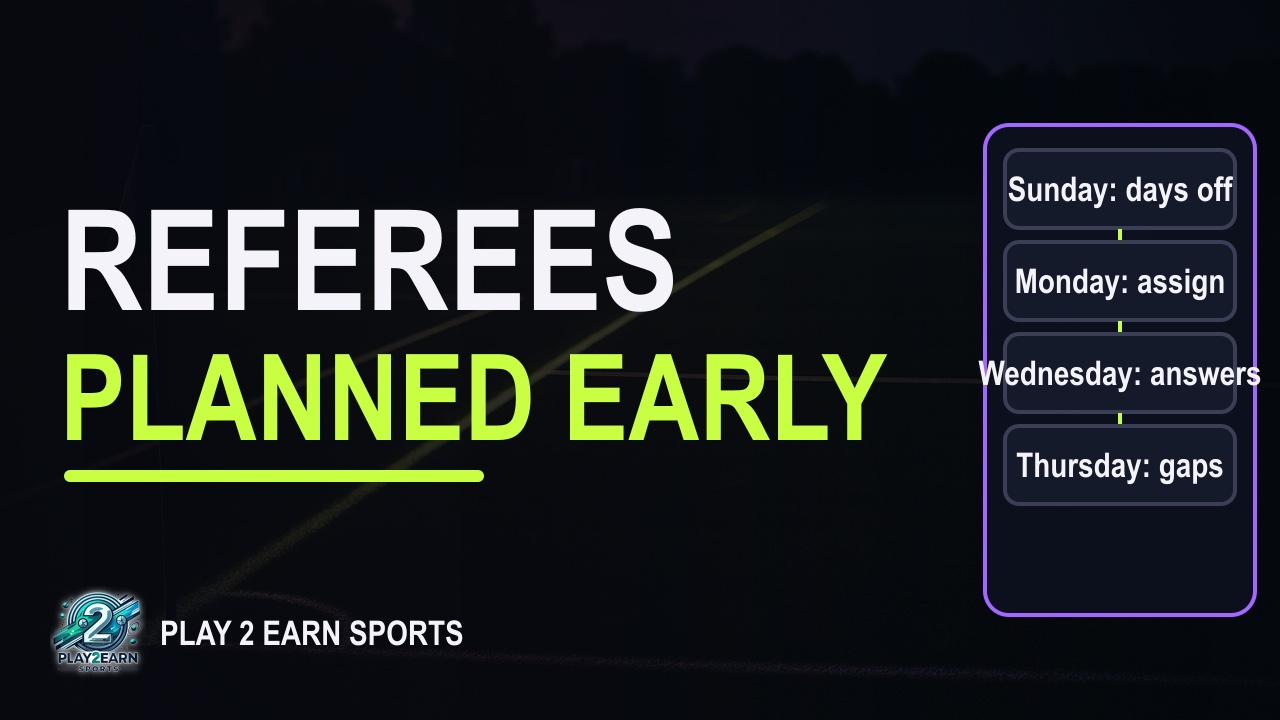
1:13 Now the weekly routine. It runs on the same days every week, so everyone knows when to look. A routine helps referees plan their own weeks, and it helps the assignor finish early. By Sunday evening, referees update their days off.
1:27 On Monday, the assignor assigns games two to three weeks ahead, starting with the hardest games. By Wednesday, every referee has accepted or declined. On Thursday, the assignor reassigns any declined or handed-back games, while there is still time to plan. On Friday, everyone checks the field numbers and kickoff times. After the weekend, the assignor updates fee records and notes any feedback for newer referees.
Young referees
1:54 Many soccer referees start young. A kind first season helps them stay. Start new referees on small-sided games, near an experienced mentor. Give a new referee one or two games in a row, not a full day.
2:10 Ask the mentor to share one thing that went well and one thing to try next time. Follow your association's safeguarding rules for young officials.
Assistant referees
2:18 For full-sided games, the assignor builds the crew: a referee and two assistant referees. Keep a crew together across back-to-back games on one field, so the next kickoff stays on time.
When a game moves
2:30 Weather moves games. When one moves, confirm the new time with the whole crew, or reassign. Keep the moved game on your list of games that need officials until the crew is confirmed. A single clear message keeps the crew together.
How Play 2 Earn Sports helps
2:44 Now, how Play 2 Earn Sports helps. The league assigns a referee to each league game. The picker hides referees of the wrong sport, and flags anyone below the league's level or unavailable that day. The referee accepts, declines or hands the game back, and the league sees each game's state.
3:04 Referees see their league games in My matches. When a game is handed back, the league assigns another referee. Today, the league assigns the game's referee in Play 2 Earn Sports. Your assignor schedules assistant referees the way they do now, from the same published schedule.
3:22 For tournament and club games, referees can claim open games their level allows. And each game's referee fee is recorded, so the referee sees what is owed and what has been marked paid. The league or club pays the referee directly.
When a league game moves
3:36 When a published, upcoming league game moves, change notices are queued for both clubs' staff, the affected coaches, rostered players, linked parents and any assigned referee with an account, with updates in existing team chats.
Try it with your own league
3:50 Write the officials per game, collect days off, keep the weekly rhythm, and give young referees a kind start. The full guide is on the page linked in the description. Try it with your own league: Starter is free for clubs with up to 10 teams. Thanks for watching.
Step 1 — write down the officials each game needs
Illustrative example, not a specific league. Your association's rules decide; check your association's rulebook.
| Game format | Officials per game (typical) | Who often works it |
|---|---|---|
| Small-sided, younger players | 1 referee | Newer and young referees, near a mentor |
| Mid-sided | 1 referee, sometimes with club assistants | Developing referees |
| Full-sided, older players | 1 referee + 2 assistant referees | Experienced crews |
| Playoffs and finals | 1 referee + 2 assistant referees, sometimes a fourth official | The most experienced crews |
Write the officials per game for each age group into your league rules, so clubs and referees read the same plan.
Step 2 — count the assignments, and each referee's day
Assignments = games × officials per game. Illustrative example, not a specific league. A Saturday at one soccer park has twelve games: six small-sided games with one referee and six full-sided games with three officials. That is 6 × 1 + 6 × 3 = 24 assignments.
Games per day. Game length grows with age, so a referee's day depends on the games. A referee might take three short games in a morning but only two longer ones. Ask each referee for their limit and write it next to their days off.
The referee roster. One line per referee:
- days off for the season, updated by a set day each week;
- grade or level, and the formats they work (referee, assistant referee or both);
- the most games they will work in a day;
- how far they will travel;
- a mentor, for newer referees.
Step 3 — the weekly routine
Same days, every week, so everyone knows when to look.
| Day | Who | What happens |
|---|---|---|
| Sunday evening | Referees | Update days off for the next three weeks |
| Monday | Assignor | Assign games two to three weeks ahead: playoffs, the oldest divisions and the top of the table first |
| Monday to Wednesday | Referees | Accept or decline every assignment |
| Wednesday | Assignor | Follow up on any assignment without an answer |
| Thursday | Assignor | Reassign declined and handed-back games while there is time to plan |
| Friday | Everyone | Check field numbers, kickoff times and arrival times |
| Saturday and Sunday | Assignor, referees | Game days; confirm the crew for any game that moves |
| After the weekend | Assignor | Update fee records and note feedback for newer referees |
A sent assignment stays open until the referee says yes. A routine like this helps referees plan their own weeks, and it helps the assignor finish early.
Worked example — one Saturday at a soccer park
Illustrative example, not a specific league. Referee labels are made up.
Fields 1 and 2 are full-size. Field 3 is split into two small-sided pitches, 3A and 3B.
| Kickoff | Field 1 (full-sided) | Field 2 (full-sided) | Pitch 3A (small-sided) | Pitch 3B (small-sided) |
|---|---|---|---|---|
| 9:00 | Crew A | Crew B | Young referee Y1 | Young referee Y2 |
| 10:15 | — | — | Y1 | Y2 |
| 11:00 | Crew A | Crew B | — | — |
| 11:30 | — | — | Young referee Y3 | Young referee Y4 |
| 1:00 | Crew C | Crew D | — | — |
Each crew is a referee and two assistant referees. A mentor watches pitches 3A and 3B all morning.
| Check | Count |
|---|---|
| Full-sided games | 6, with 3 officials each = 18 assignments |
| Small-sided games | 6, with 1 referee each = 6 assignments |
| Total | 24 assignments |
| People needed | 4 crews × 3 + 4 young referees = 16, plus the mentor |
| Busiest kickoff | 9:00: 2 crews + 2 young referees = 8 officials |
Crews A and B stay on one field for two games in a row, so the 11:00 kickoffs start on time. Each young referee works two short games in a row, not a full day, with a mentor nearby.
Young referees: a kind first season
Many soccer referees start young. A kind first season helps them stay.
- Start on small-sided games, near an experienced mentor.
- One or two games in a row, not a full day.
- Feedback that helps: one thing that went well, and one thing to try next time.
- Clear support on game day: a named adult at the field who backs the referee up, and a club rule on respectful sideline behaviour.
- Safeguarding: follow your association's safeguarding rules for young officials, including how they are contacted and who travels with them.
Assistant referees and crews
- Build crews, then assign them together. A referee and two assistant referees who work well together are easier to schedule as a unit.
- Keep a crew on one field for back-to-back games. If a crew must move fields, leave a full kickoff gap.
- Grow assistants into referees. Assistant referee games are a calm way for developing referees to see older games.
When a game moves
- Confirm the new time with the whole crew, or reassign.
- Keep the moved game on your list of games that need officials until the crew has confirmed.
- Send one clear message with the new time and field number.
For a full closure process, see the rainout process from closure to make-up.
Checklist: before you publish the referee schedule
- Officials per game written for every age group.
- Referee roster current: days off, grade, formats, games per day, travel, mentor.
- Assigned two to three weeks ahead, hardest games first.
- Every assignment accepted, or followed up the same day.
- Young referees on small-sided games, near a mentor, one or two games in a row.
- Crews kept on one field for back-to-back games.
- Field numbers and kickoff times in every assignment.
Common mistakes
- Assigning the easy games first. Experienced crews then end up on games a newer referee would enjoy.
- Treating a sent assignment as confirmed. It is open until the referee says yes.
- A full day for a new referee. Two short games and a kind word work better.
- Moving a game without the crew. Confirm every official, not only the referee.
How Play 2 Earn Sports supports this
Play 2 Earn Sports keeps referee assignments on the same schedule as the league's games. For the whole officials picture, see how to assign officials on the same schedule; for the season itself, see soccer league scheduling.
Referees are one part of the league office; see the soccer league management software.
- The league assigns the referee. League staff with referee assignments, such as a referee coordinator, assign a referee to each league game. Referees do not claim league games themselves.
- Checks on every pick. The picker hides referees of the wrong sport and flags anyone below the league's required level or unavailable that day. The league sets the level its games need: any level, or Level 1 to 5 or higher.
- Days off, recorded once. Referees set the days they can't work, and a referee who blocked a game's date isn't assigned to it.
- Answers you can see. The referee accepts, declines or hands the game back, and each game shows its state: Waiting for referee, Accepted, Declined or Handed back. Referees see their league games in My matches.
- Assistant referees. Today, the league assigns the game's referee in Play 2 Earn Sports. Your assignor schedules assistant referees the way they do now, from the same published schedule.
- Tournament and club games. Referees see an Open games list for tournament and club games in their sport, and can claim the ones their level allows. For a tournament you host, you can create the event and take entries.
- Fee records. Play 2 Earn Sports records each game's referee fee and shows the referee what is owed and what has been marked paid. The league or club pays the referee directly. For the routine, see recording referee fees game by game.
- When games move. When a published, upcoming league game is moved, postponed or cancelled, a notice goes to both clubs' staff, the affected coaches, rostered players, linked parents and any assigned referee with an account. It appears in the app and in the teams' existing chats, and by email and push for people who keep those switched on.
See your referee week on the same schedule as your games.
Frequently asked questions
The assignor puts the right officials on every game: they keep the referee roster, assign games two to three weeks ahead, collect answers, fill gaps and update everyone when a game moves.
Often one referee for small-sided games and a referee with two assistant referees for full-sided games. Your association's rules decide; check your association's rulebook.
Two to three weeks, on the same day each week, so referees know when to look and there is time to reassign declines.
It depends on game length and the referee. A referee might take three short games or two longer ones; ask each referee for their limit and keep it on the roster.
Start them on small-sided games near a mentor, give them one or two games in a row, share kind, specific feedback, and follow your association's safeguarding rules for young officials.
In Play 2 Earn Sports, referees can claim tournament and club games from an Open games list at their level. League games are assigned by the league, and the referee accepts, declines or hands the game back.
Today, the league assigns the game's referee in Play 2 Earn Sports. Your assignor schedules assistant referees the way they do now, from the same published schedule.
Starter is free for clubs with up to 10 teams. Pro is $49.67 USD a month for 11 to 25 teams. Unlimited is $99.67 USD a month for 26 or more teams. For leagues, Starter is free for up to 10 clubs, League Pro is $97.85 USD a month for 11 to 25 clubs, and League Unlimited is $196.35 USD a month for 26 or more clubs. Every feature is on every plan, and players and parents are always included. See pricing.
Related guides
- League scheduling guides: every league scheduling guide in one place.
- How to assign referees in a youth league
- When there are not enough referees
Explore league and club scheduling software, compare current plans and pricing, or request a scheduling demo.
