

In this guide
- Why the shortage hits the same games every week
- Step 1 — count the gap before the week starts
- Worked example — 40 games, counted slot by slot
- Step 2 — decide which games get covered first
- Step 3 — schedule so each referee covers more games
- Step 4 — confirm availability early, and close the loop
- Step 5 — write the "no referee" rule before you need it
- Step 6 — the long-term fix: recruit and keep officials
- How Play 2 Earn Sports supports this
- Frequently asked questions
- Related guides
An illustrative question from a league organizer (not a real quote): "We have forty games this Saturday and maybe twenty-five referees. Every week I'm texting people at midnight. What do we do when we don't have enough referees?"
This guide uses "referee" for referees, umpires and officials in every sport.
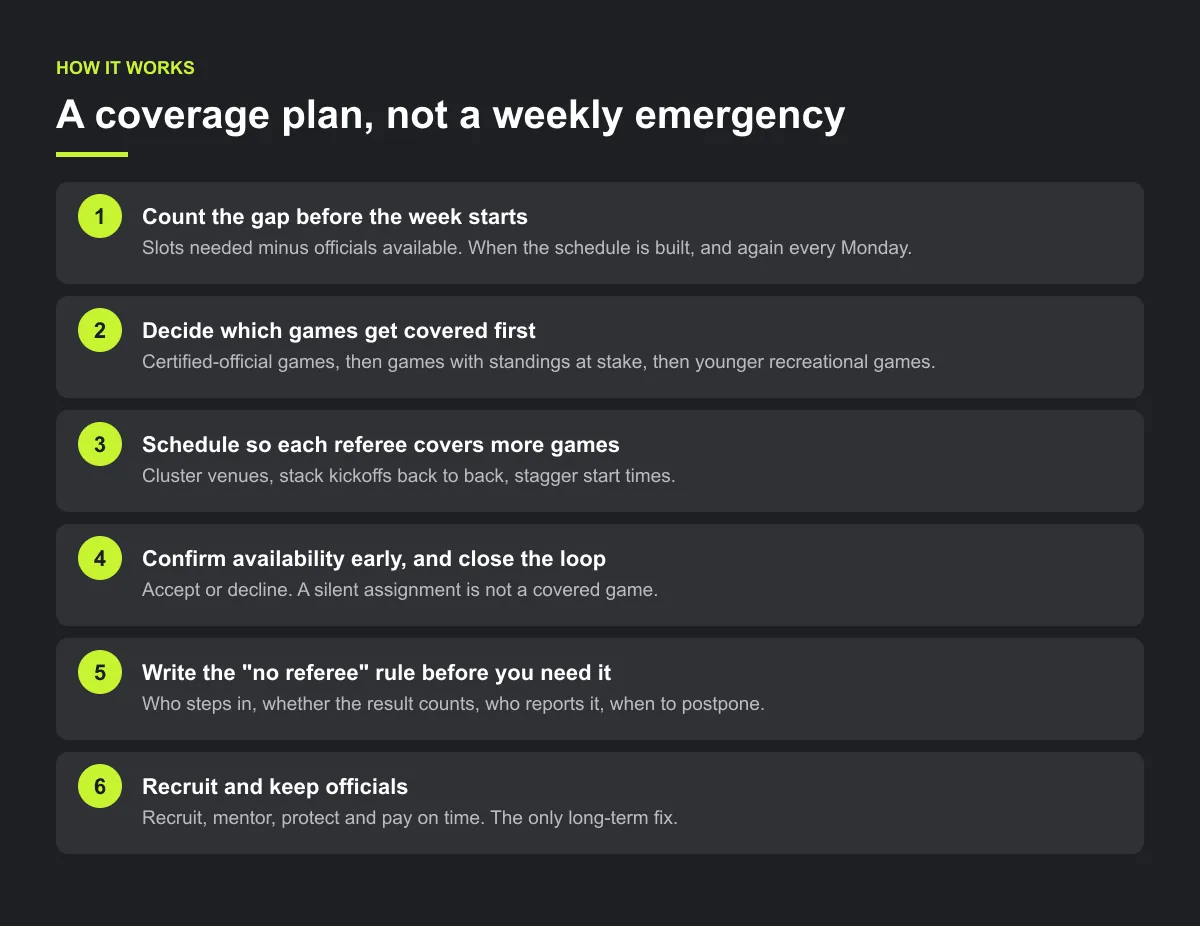
Why the shortage hits the same games every week
- Nobody counts the gap until Thursday. Games are scheduled without checking how many officials each time slot needs.
- Kickoffs are spread out. One referee could cover three back-to-back games at one venue, but the games are at three venues at three odd times.
- Availability is guessed. Assignors find out who is free by messaging people one at a time.
- There is no written backup rule. When a game has no referee, coaches argue on the sideline about whether it still counts.
- Officials quit. Sideline abuse and late changes can push new referees out after one season.
Step 1 — count the gap before the week starts
For each game day, list:
- Games per time slot, by venue.
- Officials each game needs under your rules (one referee, a two-person crew, a full crew).
- Officials actually available in that slot.
Officials available minus officials needed is your gap for that slot. Do this when the schedule is built, and again every Monday.
Worked example — 40 games, counted slot by slot
Illustrative example, not a specific league.
A league has 40 games on one Saturday. Younger games need one official; older games need a three-person crew. The league's referees have told it which slots they can work: 68 officials across the five slots.
Before:
| Slot | 1-official games | 3-person crew games | Officials needed | Available | Gap |
|---|---|---|---|---|---|
| 9:00 | 11 | 0 | 11 | 16 | +5 |
| 10:30 | 8 | 1 | 11 | 15 | +4 |
| 12:00 | 4 | 4 | 16 | 15 | −1 |
| 13:30 | 2 | 5 | 17 | 12 | −5 |
| 15:00 | 0 | 5 | 15 | 10 | −5 |
| Total | 25 | 15 | 70 | 68 | −2 |
The day total says 2 short. Slot by slot, the afternoon is 11 short (1 + 5 + 5) while the morning has 9 spare.
Two changes, agreed with clubs and allowed by the rules:
- Move one crew game from 13:30 to 9:00 and one from 15:00 to 10:30, onto fields that are free in the morning.
- Use a two-person crew for the six afternoon games in the younger of the two older divisions.
After:
| Slot | 1-official | 3-person crew | 2-person crew | Needed | Available | Gap |
|---|---|---|---|---|---|---|
| 9:00 | 11 | 1 | 0 | 14 | 16 | +2 |
| 10:30 | 8 | 2 | 0 | 14 | 15 | +1 |
| 12:00 | 4 | 2 | 2 | 14 | 15 | +1 |
| 13:30 | 2 | 2 | 2 | 12 | 12 | 0 |
| 15:00 | 0 | 2 | 2 | 10 | 10 | 0 |
| Total | 25 | 9 | 6 | 64 | 68 | +4 |
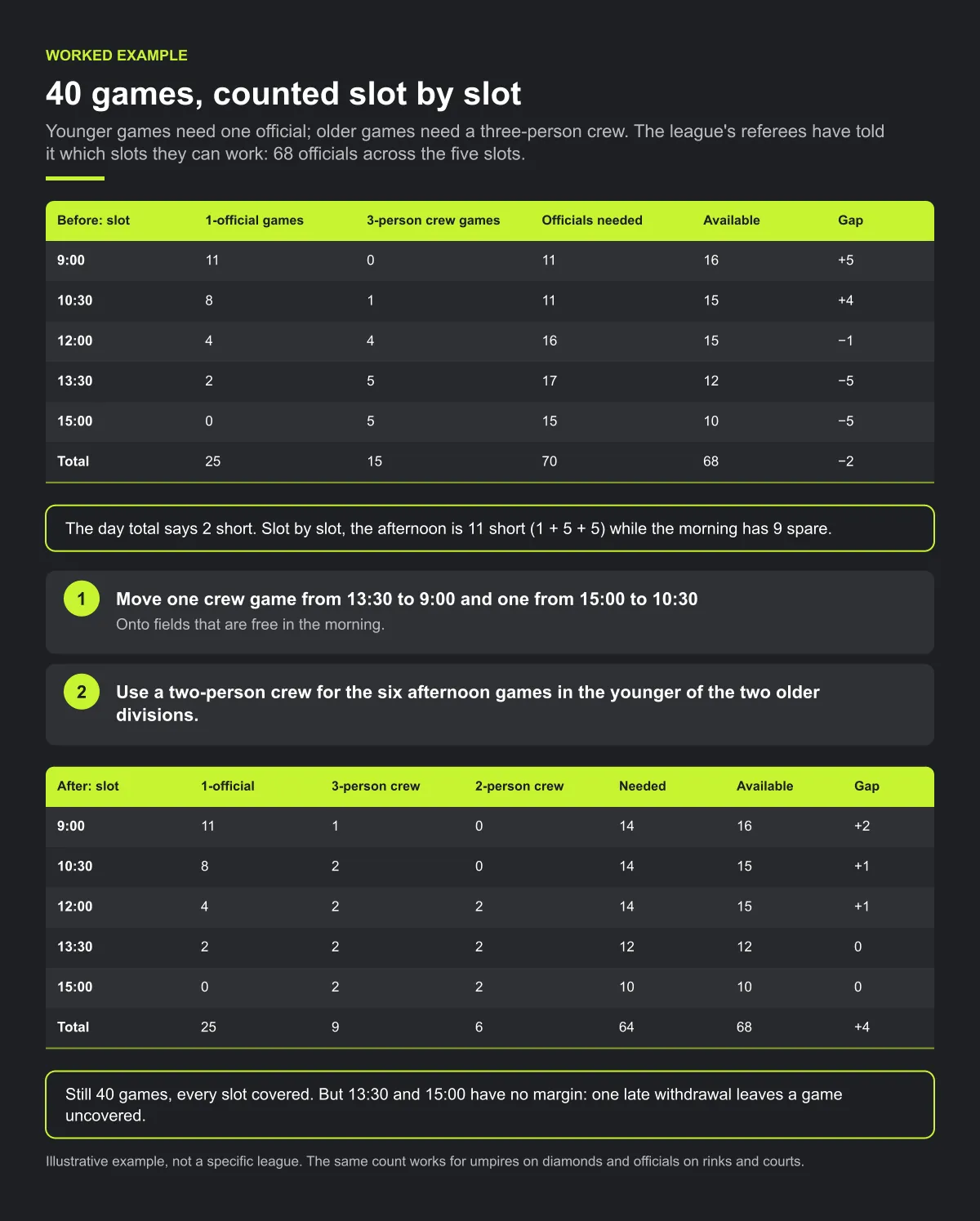
Still 40 games, every slot covered. But 13:30 and 15:00 have no margin: one late withdrawal leaves a game uncovered, and the priority list and "no referee" rule (Steps 2 and 5) apply. The same count works for umpires on diamonds and officials on rinks and courts.
Step 2 — decide which games get covered first
Write a priority order and share it with clubs before the season:
- Games where your rules or your association require a certified official (for example, your oldest and most competitive divisions).
- Games with standings or playoff places at stake.
- Younger recreational games, which can use a newer referee, a mentored youth official or an agreed club volunteer where your rules allow.
When there aren't enough people, the priority list decides, not whoever answers their phone first.
Step 3 — schedule so each referee covers more games
- Cluster games at fewer venues on busy days.
- Stack kickoffs back to back at one field, rink or court, with a short break built in, so one referee can do two or three games without travelling.
- Stagger start times across venues if the same officials have to move.
- Use smaller crews where your rules allow, for example a two-person system instead of a full crew for younger age groups.
Illustrative example, not a specific league.
Here is an illustrative example. A league has twelve games spread across six venues on a Saturday, at scattered times, and the assignor needs twelve referees. Moved to three venues with four games stacked back to back at each, the same twelve games can be covered by six referees each working two games in a row.

Step 4 — confirm availability early, and close the loop
- Ask officials for the days they can't work at the start of the season, not week by week.
- Assign at least a week ahead and ask each referee to accept or decline. A silent assignment is not a covered game.
- Track unconfirmed games by Wednesday, and chase those first.
- When a game moves, tell the referee the same way you tell the teams.
Step 5 — write the "no referee" rule before you need it
Put it in the league rules:
- Who can step in (a registered club volunteer, a coach from each side, a mentored youth official) and whether both coaches must agree before kickoff.
- Whether the result counts for standings.
- Who reports it to the league, and by when.
- When a game is postponed instead of played.
Step 6 — the long-term fix: recruit and keep officials
- Recruit from your own community: older players, former players and parents. Help them get certified through your sport's governing body.
- Mentor new officials for their first games. Pair them with an experienced referee.
- Protect them. A written sideline code of conduct, enforced by the league, with a clear way for referees to report abuse.
- Pay on time and keep a clear record of what each official is owed (see the referee fee tracking guide).
- Give good games to reliable people. Fair, predictable assignments keep officials coming back.
Checklist: referee coverage
- Officials needed counted per slot, with crew sizes from your rules.
- Officials available counted per slot, not per day.
- Priority order written and shared with clubs.
- Games moved toward slots with spare officials; smaller crews used where rules allow.
- Every assignment accepted or declined by Wednesday.
- "No referee" rule in the league rules.

Common mistakes
- Counting the gap for the whole day. Slots with spare officials can't cover slots without them unless games move.
- Leaving zero-margin slots unplanned. A slot with exactly enough officials needs a named backup or a priority call.
- Deciding the no-referee rule on the sideline. Two coaches arguing at kickoff is the wrong time to write a rule.
How Play 2 Earn Sports supports this
- League referee assignment. The league assigns a referee to each game. The picker hides referees of the wrong sport and flags anyone below the league's required level or unavailable that day.
- Accept, decline or hand back. The referee accepts, declines or hands the game back, and the league can see each game's status, including games still waiting for a referee.
- Days referees can't work. Referees mark the days they can't work, so the league sees it when assigning.
- Open games for tournament and club games. Referees see an Open games list for tournament and club games in their sport and can claim the ones their level allows. League games are not in that list. They are assigned by the league's referee coordinator.
- Referees on approved club requests. When the league approves a club's request, the clubs and the referee are told. Tell everyone else in the game yourself.
What stays with your league: Play 2 Earn Sports does not alert you to a shortage or fill unassigned games automatically. The gap count, the priority list, the "no referee" rule and recruiting are league work.
See league referee assignment in a demo league.
Frequently asked questions
Count the gap for each time slot, cover the games that need a certified official first, cluster and stack kickoffs so each referee can work several games at one venue, confirm availability early, and write down what happens when a game still has no referee.
Games where your rules or association require a certified official, then games with standings or playoff places at stake, then younger recreational games, which can use newer or mentored officials where your rules allow.
Only if your league rules say so. Write down who may step in, whether both coaches must agree, whether the result counts and who reports it.
Ask older players, former players and parents, help them get certified through your sport's governing body, mentor them in their first games, and protect them with an enforced sideline code of conduct.
No. League games are assigned by the league. Referees can claim tournament and club games from the Open games list, within their sport and level. For league games, the referee accepts, declines or hands the game back.
Starter is free for clubs with up to 10 teams. Pro is $49.67 USD a month for 11 to 25 teams. Unlimited is $99.67 USD a month for 26 or more teams. For leagues, Starter is free for up to 10 clubs, League Pro is $97.85 USD a month for 11 to 25 clubs, and League Unlimited is $196.35 USD a month for 26 or more clubs. Every feature is on every plan, and players and parents are always included. See pricing.
Related guides
- League scheduling guides: every league scheduling guide in one place.
- How to build a youth league schedule
- Rainout and field closure process
- Referee scheduling software
- Sports league scheduling software
- Tournament scheduling software
- Pricing
