

In this guide
The question club leaders ask: "New families ask us the same things every season: what to buy, how far we travel, what tournaments cost, whether they have to volunteer, whether their child's photo will be posted. Our coaches answer them one at a time. What should a parent handbook include, and how do we get families to read it?"
An example: the first month of a new family
Illustrative example, not a specific club.
Here is an example. A family joins a club's U10 basketball team in September.
- Week 1: they buy black socks. The team wears white.
- Week 2: a tournament is announced, with a cost they didn't expect.
- Week 3: they're put on the snack and scorekeeping rota they didn't know existed.
- Week 4: their child's photo appears on the club's social page, and they had wanted to opt out.
None of these are big problems on their own. Together, they make the club feel disorganized, and they all reach the coach.
Why parents are confused
- Answers are spread out: old emails, an outdated website page, whatever the coach remembers to say.
- Every coach explains it differently, so a family with two children gets two versions.
- New families don't know what to ask until it's already a problem.
What it costs
- Coaches answering the same questions over and over.
- Surprise costs that become complaints.
- Volunteer jobs nobody knew they'd agreed to.
- Photo consent problems that are much harder to fix after a photo is posted.
- Unfairness between teams. When one coach asks for two volunteer jobs and another asks for none, families compare notes, and the club looks inconsistent.
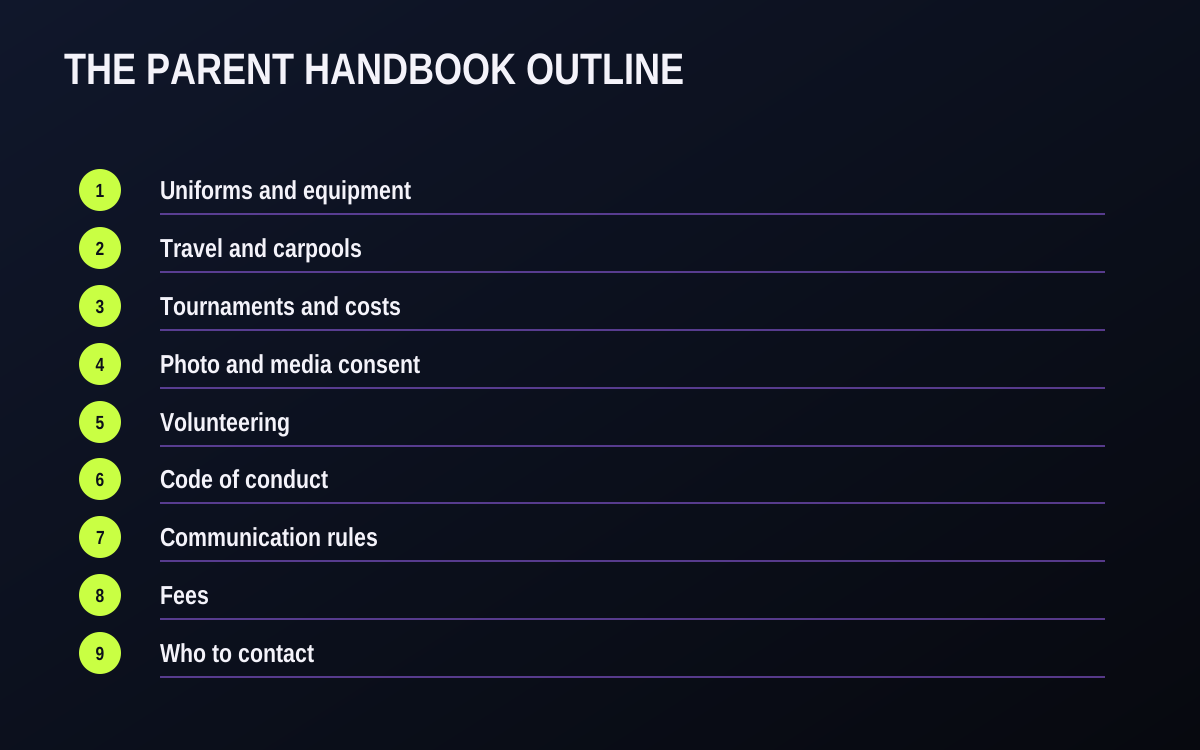
The handbook outline
A few lines each. Answer first, details after.
Uniforms and equipment.
What the fee includes, what families buy, what to wear to games and to practice, and where to get it.
Travel and carpools.
How far teams usually travel, how carpools are organized, and the club's rules for adults driving other people's children.
Tournaments and costs.
How many to expect, a rough cost range, and how much notice families get.
Photo and media consent.
What the club posts, where, whether names appear with photos, and how a family opts out at any time.
Volunteering.
What every family is expected to give (for example, a set number of jobs or hours per season) and how jobs are assigned.
Code of conduct.
A short summary for parents in the stands and on the sideline, with where to find the full version.
Communication rules.
Where the schedule lives, where club news goes, how to reply to RSVPs, and when coaches answer messages.
Fees.
What they cover, when they're due, how to pay, and how to ask privately for help.
Who to contact.
One line per topic: the coach for the player, the registrar for registration, the treasurer for fees, a named person for concerns.
Keep it short
- Aim for something a parent will read in one sitting, on a phone.
- Plain words, answer first. "Players wear the club's white socks to games" beats a paragraph about uniform suppliers.
- Summarize long policies, like the full code of conduct or the safeguarding policy, and say where to find the full text.
- Use the same nine headings every season, so returning families know where to look.
- Test it on a new family. Before you publish, ask one family who joined last season to read it and tell you what was missing or confusing.
Keep it short enough to use.

Version it every season
- Put the season on the cover, for example "Fall 2026 – Spring 2027".
- Start with a "What changed" box, so returning families read only the new parts:
What changed this season: new away uniform colour; tournament notice moved to four weeks; one volunteer job per family instead of two; new contact for fee questions.
- Review it with the board before registration opens, so families sign up under this season's answers.

Where each answer belongs
| Kind of information | Where it goes |
|---|---|
| Rules for the whole season | The handbook, shared as a PDF through your club's usual channel (registration page, welcome email) |
| Details for one game or event | On that game: arrival time, uniform colour, directions |
| A change during the season | A club announcement |
| Conversation about the team | Team chat |
Make coaches part of it
Give every coach the handbook before the season. When a parent asks a handbook question, the coach answers in one line and points to the right section. Families learn where to look first.
A one-line reply a coach can save: "Good question. It's in the handbook under Tournaments and costs. If it doesn't answer it, [registrar] can help." Coaches should not answer fee, consent or volunteering questions from memory; a wrong answer from the coach becomes the answer families remember.
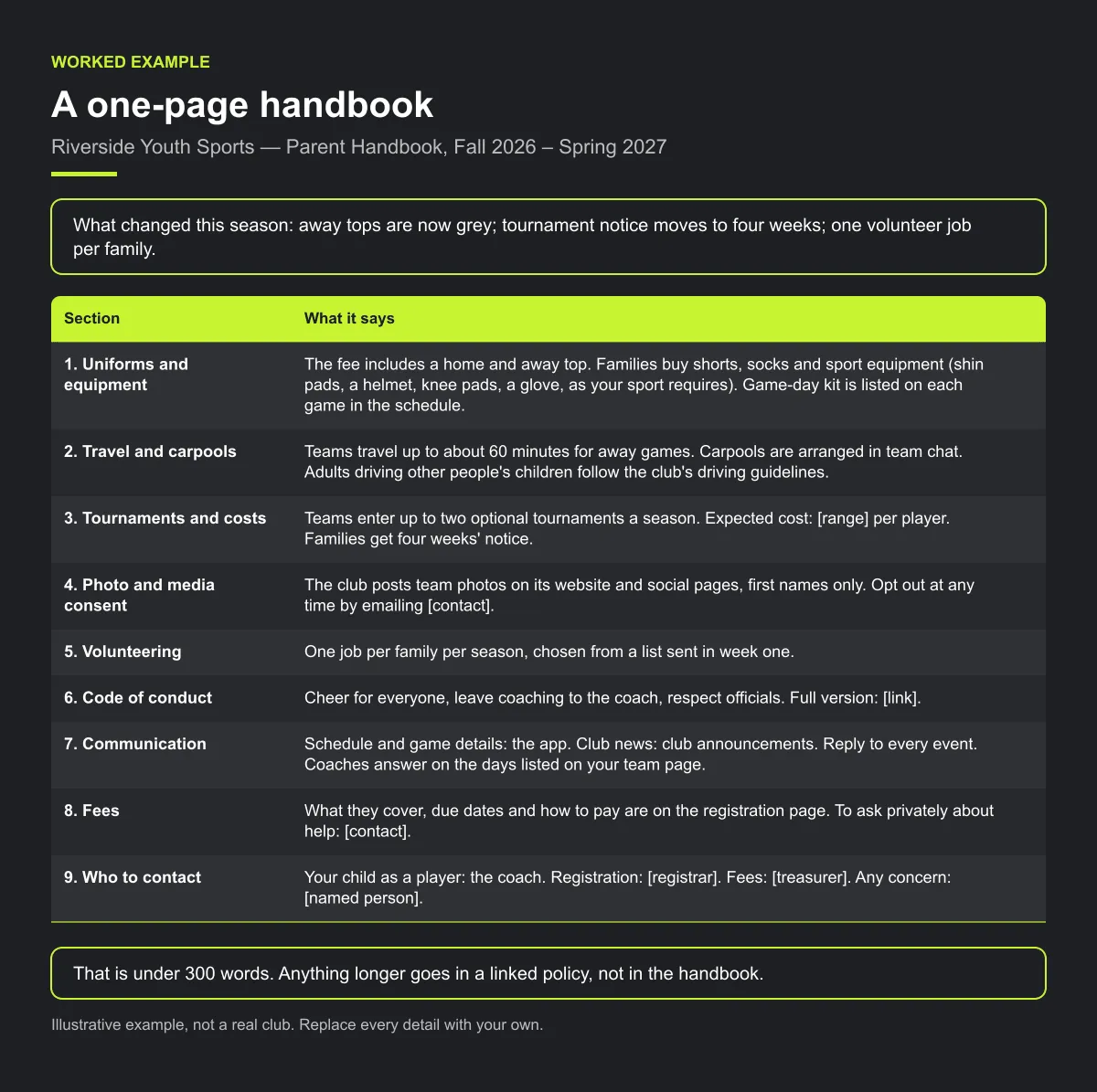
Worked example — a one-page handbook
Illustrative example, not a real club. Replace every detail with your own.
Here is the whole handbook for a fictional multi-sport club, short enough to fit one printed page or one phone scroll.
Riverside Youth Sports — Parent Handbook, Fall 2026 – Spring 2027
What changed this season: away tops are now grey; tournament notice moves to four weeks; one volunteer job per family.
1. Uniforms and equipment. The fee includes a home and away top. Families buy shorts, socks and sport equipment (shin pads, a helmet, knee pads, a glove, as your sport requires). Game-day kit is listed on each game in the schedule.
2. Travel and carpools. Teams travel up to about 60 minutes for away games. Carpools are arranged in team chat. Adults driving other people's children follow the club's driving guidelines.
3. Tournaments and costs. Teams enter up to two optional tournaments a season. Expected cost: [range] per player. Families get four weeks' notice.
4. Photo and media consent. The club posts team photos on its website and social pages, first names only. Opt out at any time by emailing [contact].
5. Volunteering. One job per family per season, chosen from a list sent in week one.
6. Code of conduct. Cheer for everyone, leave coaching to the coach, respect officials. Full version: [link].
7. Communication. Schedule and game details: the app. Club news: club announcements. Reply to every event. Coaches answer on the days listed on your team page.
8. Fees. What they cover, due dates and how to pay are on the registration page. To ask privately about help: [contact].
9. Who to contact. Your child as a player: the coach. Registration: [registrar]. Fees: [treasurer]. Any concern: [named person].
That is under 300 words. Anything longer goes in a linked policy, not in the handbook.
Checklist: before you share the handbook
- All nine sections answered in a few lines each.
- Season dates on the cover and a "What changed" box at the top.
- Every contact is a named role with a current email.
- Costs are stated as ranges or exact amounts, never "TBD".
- Photo opt-out is explained in one sentence.
- Coaches have read it and know where each answer is.
- It is shared as a PDF on the registration page and in the welcome email.
Common mistakes
- Copying last year's handbook without checking. An old contact email or last season's tournament cost can do more harm than leaving it out.
- Writing it like a policy document. Families skim on phones. Answer first, in plain words.
- Putting game details in the handbook. Arrival times and kit colours change; they belong on each game.
- Sending it once and never pointing to it again. A handbook nobody is directed to can go unread. Coaches and the club office point back to it.
How Play 2 Earn Sports supports this
- Club announcements for official news and mid-season changes, separate from team chat.
- Game descriptions of up to 2,000 characters, for arrival time, uniform and directions, so event details sit on the event.
- RSVPs on events, with "No reply" visible to coaches.
- Team chat with team, coaches and parents channels for conversation, without personal phone numbers.
- One schedule for every team, and families see their own child's.
Share the handbook itself as a PDF through your club's usual channel, such as your welcome email or registration page.
See where each answer lives in one club app.
Frequently asked questions
Uniforms and equipment, travel and carpools, tournaments and costs, photo and media consent, volunteering expectations, a code of conduct, communication rules, fees, and who to contact for what.
Short enough to read in one sitting on a phone. A few lines per section, with long policies summarized and linked.
Every season, before registration opens, with a "What changed" box at the top for returning families.
As a PDF through your club's usual channel, such as the registration page and the welcome email. Put event-specific details on each game and send mid-season changes as club announcements.
What the club posts and where, whether names appear with photos, and how a family can opt out at any time. Follow your club's or association's safeguarding policy.
Starter is free for clubs with up to 10 teams. Pro is $49.67 USD a month for 11 to 25 teams. Unlimited is $99.67 USD a month for 26 or more teams. Every feature is on every plan, and players and parents are always included. See pricing.
