

In this guide
- Where pool play tournaments go wrong
- Step 1 — choose pool sizes
- Step 2 — count games against venue time
- Step 3 — build in rest time
- Step 4 — decide the crossover and knockout before the first game
- Step 5 — write the tiebreaker rule down
- Worked example — 16 teams, pools on Saturday, crossovers on Sunday
- How Play 2 Earn Sports supports this
- Frequently asked questions
- Related guides
The question league organizers ask: "We're running a weekend tournament with sixteen teams. Pools on Saturday, a bracket on Sunday. How big should the pools be, how do crossovers work, and how do we stop the tiebreaker argument at 6 p.m. on Saturday?"
Where pool play tournaments go wrong
- Uneven pools. One pool of five and one of three means some teams play twice as many games as others.
- No rest built in. A team plays back-to-back because the grid was filled in order.
- The crossover is decided late. Coaches find out who they play on Sunday after the last pool game.
- Tiebreakers written after the tie. Whatever is decided at 6 p.m. looks unfair to somebody.
Step 1 — choose pool sizes
In a pool, every team plays every other team once. The arithmetic:
| Pool size | Games per team | Games in the pool |
|---|---|---|
| 3 | 2 | 3 |
| 4 | 3 | 6 |
| 5 | 4 | 10 |
| 6 | 5 | 15 |
Pools of four give each team three games. A pool can fit in a day if game lengths, available venue hours and required rest leave enough time. Keep pools the same size where you can. If you can't, give every team the same minimum number of games, adding a placement game for the smaller pools if needed.
Step 2 — count games against venue time
Add pool games and bracket games, then compare with the slots you hold.
Illustrative example, not a specific tournament.
Here is an example. Sixteen teams in four pools of four play 24 pool games. The top two in each pool go into an eight-team single elimination bracket: four quarterfinals, two semifinals and a final, 7 more games. That is 31 games. With four fields, rinks or courts, the pool round needs six slots on each, and the bracket needs three rounds on Sunday.
If the slots don't fit, change the plan now: fewer teams, shorter games where your rules allow, or one more venue.
Step 3 — build in rest time
- Set a minimum rest between games for every team, for example at least one slot off, and longer for the youngest ages.
- Follow your governing body's limits on games or minutes per day where they exist.
- Spread each team's games through the day, not all in the morning.
- Check travel time if a team moves between venues.
Build each pool's games into the grid, then check every team's day in one list: start times, venue, and the gap before the next game.
Step 4 — decide the crossover and knockout before the first game
Publish the bracket shape with the schedule, so every coach knows the path:
- Crossover: 1A plays 2B, 1B plays 2A, so pool winners meet runners-up from another pool and pool rematches wait until later.
- Knockout: single elimination from the crossover onward, with the times and venues already in the schedule as "Winner of game 25 v Winner of game 26".
- Placement or consolation games for teams that don't advance, if your venue time allows. A set number of games for every team can matter to families as much as the bracket.
Step 5 — write the tiebreaker rule down
Put the tiebreaker order in the tournament rules, send it to coaches before the event and post it at the venue. Choices a tournament can use, in an order you decide:
- Head-to-head result (between two tied teams).
- Goal, point or run difference, which can be capped per game.
- Fewest goals, points or runs allowed.
- A coin toss or draw, as the last step.
Say how three-way ties work, because head-to-head may not settle them. Then apply the rule as written, even when the result is disappointing.

Worked example — 16 teams, pools on Saturday, crossovers on Sunday
Illustrative example, not a specific tournament.
A volleyball tournament has 16 teams in four pools of four (A to D), 4 courts and 75-minute slots. Pool play needs 4 × 6 = 24 games. Saturday has 6 slots × 4 courts = 24 court slots, so the pool round fits exactly.
The rest problem. A pool of four on one court can't give every team a slot off between games: each team plays 3 of the 6 slots, and there is no way to arrange that without someone playing back to back. So two pools share two courts and take turns:
| Slot | Court 1 | Court 2 |
|---|---|---|
| 8:00 | A1 v A4 | A2 v A3 |
| 9:15 | B1 v B4 | B2 v B3 |
| 10:30 | A1 v A3 | A4 v A2 |
| 11:45 | B1 v B3 | B4 v B2 |
| 13:00 | A1 v A2 | A3 v A4 |
| 14:15 | B1 v B2 | B3 v B4 |
Pools C and D run the same pattern on Courts 3 and 4. Every Pool A team plays at 8:00, 10:30 and 13:00; every Pool B team at 9:15, 11:45 and 14:15. Each team gets one full slot off between games, and each pool plays all six of its pairings.
Sunday: crossovers into an eight-team bracket. The top two in each pool advance, 8 teams, 7 games:
| Time | Court | Game | Matchup |
|---|---|---|---|
| 9:00 | 1 | QF1 | 1A v 2B |
| 9:00 | 2 | QF2 | 1B v 2A |
| 9:00 | 3 | QF3 | 1C v 2D |
| 9:00 | 4 | QF4 | 1D v 2C |
| 11:00 | 1 | SF1 | Winner QF1 v Winner QF3 |
| 11:00 | 2 | SF2 | Winner QF2 v Winner QF4 |
| 13:30 | 1 | Final | Winner SF1 v Winner SF2 |
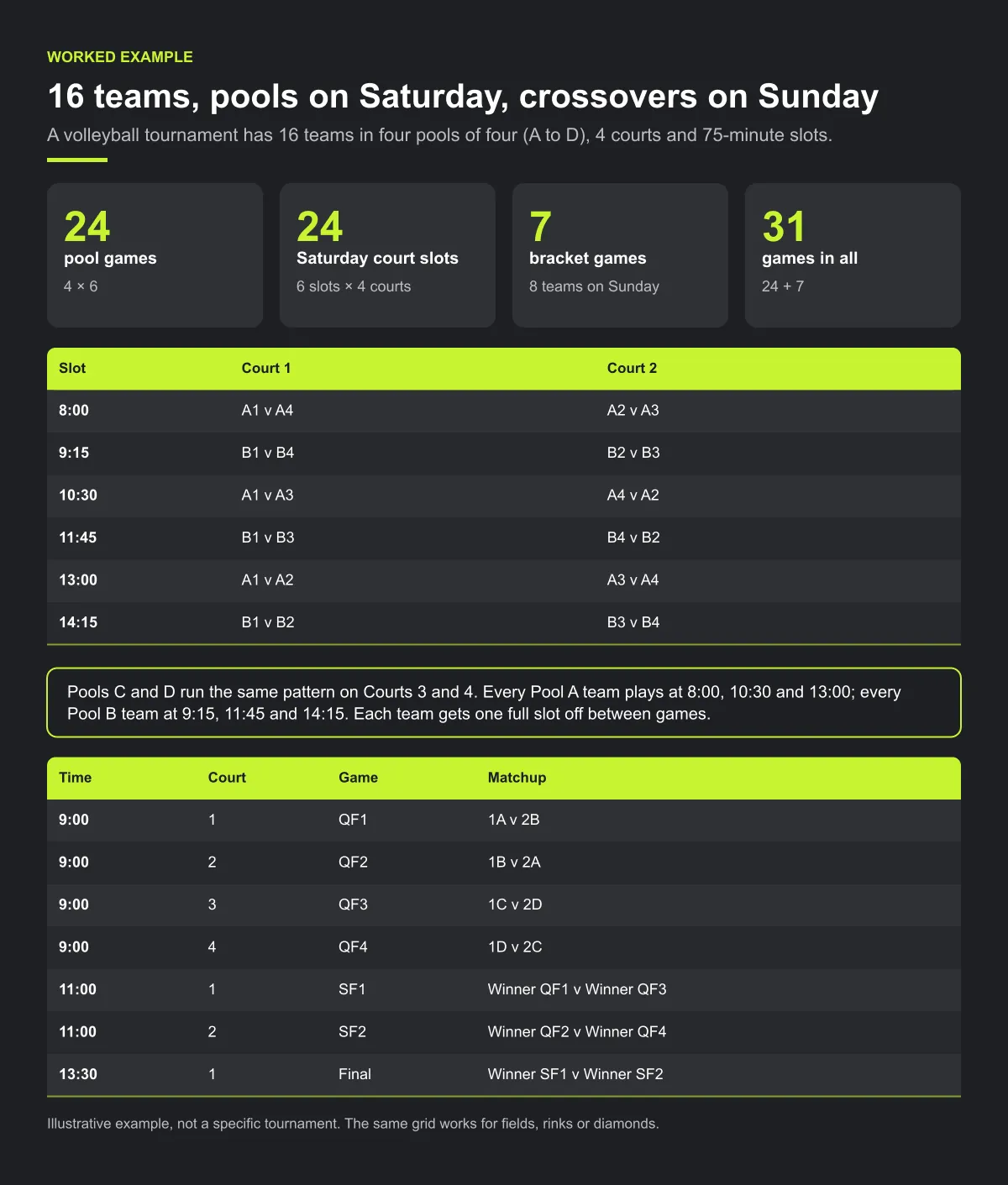
Check: 24 pool games + 7 bracket games = 31. Because 1A sits in the top half (QF1 and SF1) and 2A in the bottom half (QF2 and SF2), two teams from the same pool can only meet again in the final. Courts 3 and 4 are free from 11:00 for placement games for the eight teams that didn't advance. The same grid works for fields, rinks or diamonds.
Checklist: pool play
- Equal pools, or the same minimum games for every team.
- Pool games + bracket games counted against slots.
- Pools alternated on shared venues so every team rests at least one slot.
- Each team's day checked in one list: times, venue, gaps.
- Crossover and bracket published with the schedule.
- Tiebreaker order, including three-way ties, sent to coaches and posted.
Common mistakes
- Running one pool straight through on one court. Someone ends up playing back to back.
- Placing same-pool teams in the same bracket half. They can meet again in a semi-final.
- Counting pool games but not the bracket. Sunday then runs out of slots.
- Leaving non-qualifiers with nothing. Decide on placement games before the event.
How Play 2 Earn Sports supports this
- Pools and brackets. Tournament formats include round robin pools (group stages) and single elimination. Double elimination and Swiss formats are not supported.
- Clash checks when placing fixtures by hand. When you place or move a tournament fixture yourself, a field or team that is already booked is blocked.
- Postpone without a new time. A tournament fixture can be postponed before the new slot is known.
- Change notices. Automatic change notices are confirmed only for league games: when the league approves a club's request, the clubs and the referee are told. For a moved tournament fixture, tell the teams, families, coaches and referees or your assignor yourself.
- One connected schedule. Families see their own child's games.
Your tiebreaker order lives in your written tournament rules. Check standings against it before you announce who advances.
See pools and a single elimination bracket built for your tournament.
Frequently asked questions
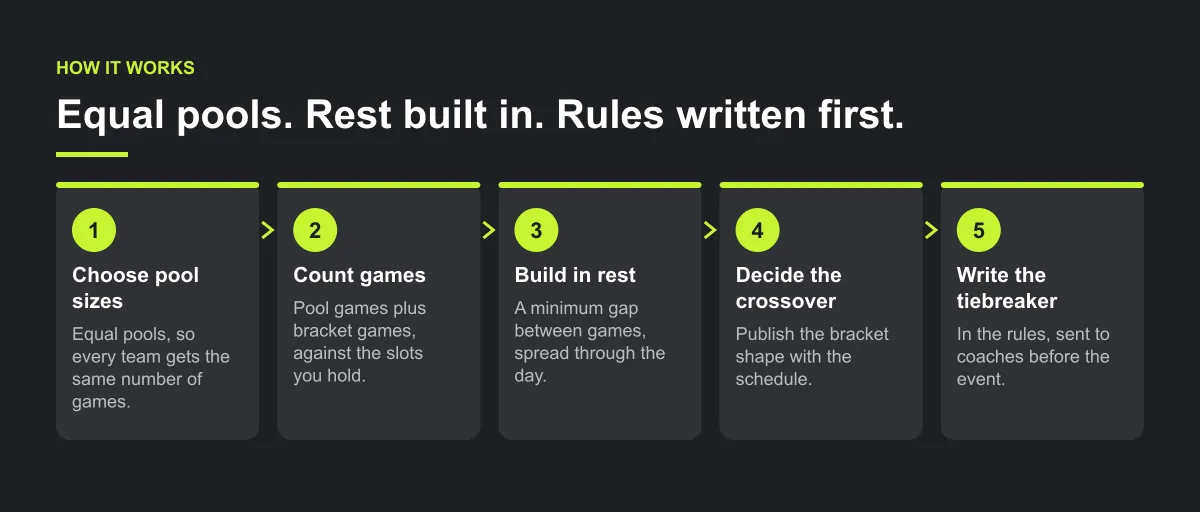
Choose equal pool sizes, count pool and bracket games against your venue time, build in a minimum rest between games, publish the crossover and bracket shape with the schedule, and write the tiebreaker order down before the first game.
Pools of four give three games per team and six games per pool. Pools of three give two games each; pools of five give four. Keep pools equal or give every team the same minimum number of games.
After pool play, the winner of one pool plays the runner-up of another (1A v 2B, 1B v 2A). It avoids pool rematches straight away and leads into the knockout round.
Pick an order and publish it before the event, for example head-to-head, then a capped goal, point or run difference, then fewest allowed, then a coin toss. State how three-way ties are settled.
No. Tournament formats are round robin pools (group stages) and single elimination. Double elimination and Swiss formats are not supported.
Starter is free for clubs with up to 10 teams. Pro is $49.67 USD a month for 11 to 25 teams. Unlimited is $99.67 USD a month for 26 or more teams. For leagues, Starter is free for up to 10 clubs, League Pro is $97.85 USD a month for 11 to 25 clubs, and League Unlimited is $196.35 USD a month for 26 or more clubs. Every feature is on every plan, and players and parents are always included. See pricing.
Related guides
- League scheduling guides: every league scheduling guide in one place.
- Rainout and field closure process
- Parents keep missing schedule changes
- Tournament scheduling software
- Round robin generator
- Pricing
