

In this guide
- Why playoff brackets get rushed
- Step 1 — decide who qualifies
- Step 2 — set the seeding rules
- Step 3 — pick a bracket size that fits
- Step 4 — write the rule for a tied playoff game
- Step 5 — hold the dates and venues now
- Step 6 — publish the shape before the season ends
- Worked example — six teams, a play-in, then a four-team bracket
- How Play 2 Earn Sports supports this
- Frequently asked questions
- Related guides
An illustrative planning scenario: The regular season ends on Sunday and playoffs start the next weekend. The bracket, venues and seeding rules are still undecided. How can a league set up playoffs before the rush?
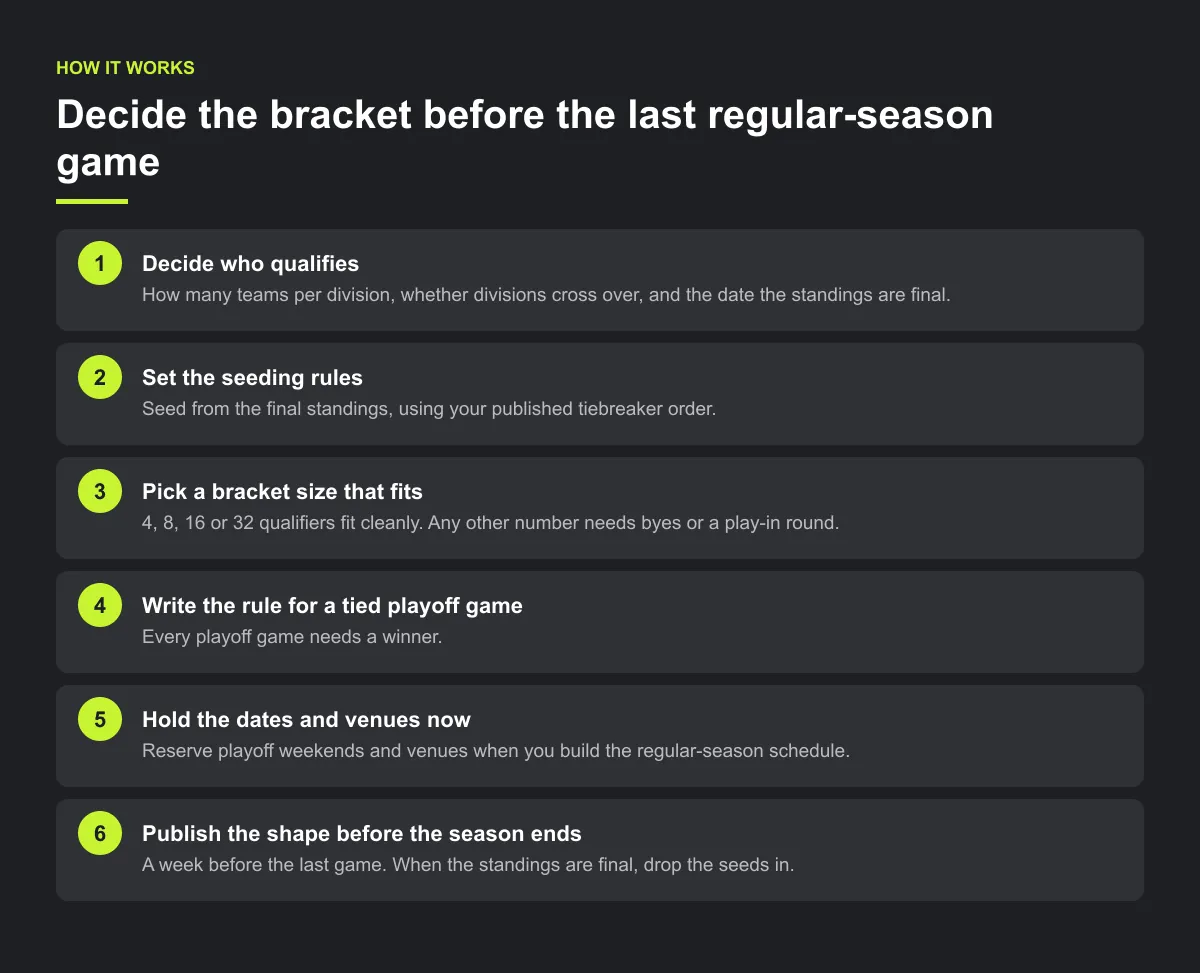
Why playoff brackets get rushed
- Qualification isn't written down. Top four? Top half? Everyone?
- Seeding is argued after the fact. Especially when teams are tied.
- Venues aren't held. The fields, rinks or courts for playoff weekend were never booked.
- The bracket size doesn't fit. Six teams qualify and nobody knows who gets a bye.
- Tied games have no rule. Overtime, shootout, extra innings or a replay, decided on the night.
Step 1 — decide who qualifies
Write it into the league rules before the season:
- How many teams per division make the playoffs (for example, the top four), or whether every team plays.
- Whether divisions cross over (first in Division A plays second in Division B).
- The date the standings are final for qualification. Pending results after that date are settled by the league office.
Step 2 — set the seeding rules
- Seed from the final standings, using your published tiebreaker order (see the tiebreaker guide).
- Standard pairings: 1 v 8, 2 v 7, 3 v 6, 4 v 5 in an eight-team bracket, so the top seeds meet as late as possible.
- Fixed bracket or re-seed? A fixed bracket is simpler for families to follow. Say which you use.
- Home advantage: the higher seed hosts, where venues allow.
Step 3 — pick a bracket size that fits
Single elimination needs one fewer game than teams: 4 teams play 3 games, 8 teams play 7, 16 teams play 15.
- 4, 8, 16 or 32 qualifiers fit a bracket cleanly.
- Any other number needs byes or a play-in round. For six qualifiers, seeds 3 to 6 play a play-in round, and the two winners join seeds 1 and 2 in a four-team bracket.
Illustrative example, not a specific league.
A division of eleven teams finishes level at sixth place, and the rules say "top six qualify" but say nothing about byes or ties. Two clubs claim the last place. A published qualification line, tiebreaker and bye or play-in rule would tell them how the bracket will be filled.
Step 4 — write the rule for a tied playoff game
Every playoff game needs a winner. Use your sport's rules and write the short version where coaches will read it: overtime, a shootout, extra innings, a deciding set, or a replay. Say how long overtime is for each age group.

Step 5 — hold the dates and venues now
- Reserve playoff weekends and venues when you build the regular-season schedule.
- Allow rest between rounds, especially for younger players and back-to-back games.
- Plan referees for every round, ideally your most experienced for the final.
- Decide whether teams that don't qualify play placement or friendly games, and schedule them as separate games.

Step 6 — publish the shape before the season ends
Publish the empty bracket, the seeding rule, the tie rule and the dates a week before the last game. When the standings are final, drop the seeds in. Publishing early lets families hold the dates, lets clubs see what each position is worth before the last game, and means the only thing left to argue about is a result, not a rule. Name the person who drops the seeds in and the time they will do it.
Worked example — six teams, a play-in, then a four-team bracket
Illustrative example, not a specific league.
A hockey division's rules say the top six qualify. Six isn't a bracket size, so seeds 3 to 6 play in and seeds 1 and 2 get a bye into the semi-finals. Single elimination needs one game fewer than teams: 6 − 1 = 5 games, played over two weekends on one rink.
| Round | Game | Matchup | When and where |
|---|---|---|---|
| Play-in | P1 | Seed 3 vs Seed 6 | Weekend 1, Saturday 10:00, Rink 1 |
| Play-in | P2 | Seed 4 vs Seed 5 | Weekend 1, Saturday 12:00, Rink 1 |
| Semi-final | S1 | Seed 1 vs winner of P2 | Weekend 2, Saturday 10:00, Rink 1 |
| Semi-final | S2 | Seed 2 vs winner of P1 | Weekend 2, Saturday 12:00, Rink 1 |
| Final | F | Winner S1 vs winner S2 | Weekend 2, Sunday 14:00, Rink 1 |
Check: 2 play-in games + 2 semi-finals + 1 final = 5. Seeds 1 and 2 play at most 2 games; seeds 3 to 6 play at most 3. Five rink slots are needed, so five are booked when the regular season is built.
Fixed bracket or re-seed? The table above is a fixed bracket: seed 1 always meets the 4/5 winner. Under re-seeding, seed 1 meets the lowest seed left. Suppose seeds 6 and 4 win the play-ins:
| Semi-final | Fixed bracket | Re-seeded |
|---|---|---|
| Seed 1 plays | Seed 4 | Seed 6 |
| Seed 2 plays | Seed 6 | Seed 4 |
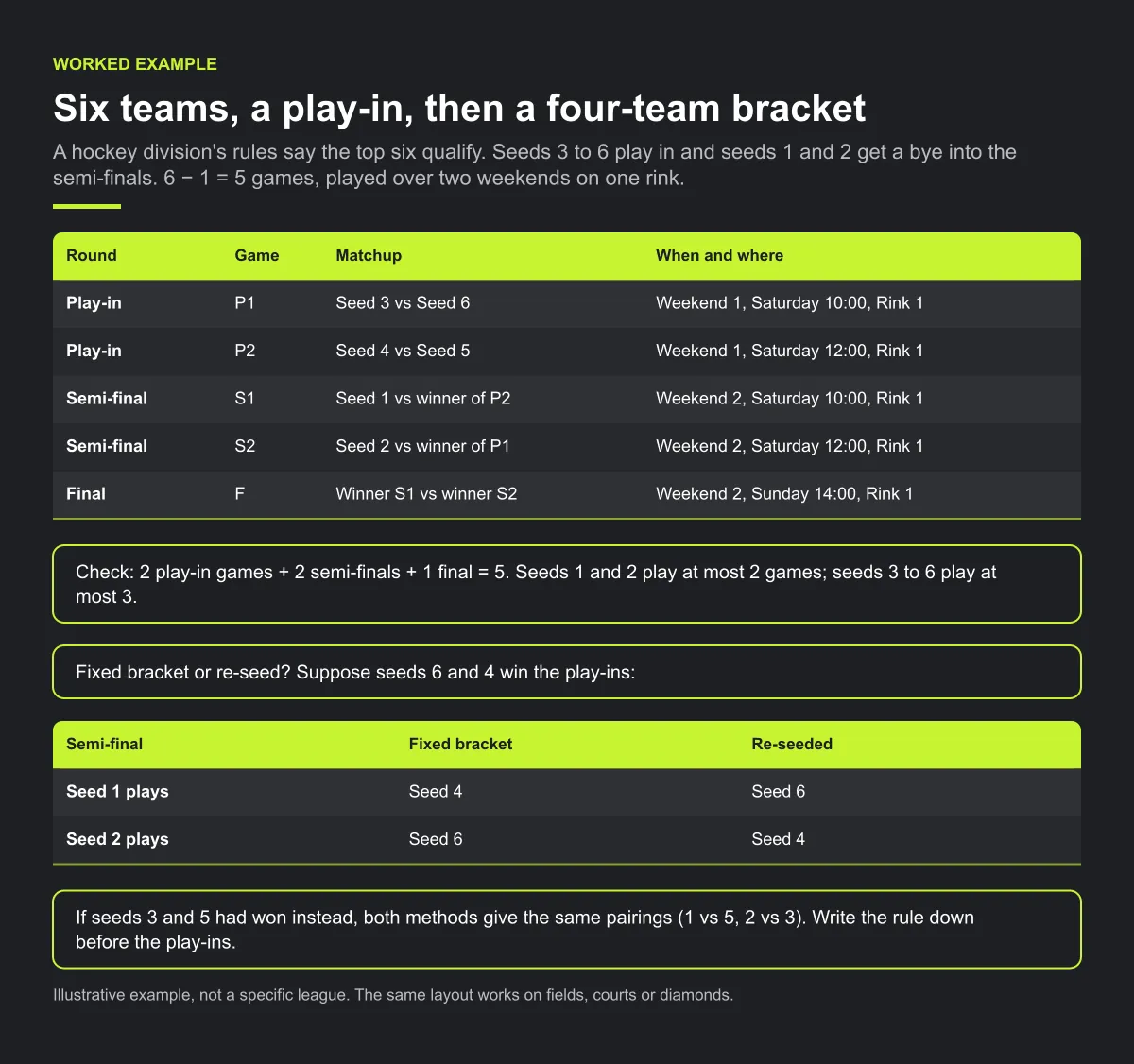
If seeds 3 and 5 had won instead, both methods give the same pairings (1 vs 5, 2 vs 3). Because the methods can differ, the rule has to be written down before the play-ins. The same layout works on fields, courts or diamonds.
Checklist: league playoffs
- Qualifiers per division and the date standings are final.
- Seeding from standings, with the published tiebreaker order.
- Bracket size, with byes or a play-in if qualifiers aren't 4, 8, 16 or 32.
- Fixed bracket or re-seed, stated.
- Tied-game rule per age group.
- Venues, dates, rest and referees held for every round.
- Empty bracket published a week before the last game.
Common mistakes
- Deciding the play-in after the standings are known. Every option then helps a known team.
- Forgetting rest for play-in teams. They may play three games in eight days; check your age group's limits.
- Booking venues for the final only. Play-ins and semi-finals need slots too.
- Leaving re-seeding unstated. Families will read the bracket one way and the league another.
How Play 2 Earn Sports supports this
- A free bracket generator builds a single-elimination bracket for 4, 8, 16 or 32 teams.
- Turn it into a tournament. A bracket from the generator becomes a Play 2 Earn tournament with a knockout format, where you schedule the playoff games, venues and times. Tournament formats also include round robin and group stages.
- League playoffs are a separate tournament. Leagues in Play 2 Earn have no playoff stage, and the bracket doesn't seed itself from league standings. You place the teams by seed from your final standings.
- Not available: double elimination, Swiss and consolation brackets. Play-ins and placement games are scheduled as separate games.
See a single-elimination playoff bracket built and scheduled.
Frequently asked questions
Before the season ends, decide who qualifies, the seeding rule and tiebreakers, the bracket size and any play-in, the rule for tied playoff games, and the dates and venues. Publish the empty bracket, then drop the seeds in when the standings are final.
From the final standings using your published tiebreakers, with standard pairings (1 v 8, 2 v 7, 3 v 6, 4 v 5) so the top seeds meet as late as possible. Say whether the bracket is fixed or re-seeded after each round.
Use a play-in round or byes. For six teams, seeds 3 to 6 play first and the two winners join seeds 1 and 2 in a four-team bracket.
One fewer than the number of teams: 7 games for 8 teams, 15 for 16, over 3 and 4 rounds.
Leagues have no playoff stage. You build a single-elimination bracket for 4, 8, 16 or 32 teams with the free bracket generator, turn it into a Play 2 Earn tournament and schedule the games there, placing teams by seed from your standings. Double elimination, Swiss and consolation brackets are not available.
Starter is free for clubs with up to 10 teams. Pro is $49.67 USD a month for 11 to 25 teams. Unlimited is $99.67 USD a month for 26 or more teams. For leagues, Starter is free for up to 10 clubs, League Pro is $97.85 USD a month for 11 to 25 clubs, and League Unlimited is $196.35 USD a month for 26 or more clubs. Every feature is on every plan, and players and parents are always included. See pricing.
Related guides
- League scheduling guides: every league scheduling guide in one place.
- How to build a youth league schedule
- Tournament scheduling software
- Sports league scheduling software
- Round robin generator
- Pricing
