

In this guide
- Why tiebreakers cause fights
- Step 1 — pick an order and publish it
- Step 2 — say how a three-way tie works
- Step 3 — decide on a goal-difference cap
- Step 4 — include a worked example
- Worked example — a three-way tie, two different orders
- Step 5 — say who applies it, and when
- How Play 2 Earn Sports handles ties
- Frequently asked questions
- Related guides
The question league organizers ask: "Two teams finished level on points and we realized our rules never said what happens next. Both clubs had a different answer. What tiebreakers should a youth league use?"
This guide says "goals" for simplicity. In basketball, volleyball or baseball, read points, sets or runs.
Why tiebreakers cause fights
- They're written after the tie. Every club argues for the rule that helps them.
- Head-to-head breaks down with three teams. A beat B, B beat C, C beat A, and nobody knows what to do next.
- Big wins decide it. One lopsided score against a weak team outweighs a whole season.
- Nobody knows who applies it. The standings page shows one order, and the league announces another.
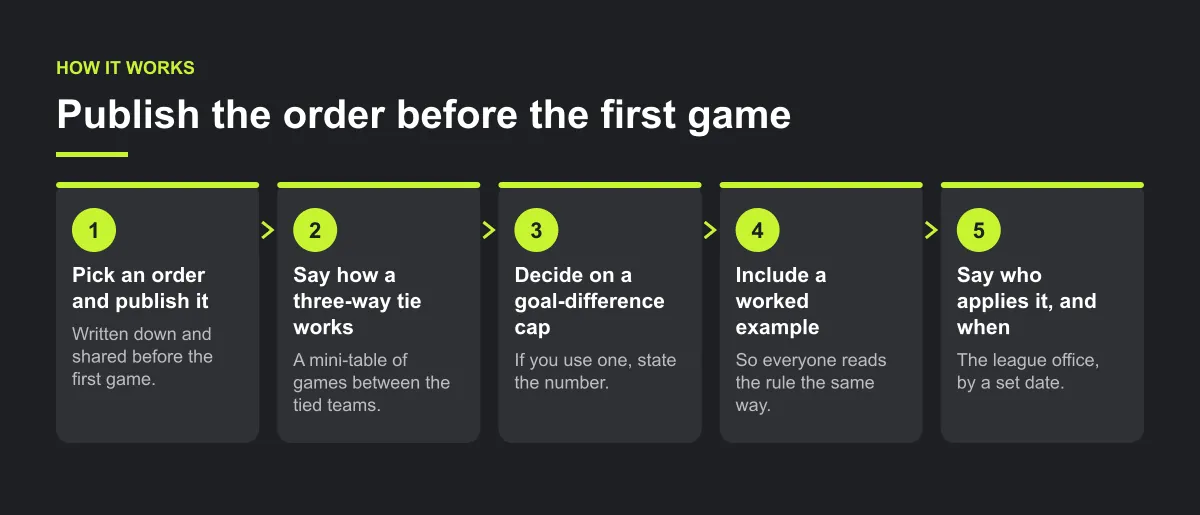
Step 1 — pick an order and publish it
One order a youth league can use, from first to last:
- Points (for example, win 3, draw 1, loss 0).
- Head-to-head result between the tied teams.
- Goal difference across all games.
- Goals scored.
- Fewest goals against or a fair-play record, if you track cards or penalties.
- Draw by lot (a coin toss or drawing names), done by the league office, with witnesses.
A league can also put goal difference before head-to-head. Either can work. What matters is that it's published.

Step 2 — say how a three-way tie works
For head-to-head with three or more teams tied:
- Build a mini-table using only the games between the tied teams.
- Apply the order to that mini-table.
- If one team is separated, decide whether the remaining teams restart at the top of the order or continue down it. Write down which.
For example, three teams are tied and the mini-table puts one of them first while the other two are still level. Under "restart", the remaining two go back to head-to-head, which now means just their one game against each other. Under "continue", they move straight on to goal difference across the season. The two methods can give different answers, so the rules have to say which one you use.
Step 3 — decide on a goal-difference cap
A league may cap the goal difference counted from one game (for example, a maximum margin of 5). A cap limits how much one lopsided result can affect the tiebreaker. If you use one, state the number and calculation in the rules, and note it is applied when the league calculates the final order.
Step 4 — include a worked example
Illustrative example, not a specific league.
Team Blue and Team Gold both finish on 16 points. Both have a goal difference of +7. Blue scored 18 goals and Gold scored 15. Gold beat Blue 2–1 when they met.
- Order "points, goal difference, goals scored": Blue finishes first.
- Order "points, head-to-head, goal difference": Gold finishes first.
Same season, different champion. That's why the order must be decided first. Put an example like this in your rules.
Worked example — a three-way tie, two different orders
Illustrative example, not a specific league.
Six teams play a double round robin, 10 games each. Three finish level on 16 points:
| Team | Points | Goals for | Goals against | Goal difference |
|---|---|---|---|---|
| Red | 16 | 20 | 11 | +9 |
| Blue | 16 | 19 | 13 | +6 |
| Gold | 16 | 16 | 10 | +6 |
Order A: points, then goal difference, then goals scored.
- Points: all three on 16. Still tied.
- Goal difference: Red +9 is highest, so Red is first. Blue and Gold are both +6.
- Goals scored: Blue 19, Gold 16, so Blue is second, Gold third.
Order B: points, then head-to-head, then goal difference. Build a mini-table from the games between the three tied teams only:
| Game | Result | Mini-table points |
|---|---|---|
| Gold vs Red | Gold 2–1 | Gold 3 |
| Gold vs Blue | Gold 1–0 | Gold 3 |
| Blue vs Red | Blue 2–0 | Blue 3 |
| Mini-table | Gold 6, Blue 3, Red 0 |
(In a double round robin each pair meets twice. To keep the example short, each pair's second meeting was a 0–0 draw, which adds 2 points to each team in the mini-table and changes nothing: Gold 8, Blue 5, Red 2.)
Under Order B, Gold is first, Blue second, Red third.
| Finish | Order A | Order B |
|---|---|---|
| 1st | Red | Gold |
| 2nd | Blue | Blue |
| 3rd | Gold | Red |
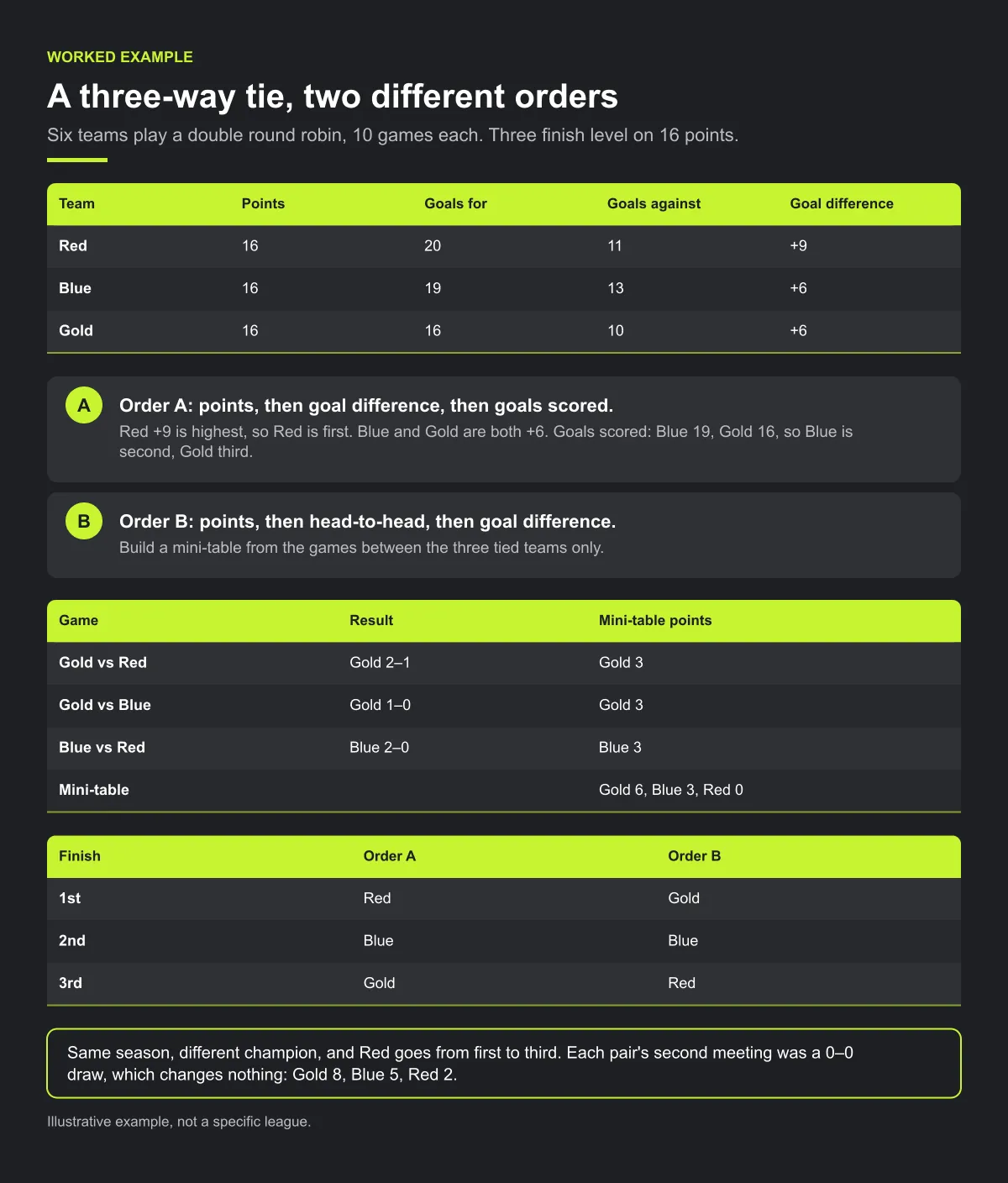
Same season, different champion, and Red goes from first to third. Play 2 Earn standings use Order A and would show Red, Blue, Gold. A league whose written rules use head-to-head would announce Gold, Blue, Red from the league office. The same arithmetic applies to runs, points or sets in other sports.
Step 5 — say who applies it, and when
- The league office applies the tiebreakers and announces the final order by a set date.
- Say whether the same order is used for the title, playoff seeding and promotion.
- If a tie is still unbroken after every step, the draw by lot happens at a named time and place, or a playoff game if dates allow.
Checklist: tiebreaker rules
- Full order written, first to last, ending in a draw by lot.
- Three-way ties: mini-table, and "restart" or "continue" stated.
- Goal-difference cap, if used, with the number.
- A worked example in the rules.
- Who applies it and the date the final order is announced.
- Same order for title, seeding and promotion, or the differences stated.
- Your standings table's own sort order checked against your rules.

Common mistakes
- Assuming the standings page applies your rules. If the table sorts differently from your written order, the league office has to announce the final order.
- Head-to-head with no three-way rule. A beats B, B beats C, C beats A leaves nothing decided.
- Changing the order mid-season. Any change after a game is played helps someone; save it for next season.
How Play 2 Earn Sports handles ties
- Standings rank teams by points, then goal difference, then goals scored. That order is fixed and isn't a setting.
- Points are win 3, draw 1, loss 0, from confirmed results only.
- If teams are still level, the table lists them alphabetically so it stays stable. That is a display order, not a tiebreaker your rules should rely on.
- No head-to-head in the product. If your rules use head-to-head, a goal-difference cap, fair play or a draw by lot, the league office applies them and announces the final order. The worked example above shows when that changes the result.
See standings from confirmed results in a demo league.
Frequently asked questions
One order is points, head-to-head between the tied teams, goal difference, goals scored, then fewest goals against or fair play, and finally a draw by lot. Publish your order before the first game, with a worked example.
Both are used. Head-to-head rewards the result between the tied teams. Goal difference rewards the whole season. Choose one, write it down, and say how a three-way tie works.
Make a mini-table of only the games between the tied teams and apply your order to it. If one team separates, your rules should say whether the others restart at the top of the order or continue down it.
A cap can limit how much one lopsided result affects the tiebreaker. If you choose one, state the number and calculation in the rules and apply it when calculating the final order.
Points, then goal difference, then goals scored, in a fixed order. If teams are still level, they are listed alphabetically for display. Head-to-head and other league rules are applied by the league office.
Starter is free for clubs with up to 10 teams. Pro is $49.67 USD a month for 11 to 25 teams. Unlimited is $99.67 USD a month for 26 or more teams. For leagues, Starter is free for up to 10 clubs, League Pro is $97.85 USD a month for 11 to 25 clubs, and League Unlimited is $196.35 USD a month for 26 or more clubs. Every feature is on every plan, and players and parents are always included. See pricing.
Related guides
- League scheduling guides: every league scheduling guide in one place.
- How to build a youth league schedule
- Club communication standards
- Sports league scheduling software
- Round robin generator
- Pricing
