

In this guide
- Why standings get disputed
- Step 1 — one person enters, the other side confirms
- Step 2 — set deadlines
- Step 3 — a dispute process with a written reason
- Step 4 — write the scoring rules before the season
- Step 5 — publish standings that say what they count
- Worked example — one disputed score, three tables
- How Play 2 Earn Sports supports this
- Frequently asked questions
- Related guides
The question league organizers ask: "Half our scores come in days late, a few are wrong, and every spring two clubs argue about the standings. How do we keep league standings accurate?"
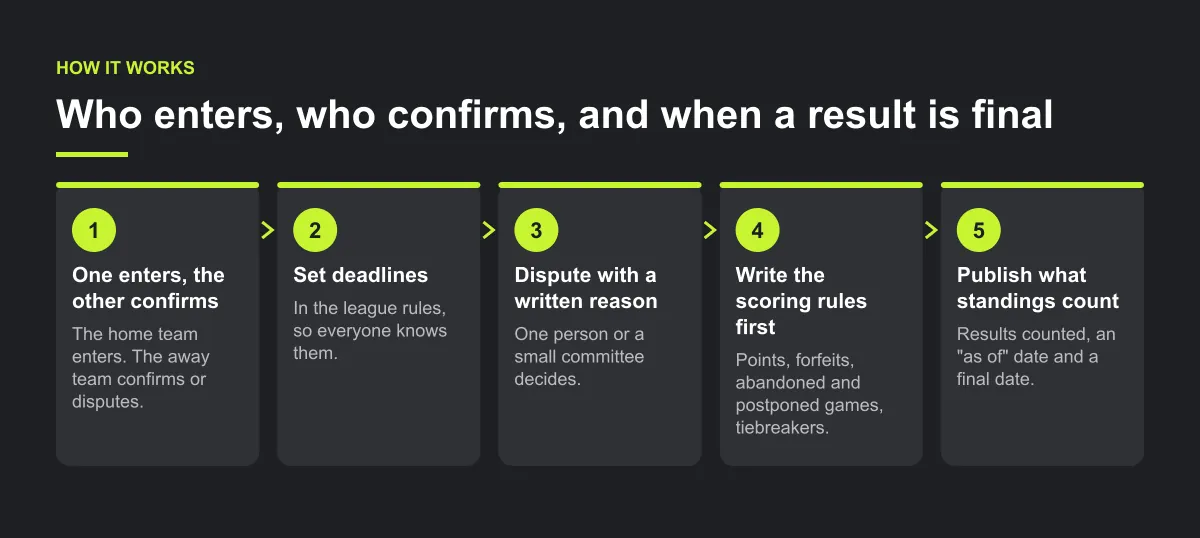
Why standings get disputed
- Nobody owns score entry. Results arrive by text, email and a photo of a score sheet, or not at all.
- Nobody confirms. One side's number goes straight into the table.
- There is no deadline. A score entered two weeks late changes positions after people have seen them.
- There is no dispute process. Disagreements are settled by whoever emails the league office loudest.
- The rules aren't written down. Points for a win, forfeits, abandoned games and tiebreakers are decided after the fact.
Step 1 — one person enters, the other side confirms
- The home team enters the score after the game. One named person per team: a coach or team manager.
- The away team confirms it, or disputes it. A score is not final on one side's word.
- The referee's record counts. If your officials keep a game card or score sheet, it is the evidence when the two sides disagree.

Step 2 — set deadlines
Put them in the league rules, for example:
- Home team enters the score within 24 hours of the game.
- Away team confirms or disputes within 48 hours of entry.
- Anything still unconfirmed after that goes to the league office, which chases it or decides it.
The exact hours are yours to choose. What matters is that everyone knows them.
Step 3 — a dispute process with a written reason
- A dispute must say what is wrong: the score, a forfeit, an ineligible player, an abandoned game.
- The league office looks at the evidence: the referee's record, both teams' accounts.
- One person or a small committee decides, within a set time, and the decision is final for standings.
- Protests about eligibility or conduct follow your league's separate protest rules, with any fee and deadline written down.

Step 4 — write the scoring rules before the season
- Points: for example, win 3, draw 1, loss 0. Say whether your sport has draws.
- Forfeits: what score is recorded, and whether it counts for goal or point difference.
- Abandoned and cancelled games: replayed, counted as played at the time of stoppage, or dropped.
- Postponed games: don't count until played.
- Tiebreakers: in order, before the first game (see the tiebreaker guide).
- Youngest age groups: decide whether they have published standings at all. A recreational division may choose not to.
Step 5 — publish standings that say what they count
- Show how many results are counted and that unconfirmed results are not in the table yet.
- Publish an "as of" date before playoffs or seeding.
- Set a final date after which the regular-season table is locked for seeding.
Illustrative example, not a specific league.
Here is an illustrative example. A home team enters a 3–2 win on a Saturday. The away coach says it finished 2–2. Under a written process, the away coach disputes it with a reason, the league office checks the referee's game card, and the result is settled within the week. Until then, the game isn't in the table, so the standings never show a number one side disagrees with.
Worked example — one disputed score, three tables
Illustrative example, not a specific league.
A four-team division ranks teams by points (win 3, draw 1), then goal difference. After two rounds and one game of round three, five results are confirmed:
| Round | Result | Status |
|---|---|---|
| 1 | A 2–1 C | Confirmed |
| 1 | B 1–1 D | Confirmed |
| 2 | A 0–1 D | Confirmed |
| 2 | B 2–0 C | Confirmed |
| 3 | C 1–1 D | Confirmed |
| 3 | A vs B | Disputed: A entered 3–2, B says 2–2 |
The timeline: the game is on Saturday. A's team manager enters 3–2 on Sunday morning, inside the 24-hour deadline. On Monday, B disputes it with a written reason: "A's third goal was disallowed by the referee." On Wednesday, the league office checks the referee's game card, which shows 2–2. On Thursday, the league records 2–2 as final.
Here is what the table shows at each stage (points, with goal difference in brackets):
| Team | While disputed (5 results counted) | If A's 3–2 had gone straight in | Settled at 2–2 (6 results) |
|---|---|---|---|
| A | 3 (0), 3rd | 6 (+1), 1st | 4 (0), 3rd |
| B | 4 (+2), 2nd | 4 (+1), 3rd | 5 (+2), 1st |
| C | 1 (−3), 4th | 1 (−3), 4th | 1 (−3), 4th |
| D | 5 (+1), 1st | 5 (+1), 2nd | 5 (+1), 2nd |
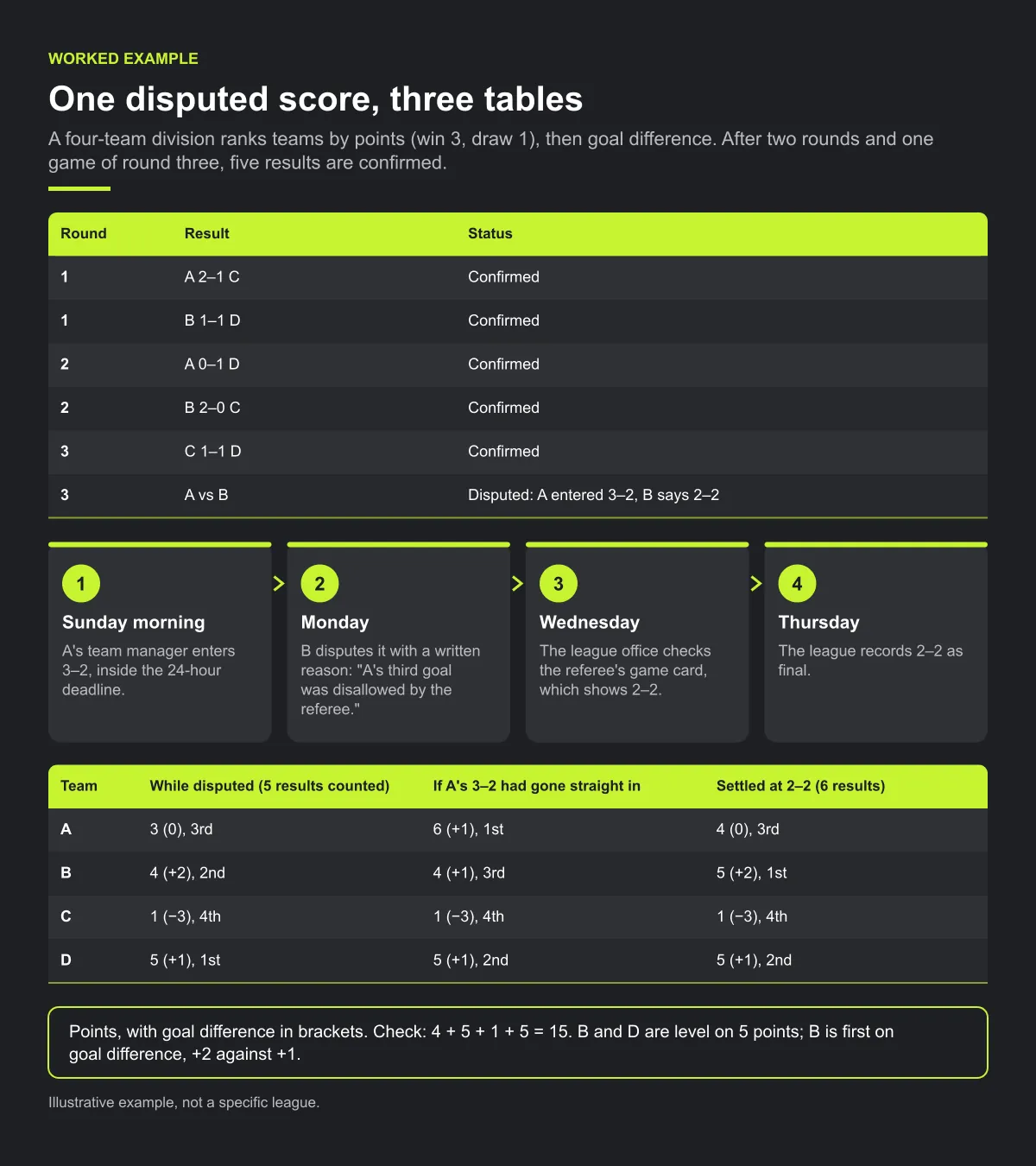
Check: in the settled table, the six results hold three wins (9 points) and three draws (6 points), so 15 points in all, and 4 + 5 + 1 + 5 = 15. B and D are level on 5 points; B is first on goal difference, +2 against +1.
If one side's score had gone straight in, A would have been shown top from Sunday to Thursday and then dropped to third. Counting only confirmed results meant the table never showed a position that was about to change. The same flow works for runs, goals or points in any sport.
Checklist: accurate standings
- Named score-entry person on every team.
- Entry and confirmation deadlines in the league rules.
- Disputes need a written reason; the referee's record is the evidence.
- One person or small committee decides, within a set time.
- Points, forfeits, abandoned games and tiebreakers written before the season.
- Standings show how many results are counted and an "as of" date.
Common mistakes
- Letting one side's score into the table. A position shown for a week and then reversed causes more argument than a short wait.
- Accepting a dispute with no reason. "We don't agree" gives the league office nothing to check.
- No deadline for the away side. Without one, an unconfirmed result can sit until seeding.
- Writing the forfeit rule after a forfeit. Every club will read it in light of the standings.
How Play 2 Earn Sports supports this
- Home enters, away confirms. The home team's coach or club enters the score. The away team's coach or club confirms it or disputes it, and a dispute needs a written reason. The home side can't confirm its own result.
- The referee and the league can step in. The assigned referee can correct the result, and the league admin, or league staff given the results permission, has the final word.
- Standings count only confirmed results. Results waiting for the other side's confirmation are not counted. Cancelled and postponed games never count.
- Points are fixed: win 3, draw 1, loss 0. The standings page says how many confirmed results it counts.
- Unconfirmed results wait. A pending result waits for the away side or the league to act, so your deadline and follow-up rule still matter.
See confirmed results and standings in a demo league.
Frequently asked questions
Have the home team enter each score, the away team confirm or dispute it, set deadlines for both, settle disputes with a written reason and the referee's record, and let the standings count only confirmed results.
One named person per team, for example the home team's coach or manager, within a set time after the game. The away team then confirms or disputes it.
The dispute states what is wrong. The league office checks the referee's game card and both teams' accounts, and one person or a small committee decides within a set time. That decision is final for standings.
Write a rule: after the confirmation deadline, the league office chases it or decides it. In Play 2 Earn Sports, an unconfirmed result waits for the away side or the league and isn't counted until then.
Yes, from confirmed results. The home team enters, the away team confirms or disputes, the assigned referee can correct it and the league has the final word. Points are win 3, draw 1, loss 0, and cancelled or postponed games don't count.
Starter is free for clubs with up to 10 teams. Pro is $49.67 USD a month for 11 to 25 teams. Unlimited is $99.67 USD a month for 26 or more teams. For leagues, Starter is free for up to 10 clubs, League Pro is $97.85 USD a month for 11 to 25 clubs, and League Unlimited is $196.35 USD a month for 26 or more clubs. Every feature is on every plan, and players and parents are always included. See pricing.
Related guides
- League scheduling guides: every league scheduling guide in one place.
- How to build a youth league schedule
- Club communication standards
- Sports league scheduling software
- Tournament scheduling software
- Pricing
