

In this guide
Watch the video guide
Read the video transcript
A parent meeting that sets up the season
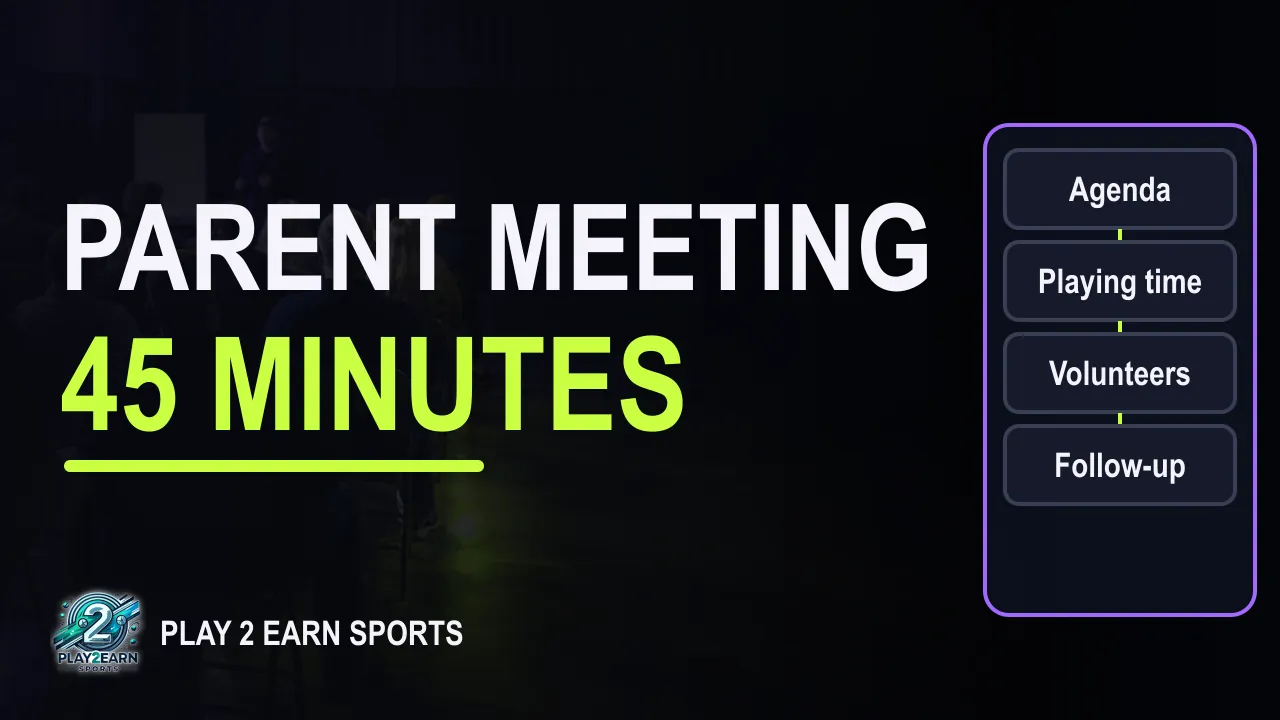
0:00 By the end of this video, you will have a preseason parent meeting agenda you can use this week. It fits in forty-five minutes, and it answers the questions families ask all season. We will cover when and where to hold it, a seven-part agenda, a one-page handout and the follow-up message. Then how Play 2 Earn Sports helps.
When and where to hold it
0:19 Hold the meeting one to two weeks before the first game. If a separate evening is hard, hold it right after the first practice, while families are already there. Keep it to forty-five minutes. Invite one adult from each family.
0:32 The coach leads, the team manager helps, and one club contact can join for questions about club rules. Players can play nearby with an assistant, or stay home.
The forty-five-minute agenda
0:42 Here is the agenda. Five minutes for the welcome, eight for the season, eight for communication, and seven for playing time. Then seven for safety and conduct, five for volunteers and five for questions. Five plus eight plus eight plus seven plus seven plus five plus five is forty-five. If you run over, the questions block is the one to stretch, not your welcome.
Welcome, the season and communication
1:06 Start with who you are and why you coach. Then share the season at a glance: practice days and times, the first game, any tournaments, and dates when there is no practice. Name one channel for team updates, and share the hours you reply. Explain how families will hear about a change. Ask them to raise concerns the day after a game, not at the field.
Playing time, safety and conduct
1:29 Say your playing-time rule out loud, and put it in the handout. Explain how effort and steady attendance at practice lead to more responsibility on the team. Explain your safety habits. Two adults are present at every session.
1:44 Messages with players stay in team channels, with a parent or guardian included. Share the club's code of conduct for the sideline.
Volunteers, with a worked example
1:52 Ask for volunteers before families leave the room. Common jobs are a scorekeeper, the snack table, rides to away games, and setup and takedown. One job per family spreads the load. Here is a typical example.
2:07 It is illustrative, not a specific club. A team has fourteen families and ten home games. It needs a scorekeeper and a snack-table helper at each home game. Two jobs times ten games is twenty turns.
2:21 With fourteen families, each family takes one turn, and six families take a second. Ask for those six volunteers at the meeting.
The handout and the follow-up
2:29 Bring a one-page handout that follows the agenda. Send the same page by message that evening, for families who could not attend. Add the answers to any questions you promised to check.
How Play 2 Earn Sports helps
2:41 Now, how Play 2 Earn Sports helps. The team calendar shows games, practices and events on web and phone. Players and parents answer Going, Maybe or Can't go. Each team has Team, Coaches and Parents channels.
2:56 When a team event, team game or club game changes, affected families get in-app, email and push notices by default, and can opt out of event email and push. Clubs post volunteer jobs such as snack table. The app installs from the website on iPhone and Android. Show families how to join the team at the meeting.
3:17 Tap Turn on notifications to get notices on the phone, and on iPhone, add the app to the Home Screen first. Forty-five minutes, seven parts, one page and one follow-up. That is a preseason parent meeting that sets up the season. The full agenda is on the page linked in the description.
3:34 Try it with your own team: Starter is free for clubs with up to 10 teams. Thanks for watching.
When, where and who
When
One to two weeks before the first game. If a separate evening is hard, hold it right after the first practice, while families are already at the field.
Where
A quiet room is best: a club room, a school classroom, a community hall. Outdoors works if everyone can hear and sit.
Who leads
The coach leads, the team manager helps, and one club contact can join for club-rule questions.
Who comes
One adult from each family. Players can play nearby with an assistant coach, or stay home.
How long
Forty-five minutes. Start on time; families notice.
The forty-five-minute agenda (template)
| # | Part | Minutes | What to cover |
|---|---|---|---|
| 1 | Welcome | 5 | Who you are, why you coach, who your assistant and team manager are. |
| 2 | The season at a glance | 8 | Practice days and times, the first game, tournaments, dates with no practice, where the schedule lives. |
| 3 | How we communicate | 8 | One channel, your reply hours, how families hear about a change, the next-day rule for concerns. |
| 4 | Playing time and development | 7 | Your playing-time rule, how effort and attendance count, what you focus on this season. |
| 5 | Safety and conduct | 7 | Two adults at every session, messages with players in team channels with a guardian included, the club's sideline code. |
| 6 | Volunteers and carpools | 5 | The jobs the team needs, one job per family, rides to away games. |
| 7 | Questions | 5 | Open questions; write down any you promise to check. |
| Total | 45 |
5 + 8 + 8 + 7 + 7 + 5 + 5 = 45 minutes. If you run over, stretch the questions, not the welcome.
What to say in each part
1. Welcome
Keep it warm and short. Share one sentence on why you coach. Introduce your assistant and team manager, so families know who to ask.
2. The season at a glance
Give the rhythm, not every date: "Practice Tuesday and Thursday, games on Saturday, two tournaments." Say where the full schedule lives, so the handout does not have to carry it.
3. How we communicate
Name one channel for team updates. Share your reply hours. Explain how families will hear about a change. Ask them to raise concerns the day after a game, not at the field. See how to handle late-night parent messages for the reply-hours habit.
4. Playing time and development
Say the rule out loud, and put it in the handout. "For this age group, every player gets equal time across the season" is clear. Explain that effort and steady attendance at practice lead to more responsibility on the team.
5. Safety and conduct
Two adults are present at every session. Messages with players stay in team channels, with a parent or guardian included. Share the club's code of conduct for the sideline: cheer for effort, leave coaching to the coaches, respect the referee.
6. Volunteers and carpools
Ask before families leave the room. Bring the list of jobs and a pen.
7. Questions
Answer what you can. Write down what you need to check, and answer it in the follow-up message.
Worked example: volunteer turns that add up
Illustrative example, not a specific club.
A team has fourteen families and ten home games. It needs a scorekeeper and a snack-table helper at each home game.
| Item | Count |
|---|---|
| Jobs per home game | 2 |
| Home games | 10 |
| Turns needed (2 × 10) | 20 |
| Families | 14 |
| Families taking one turn | 14 |
| Families taking a second turn (20 − 14) | 6 |
Ask for those six second-turn volunteers at the meeting. Write the turns next to names before anyone leaves, and share the list in the follow-up.
The one-page handout
Follow the agenda, one short block per part:
- Coach, assistant and team manager names, and the one channel.
- The weekly rhythm and the key dates.
- Reply hours and the next-day rule.
- The playing-time rule, in one sentence.
- Safety habits and the sideline code.
- The volunteer jobs, with a space for names.
- Where to find the schedule and how to join the team.
Your club may have a longer parent handbook; the handout is the team's one page that points to it.
The follow-up message (same evening)
Send the handout by message the same evening, for families who could not attend. Add:
- the answers to any questions you promised to check;
- the volunteer list with names;
- one line on how to join the team in the app and turn on notifications.
Checklist
Checklist
- Date set one to two weeks before the first game (or after the first practice).
- Room booked; forty-five minutes on the invitation.
- Assistant, team manager and club contact invited.
- Agenda printed, with minutes for each part.
- Playing-time rule written in one sentence.
- Volunteer job list and pen ready.
- One-page handout ready.
- Follow-up message sent the same evening, with answers and the volunteer list.
How Play 2 Earn Sports supports the meeting and the season after it
Play 2 Earn Sports gives a club and its teams one place for parent communication, with the schedule, replies and team chat together.
The season at a glance
The team and club calendar shows games, practices and events on web and phone.
Who is coming
Players and parents answer Going, Maybe or Can't go, and coaches see the counts and names.
One channel, three rooms
Each team has Team, Coaches and Parents channels. Players, coaches and chat-enabled staff post in Team; coaches and guardians post in Parents. Guardians can read their child's Team channel.
Safe-sport rules
A private adult-to-minor chat brings a parent or guardian into the conversation until the player turns 18. Players under 14 can only DM teammates. Messages can be reported or blocked.
Changes
When a team event, team game or club game changes, affected families get in-app, email and push notices by default, and can opt out of event email and push.
Volunteers and rides
Clubs post volunteer jobs for events, such as scorekeeper or snack table, and team volunteers can take them. Event carpools let drivers offer seats and riders request a ride.
Add one game to a calendar
Families can add a single event to Google or Apple Calendar with an .ics link. Today, adding a whole season to a personal calendar is your team's process: families add the events they need one at a time.
Show it at the meeting
The app installs from the website on iPhone and Android, not from the app stores. Tap Turn on notifications to get notices on the phone; on iPhone, add it to the Home Screen first.
Coaching one team?
Start a free club account for your team at club starter. Starter is free for clubs with up to 10 teams, and every organization feature is on every plan.
Forty-five minutes, seven parts, one page, one follow-up.
Frequently asked questions
Seven parts: a welcome, the season at a glance, how the team communicates, playing time, safety and conduct, volunteers and carpools, and questions. In forty-five minutes, that is five, eight, eight, seven, seven, five and five minutes.
One to two weeks before the first game. If a separate evening is hard for families, hold it right after the first practice, while they are already at the field.
About forty-five minutes. Long enough to cover the season, communication, playing time, safety and volunteers, and short enough that families come. Start on time and stretch only the questions.
It is usually easier without them. Players can play nearby with an assistant coach, or stay home. Older players can join a short part on expectations if you want them to hear it too.
Say the rule out loud at the meeting, and put it in the handout in one sentence. For young players, equal time across the season is simple. Explain that playing-time questions come to the coach, the day after a game.
Ask in the room, with a written list of jobs and a pen. Ask for one job per family across the season. In the example on this page, fourteen families cover twenty turns when six take a second turn.
Send the one-page handout by message the same evening, with the answers to questions and the volunteer list. Families who missed it get the same information as those who came.
Starter is free for clubs with up to 10 teams. Pro is $49.67 USD a month for 11 to 25 teams. Unlimited is $99.67 USD a month for 26 or more teams. Every organization feature is on every plan. See pricing.
Related guides
- Parent communication for sports clubs: the complete guide
- Youth sports parent handbook: what to include
- Parents texting coaches late at night? Answer each question once
- When parents miss schedule changes
- The sports app for parents
- A first-season plan for new coaches
- The team manager's job
- A season snack rota
Keep teams, schedules and family messages together with club management software for youth clubs, compare current plans and pricing, or request a demo.
